
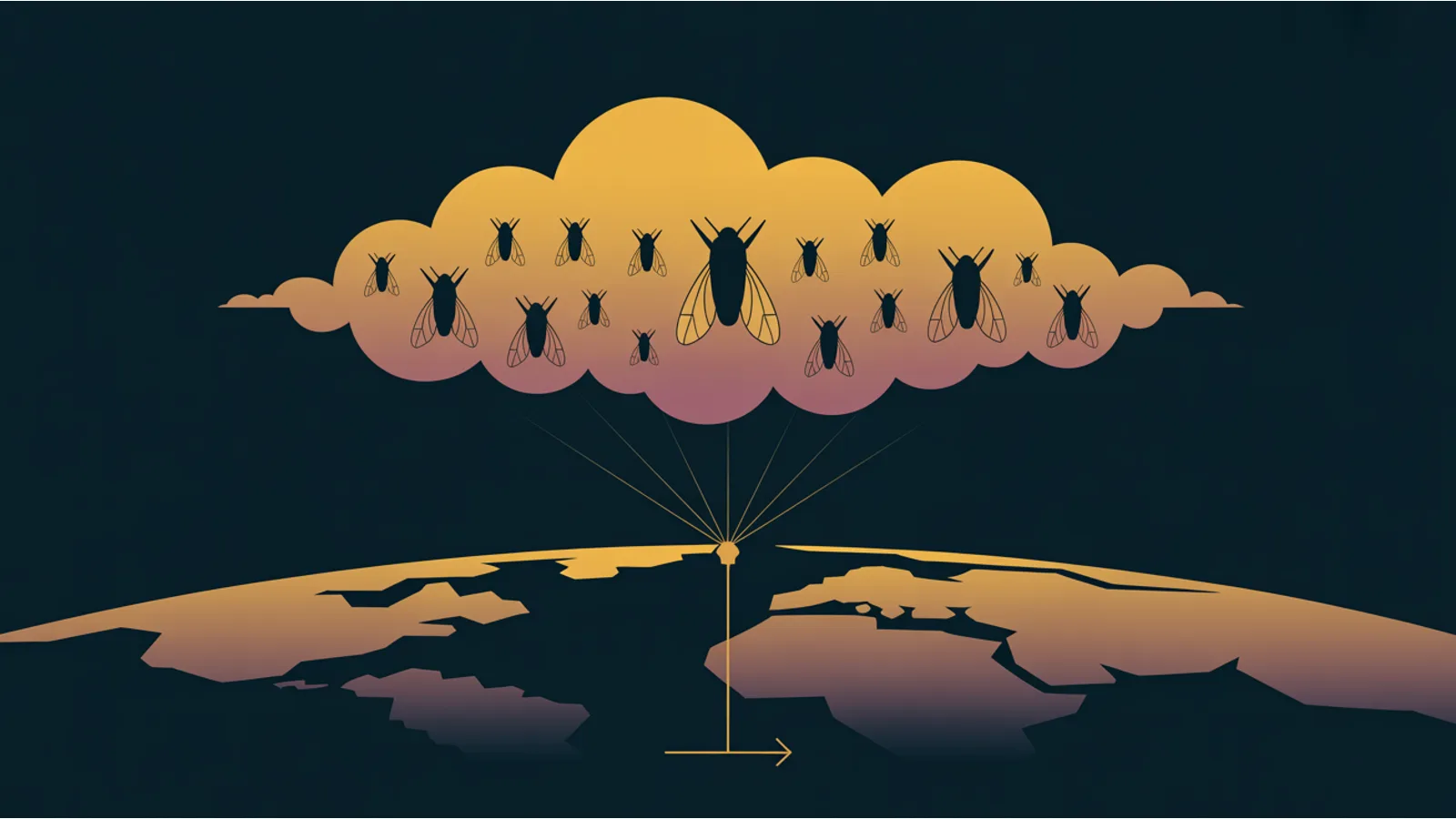
A rancher in south Texas walks a fence line and finds a calf standing apart from the herd, favoring a small wound on its flank. Up close, the wound is worse than it looked, because it is moving. Not with the ordinary maggots that clean dead tissue, but with larvae that are burrowing deeper into flesh that is still alive, widening the hole hour by hour. That is a New World screwworm strike, and for most of American history it meant a slow, expensive, and often fatal problem for anyone who kept animals. The program that made that scene rare across an entire continent is one of the strangest and most successful things the federal government has ever built. It is a set of factories that raise flies by the billion, sterilize the males with radiation, and drop them out of airplanes. It is run by the US Department of Agriculture, not the Pentagon, and by most honest accounting it has returned somewhere around $900 million to $1 billion a year to American livestock producers, against a historical cost measured in the hundreds of millions.
The parasite and the idea
The New World screwworm, Cochliomyia hominivorax, is a blowfly with a habit that sets it apart from the flies that merely feed on the dead. Its Latin name means, roughly, "man eater," and it earns it. A female is drawn to any open wound on a warm-blooded animal, even a wound as small as a tick bite or a fresh navel on a newborn calf. She lays a shingled mass of 250 to 500 eggs at the edge of it and can produce up to 3,000 eggs across her life. The larvae that hatch do not wait for the tissue to die. They screw down into living flesh, tearing it as they go, and the wound they open draws more flies. An untreated animal can be killed in one to two weeks. The fly does not respect species either, striking cattle, wildlife, pets, and, on rare and grim occasions, people.
Against that biology, USDA entomologists Edward Knipling and Raymond Bushland spent years in the 1930s, 1940s, and 1950s working a problem that chemistry alone could not solve. Knipling's insight was almost mathematical, and it turned on a single fact about the fly: a female screwworm mates only once in her life. If that one mating could be wasted, her entire reproductive output was wasted with it. So instead of trying to kill the flies with pesticide, which is expensive, incomplete, and has to be repeated forever, you could attack their reproduction. Rear enormous numbers of flies in a factory, sterilize the males, and release so many sterile males into the wild that a wild female is far more likely to mate with a sterile one than a fertile one. She lays her eggs, the eggs never hatch, and with each generation you increase the ratio of sterile to wild males until the local population simply collapses. No spraying. No poison in the environment. The pest is used to end itself.
Flooding the sky with sterile males
The method became known as the sterile insect technique, and the sterilizing agent was radiation. A measured dose of ionizing radiation, applied to the pupae, damages the flies' reproductive cells enough to make the males sterile while leaving them healthy enough to fly, compete, and mate. Getting that dose right was the whole game, and it placed the work squarely in the nuclear age. The radiation side of the program has always been told with an atomic pedigree, with the isotopes and gamma sources usually traced to the Atomic Energy Commission and its Oak Ridge laboratory. That lineage is plausible and widely repeated in the program's history, but I could not confirm the specific Oak Ridge link in a primary source I reached, so it is best treated as reported program history rather than a documented fact. What is documented is the result.
Knipling and Bushland proved the idea in the field before anyone believed it could work at scale. An early test on Sanibel Island, Florida in the early 1950s showed the population could be knocked down. Then in 1954 they eradicated the screwworm from the island of Curacao in about seven weeks, a demonstration clean enough to end the argument. The screwworm became the first animal species ever eradicated from an area in the wild using this technique. Decades later, in 1992, Knipling and Bushland shared the World Food Prize for the achievement, which a former Secretary of Agriculture called the greatest entomological achievement of the century. It remains one of the clearest cases of career government scientists inventing something cheap and permanent that quietly paid the country back for two generations.
The money, counted carefully
The dollar figures here deserve care, because the number that circulates most often is the one least supported. Start with the loss the program was built to stop. The World Food Prize records that in the 1950s, screwworms caused annual losses to American meat and dairy supplies projected at above $200 million. That is a period figure, projected in 1950s dollars, and it is the honest anchor for how much damage the fly was doing before it was cleared.
Eradication then marched south in stages. The US Southeast was cleared in the late 1950s, the Southwest by the early to middle 1960s, and then a joint campaign pushed into Mexico. Here the record splits on a date worth flagging. Many USDA accounts say the fly was eradicated from the United States by 1966, though a serious reinfestation struck Texas in the mid 1970s, the outbreak of 1976. Wikipedia and some other sources put the official "declared free" date at 1982, after the barrier had moved farther south. Independent fact-checking reconciles the two by noting the 1966 declaration but treating the country as effectively screwworm free only around 1980. From there the clearances continued: Mexico in 1991, Guatemala and Belize in 1994, and El Salvador in 1995. Since the late 1990s the fly has been held far to the south at the Darien Gap in Panama by COPEG, the Panama and United States Commission for the Eradication and Prevention of Screwworm, which mass rears and releases up to about 50 million sterile flies a week to keep a permanent biological barrier in place.
Now the benefit. The figure often quoted is "more than $1.5 billion a year," and it does not hold up against primary sources, so this piece does not use it. The USDA National Agricultural Library's exhibit on the program describes an ongoing benefit of more than $900 million a year, and an APHIS historical economic analysis puts the figure at about $796 million a year by 1996. In 2025 the Texas Animal Health Commission, citing a USDA estimate, framed it as roughly $1 billion a year in direct benefit to livestock producers plus about $3.7 billion a year to the general economy. The $1.5 billion number appears to sit between the roughly $1 billion producer figure and the $3.7 billion economy-wide figure, and reads as a conflation of the two. Defensible framing is this: on the order of $900 million to $1 billion a year to US producers, and roughly $3.7 billion a year across the wider economy.
The cost side has been muddled the same way. It is often said the program cost "roughly $1 billion over its first fifty years," but the historical record does not support that. The documented historical program cost is hundreds of millions of dollars in the United States plus about $200 million for the Central America campaign. The only billion-dollar figures in the record are new. They belong to the 2025 and 2026 emergency response, not to the original decades of work, and they include a roughly $1 billion plan announced by the Secretary of Agriculture, a planned domestic sterile fly production facility priced at about $750 million, and about $1.3 billion in emergency funding. Those are money being spent now, under pressure, and folding them back into the historical ledger makes an already good program look more expensive than it was.
The honest critique: a policy that is never finished
This is close to the opposite of a boondoggle. The recurring benefit runs to hundreds of millions of dollars a year for producers and several billion economy-wide, set against a historical build cost measured in the hundreds of millions. The critiques are structural, not stories of wasted money.
The first is that eradication is never final. A screwworm-free continent is not a monument, it is a barrier that has to be held forever. COPEG's plant in Panama is a permanent recurring cost, and if the surveillance or the sterile fly output is allowed to weaken, the fly comes back. That is not a hypothetical. Between late 2023 and 2026 the screwworm pushed back north through Central America. It reached southern Mexico in December 2024, was found in Nuevo Leon under 70 miles from the US border by September 2025, and produced the first US cases in years in Zavala County, Texas in June 2026, a small cluster reported over a few days early that month. The barrier had been under strain, and the fly moved into the gap.
The second critique follows from the first. The United States let its own sterile fly production capacity lapse, becoming dependent on the single Panama plant, and now has to rebuild that capacity in a hurry and at premium cost. The emergency buildout is real and traceable. USDA stood up a sterile fly dispersal facility at Moore Air Base near Edinburg, Texas for about $8.5 million, launched in mid June 2025 with capacity to handle up to 100 million flies a week. It funded the conversion of an old fruit fly plant at Metapa de Dominguez, Chiapas to breed screwworm for about $21 million, opened in late June 2025. And it committed to a new domestic production facility priced at about $750 million, part of a January 2026 "Grand Challenge" push. Standing all of that up under emergency conditions costs far more than quietly funding the barrier would have.
The third critique is that the emergency response externalizes real costs onto the cattle trade. To keep the fly out, USDA has repeatedly suspended live animal imports from Mexico, which protects the herd but hits ranchers and packers on both sides of the border. As a measure of the stakes, USDA's 2025 modeling estimated that a single outbreak on the scale of the 1976 event could cost about $732 million a year to Texas producers and around $1.8 billion to the Texas economy. That $1.8 billion figure, which has traveled widely, is a projected scenario for the Texas economy benchmarked to a historical outbreak, not a bill that has come due. The efficiency lesson is blunt: a cheap standing insurance policy is far cheaper than a re-invasion, and the waste risk lives in underfunding the barrier, never in the program itself.
The public good it protects
The screwworm is a textbook case for why some things only government can do. The fly ignores fences and property lines and can travel long distances, so no single rancher could ever clear it from his own land and keep it clear. Worse, no rancher has any incentive to pay for area-wide suppression, because the benefit spills over to every neighbor who paid nothing. That is the definition of a public good with cross-border externalities, and markets do not supply it on their own. Only collective action, first by USDA and then through an international commission with Panama, could clear a continent and hold a line across the narrowest part of it.
The payoff is broad and shared. Eradication protects livestock, wildlife, pets, and human health, and it lowers the cost of meat and dairy for every consumer, whether or not they have ever seen a screwworm. It is also a rare and verifiable win for basic government science, invented by career researchers on federal salaries, that delivered quietly for six decades before most people learned it existed. When a program works this well, its very invisibility becomes a political liability, because the public never sees the disaster that did not happen and so is reluctant to keep paying to prevent it.
Reading the ledger
Two readings sit here at once, and the honest thing is to leave both standing. On one side, this is one of the great returns in the history of American public spending: an idea that cost hundreds of millions to build and has thrown off hundreds of millions to billions of dollars in benefit every year for two generations, with no pesticide in the soil and a Nobel-adjacent prize to show for the science. On the other side, it is a debt that never fully retires. The barrier has to be paid for forever, the country let its own capacity decay, and the bill for that lapse is arriving right now in the form of emergency facilities, suspended cattle imports, and a flesh-eating fly back on Texas ground for the first time in decades. The screwworm program is neither a boondoggle nor a finished victory. It is the clearest example in the federal record of a bet that pays enormously and only stays paid off as long as someone keeps funding the last, boring, unglamorous mile of it.
Related reading
- The DARPA Grand Challenge that seeded self-driving cars: another government research bet whose real payoff took years and looked improbable at the start.
- DARPA's early bet on mRNA vaccines: like the sterile fly work, a basic-science wager that only proved its worth long after the money went in.
- ARPANET and the government origins of the internet: a public-science win so total it became invisible, the same fate that hid the screwworm program.
- The index of programs, lifelines, and boondoggles: the full catalog these case studies sit inside.
- The working ledgers: how the money in these pieces is sourced and counted.
Fact-check notes and sources
- The sterile insect technique was invented by USDA entomologists Edward Knipling and Raymond Bushland using radiation to sterilize male flies, the screwworm was the first animal species eradicated in the wild with the method, and the two shared the 1992 World Food Prize. The radiation lineage is commonly traced to Atomic Energy Commission and Oak Ridge isotope work, but that specific link is reported program history rather than a figure confirmed in a primary source reached here. World Food Prize, 1992 Laureates, Sterile insect technique, Edward F. Knipling.
- The 1950s loss figure is a projected period estimate: screwworms caused annual losses to American meat and dairy supplies projected at above $200 million in the 1950s. World Food Prize, 1992 Laureates.
- Biology (larvae feed on living tissue, 250 to 500 eggs per wound, up to 3,000 in a lifetime), the eradication timeline (US declared free in 1966 by USDA versus 1982 in some accounts, with a serious Texas reinfestation in 1976; Mexico 1991; Guatemala and Belize 1994; El Salvador 1995), the Darien Gap barrier held by COPEG with releases of up to about 50 million sterile flies a week, and the 2024 to 2026 northward return (southern Mexico December 2024, Nuevo Leon under 70 miles from the border September 2025, first US cases in Zavala County, Texas in June 2026) are drawn from the following. Cochliomyia hominivorax, New World screwworm, COPEG official site.
- The ongoing benefit figure is contested and often overstated. Primary and near-primary sources support roughly $900 million to $1 billion a year in benefit to US producers (a USDA National Agricultural Library exhibit cites "more than $900 million a year"; an APHIS historical economic analysis cites about $796 million a year by 1996), plus about $3.7 billion a year economy-wide per a 2025 Texas Animal Health Commission statement citing USDA. The widely quoted "more than $1.5 billion a year" is not supported and reads as a conflation of the producer and economy-wide figures. Likewise, the historical program cost was in the hundreds of millions of dollars plus about $200 million for the Central America campaign; the billion-dollar figures in current coverage (a roughly $1 billion plan, a $750 million facility, about $1.3 billion in emergency funds) belong to the 2025 to 2026 emergency response, not to the original fifty years. Sterile insect technique (citing USDA sources), New World screwworm.
- USDA's 2025 estimate that a Texas outbreak could cost $1.8 billion is a projected scenario, not a realized loss: it models an outbreak on the scale of the 1976 event and pairs about $732 million a year to Texas producers with roughly $1.8 billion to the Texas economy. Note that aphis.usda.gov and usda.gov were returning server errors during fact-checking, so the APHIS economic figures were confirmed via the National Agricultural Library exhibit, Texas Animal Health Commission statements, and the analysis's published summary rather than fetched directly. Cochliomyia hominivorax.
This post is informational and journalistic, drawn from public records and cited reporting, and is not legal, financial, or policy advice; dollar figures are attributed to their fiscal year and labeled where they are projected, approximate, or contested.
