
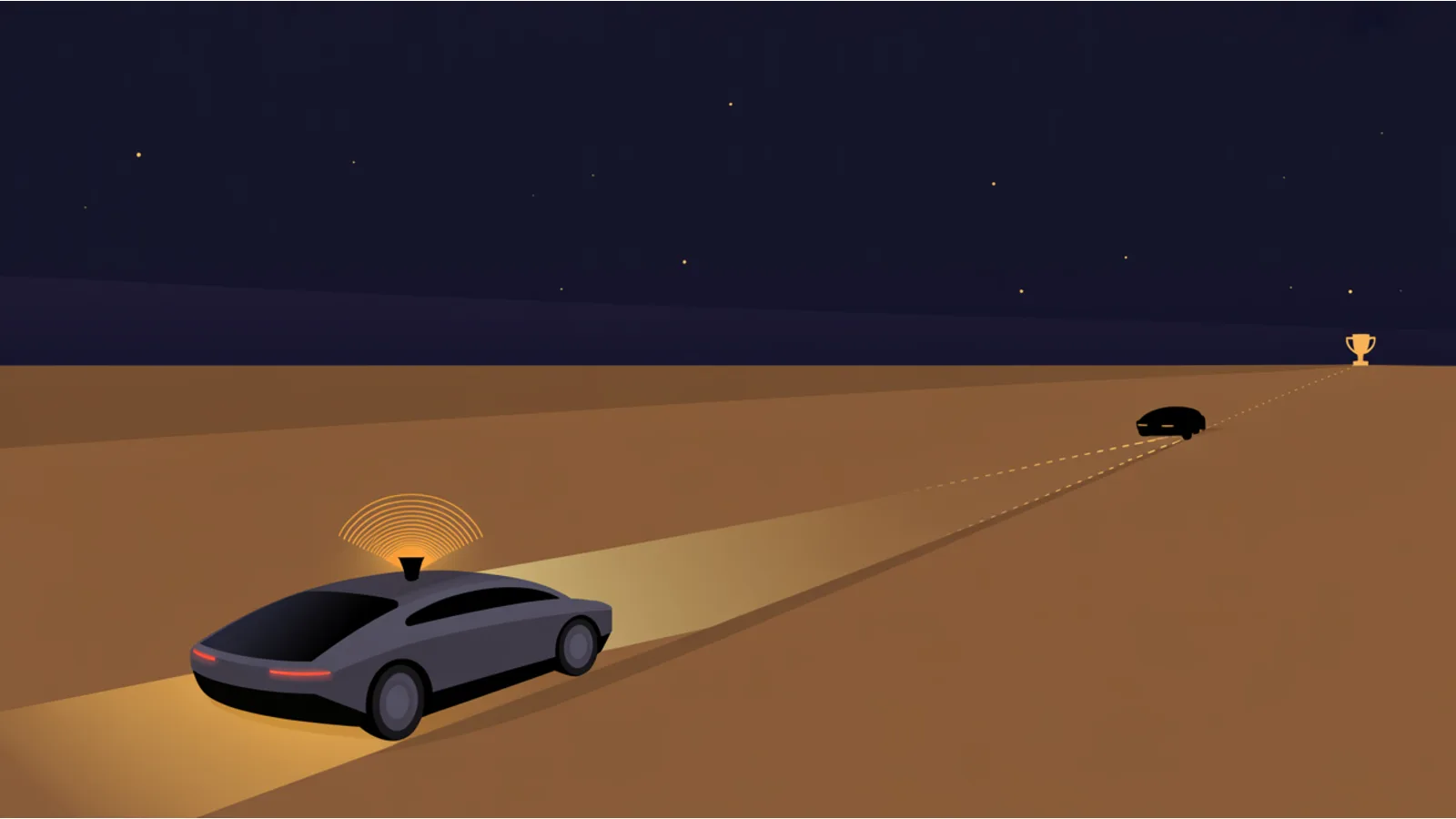
On March 13, 2004, in the Mojave Desert, the United States government held a robot race and nobody won. Fifteen driverless vehicles set out along a course through the scrub between Barstow, California, and Primm, Nevada, and every one of them broke down, drove off course, or quit. The best entry, Carnegie Mellon University's "Sandstorm," managed about 7.4 miles before it beached itself on an embankment, according to Wikipedia's account of the event. The $1,000,000 prize went home in the sponsor's pocket, unclaimed.
By any ordinary reading, that is a failed government program: a public prize, a public spectacle, and not a single finisher. This post argues the opposite, and it argues it the way the Defense Advanced Research Projects Agency itself would: as a high-risk research bet that paid off. The 2004 race did not produce a winner, but it produced something more useful. It defined a hard problem, drew hundreds of engineers into working on it, and set up a rematch. Nineteen months later, five vehicles finished. Within a decade, veterans of these races were running the self-driving programs at Google, Cruise, Zoox, and Aurora. A few million dollars in prize money helped catalyse an industry that would go on to attract tens of billions in private investment.
That is the honest frame here. Not a boondoggle, and not a story in which one agency single-handedly invented autonomous driving. A catalyst, well documented, with real limits worth naming.
What the Grand Challenge was, and why Congress wanted it
The Grand Challenge was a prize competition run by DARPA, the Defense Department's research arm. Rather than pick a contractor in advance and write a cost-plus contract, DARPA posted a goal, a course, and a cash prize, then let anyone who could build a qualifying vehicle compete. The agency would pay only for results.
The immediate motivation was military and it came from Congress, not from DARPA. Section 220 of the Floyd D. Spence National Defense Authorization Act for Fiscal Year 2001 (Public Law 106-398, enacted October 30, 2000) set a goal that by 2015, one-third of the operational ground combat vehicles of the armed forces should be unmanned, per the text of the bill at Congress.gov. The same section also set an earlier 2010 goal for unmanned deep-strike aircraft, so the ground-vehicle clause is one of two targets in that provision, not the whole of it. The Grand Challenge was DARPA's answer to the ground-vehicle mandate: if the Army was supposed to field robots that could drive themselves through hostile terrain, someone first had to prove a vehicle could cross open desert with no human aboard at all.
That target date matters later. The 2015 goal was not met on schedule, a point returned to below.
2004: a productive failure
The first race ran on March 13, 2004, along the Interstate 15 corridor from Barstow toward Primm. Course length is one of the few facts the sources genuinely disagree on: DARPA and IEEE retrospectives describe a route of roughly 142 miles, while Wikipedia's lead paragraph calls it a 150-mile route along I-15. Treat it as about 142 miles and note that the 150-mile figure exists rather than asserting either as settled.
Whatever the exact distance, none of it was completed. Carnegie Mellon's Red Team fielded "Sandstorm," a modified Humvee, and it set the field record: about 7.4 miles (11.9 km) before it took a hairpin turn badly and got stuck on an embankment, as Carnegie Mellon's own School of Computer Science reported. The next-best entries were close behind and equally short of the finish: SciAutonics II at 6.7 miles, Team DAD at 6.0 miles, the Golem Group at 5.2 miles, per the race records. The prize was not awarded.
The press coverage at the time was unkind, and fairly so on its own terms. Every vehicle had failed. But as research, the 2004 race worked. It converted a vague aspiration ("cars that drive themselves") into a concrete, measurable, shared challenge with a fixed course and a scoreboard. It assembled a community of university labs, companies, and hobbyists who now knew exactly where the hard parts were: perception, path planning, and not getting stuck on embankments. And it created the demand for a rematch, which DARPA promptly scheduled and sweetened.
2005: five vehicles finish, and Stanley wins
For the 2005 rematch DARPA doubled the prize to $2 million, according to the event record. The course again ran through the desert, and this time the field had learned.
Five vehicles finished, out of 23 finalists that started, per Wikipedia's account of the 2005 race. The winner was "Stanley," a modified Volkswagen Touareg built by the Stanford Racing Team and led by Sebastian Thrun. Stanley completed the course in roughly six hours and 53 minutes at an average speed of about 19.1 mph (30.7 km/h), and it took the $2 million prize. The precise seconds of the finish time vary across sources (6:53:58 is the most commonly cited figure, with at least one summary rendering 6:53:08), so the safe figures are the roughly six-hour-53-minute duration and the 19.1 mph average. Stanley now sits in the Smithsonian's National Museum of American History, per the vehicle's documented history.
The other four finishers tell you the field had matured: Carnegie Mellon's "H1ghlander" and "Sandstorm" came second and third, the Gray Team's "Kat-5" also finished, and Team Oshkosh's "TerraMax" completed the course after an overnight pause. Eighteen of the 23 finalists were disabled along the way. But five robots had now driven more than 130 miles of open desert with no human intervention, a result that had looked implausible 19 months earlier.
2007: the Urban Challenge
The third event, held November 3, 2007, changed the terrain from empty desert to a mock city. The DARPA Urban Challenge ran at the former George Air Force Base in Victorville, California (now the Southern California Logistics Airport), over roughly 55 to 60 miles of urban course, complete with live traffic, intersections, and traffic rules the robots had to obey.
Carnegie Mellon's Tartan Racing team won with "Boss," a modified Chevrolet Tahoe (named for General Motors engineer Charles "Boss" Kettering), taking the $2 million first prize roughly 20 minutes ahead of its nearest rival, as Carnegie Mellon reported. Second place and $1 million went to Stanford's "Junior," a Volkswagen Passat, not to be confused with Stanley from 2005. Third place and $500,000 went to "Odin," a 2005 Ford Escape hybrid fielded by Virginia Tech's Victor Tango team. (The team was Victor Tango; the car was Odin. Several summaries conflate the two.) The podium purse totalled $3.5 million.
The Urban Challenge closed the loop on the original military rationale: a robot that could cross a desert was interesting, but a robot that could negotiate a four-way stop with other moving vehicles was closer to something you could actually deploy.
The money and the outcome
Here is the full ledger of what DARPA paid out across the three events:
- 2004: $0. No finisher, prize unclaimed.
- 2005: $2,000,000 to Stanford's Stanley.
- 2007: $3,500,000 total across the Urban Challenge podium ($2M / $1M / $500K).
That is $5.5 million in prizes over three events. Against that outlay, consider what followed.
Sebastian Thrun, Stanley's team lead, went on to co-found Google X and launch Google's self-driving project, "Project Chauffeur," which began January 17, 2009, per the Waymo history. The project was publicly revealed in October 2010 through a New York Times report, and it was renamed Waymo and spun out under Alphabet in December 2016. The timeline is worth stating carefully: this did not happen the week after the 2005 race. It unfolded over several years, and Thrun's move to Google sits in the 2007-to-2011 window, not immediately after Stanley crossed the line.
The seeding went well beyond Google. Challenge veterans went on to found or lead much of the autonomous-vehicle industry. Chris Urmson, a Carnegie Mellon and Google DARPA veteran, co-founded Aurora. Jesse Levinson, from Stanford's team, co-founded Zoox. Kyle Vogt, who later co-founded Cruise, had participated in the 2004 challenge with an MIT team that retrofitted a Ford F-150 (he participated; MIT was not in the final race field). IEEE Spectrum's 20-year retrospective documents this catalytic role in detail.
So the arithmetic is stark: roughly $5.5 million in public prize money is associated with the launch of an industry that has since absorbed tens of billions of dollars in private capital. But the direction of causation deserves care, which is what the next section is for.
The ROI case and the honest caveats
The return-on-investment case
By the standards of federal research and development, the prize model was extraordinarily capital-efficient. DARPA paid nothing in 2004 and $5.5 million across 2005 and 2007, yet it mobilised dozens of university and volunteer teams that collectively spent far more than the prize building their own vehicles. That is the classic leverage effect of a prize competition: the sponsor's outlay is a fraction of the research it catalyses, because the losing teams pay their own way.
More than that, the challenges did what public research is supposed to do when it works. In 2003 and 2004, autonomous driving was widely considered infeasible, and no automaker or startup was going to bankroll a moonshot with no near-term product. A government agency willing to absorb the reputational risk of a public failure (and 2004 was a public failure, with headlines to match) created a coordination point. It standardised the problem, made the field legible and fundable, and produced a generation of roboticists who then dispersed into industry. The payoff accrued broadly, to the economy and to the public, not just to the sponsor. This is the affirmative answer to the question of why government should fund research at all: the biggest breakthroughs often sit in the gap between too-risky-for-industry and too-applied-for-pure-science, which is exactly where a mission agency like DARPA operates.
The honest caveats
None of that makes DARPA the sole author of the self-driving car, and three caveats keep the story honest.
- The prizes did not "fund" the industry. A few million dollars in prize money is trivial next to the tens of billions in private investment that followed. DARPA sparked the field; it did not bankroll it. The industry also required later private capital, advances in LIDAR sensors and computing, and years of grinding engineering. Catalyst, not sole cause.
- The original military goal was missed. Congress's Section 220 target, that one-third of ground combat vehicles be unmanned by 2015, was not met on that schedule. Judged strictly as a defense-acquisition program aimed at that deadline, the challenge underdelivered, even as it overdelivered as basic research. Full autonomy turned out to be harder and slower than 2005-era optimism implied.
- The public paid; private industry captured most of the value. The most visible returns landed in the commercial autonomous-vehicle sector rather than in the Army motor pool. That raises the perennial question of whether taxpayers should have captured more of the upside from a public research bet. It is a fair question, and it does not have a tidy answer.
Weigh those caveats honestly and the core finding still stands. A few million public dollars, structured as a prize that paid only for results, helped turn an "infeasible" problem into a working industry within a decade. That is a rare and well-documented return, and the productive failure of 2004 was the point where it started.
Fact-check notes and sources
- First Grand Challenge, March 13, 2004, Mojave Desert, $1M prize, zero finishers, prize unclaimed. The race ran the I-15 Barstow-to-Primm corridor; no vehicle finished. Course length is inconsistent across sources: about 142 miles in DARPA/IEEE retrospectives versus a 150-mile figure in Wikipedia's lead on the 2004 race. Presented as about 142 miles with the variance flagged.
- Best 2004 result: CMU Red Team's "Sandstorm" at about 7.4 miles. Sandstorm went off course on a hairpin turn and beached on an embankment; runners-up were within a couple of miles. Carnegie Mellon University School of Computer Science.
- 2005 prize doubled to $2 million; five of 23 finalists finished. Finishers were Stanley (Stanford), H1ghlander and Sandstorm (CMU), Kat-5 (Gray Team), and TerraMax (Team Oshkosh). Wikipedia: DARPA Grand Challenge (2005).
- Stanford's "Stanley" (Thrun's team) won 2005 and the $2M; roughly 6 hours 53 minutes, about 19.1 mph, modified VW Touareg, now in the Smithsonian. The finish-time seconds vary across sources, so the duration and average speed are the safe figures. Wikipedia: Stanley (vehicle).
- 2007 Urban Challenge, November 3, 2007, former George AFB, Victorville; CMU Tartan Racing's "Boss" won $2M. Mock-city course of roughly 55 to 60 miles with live traffic. Carnegie Mellon University School of Computer Science.
- 2007 podium: 2nd Stanford "Junior" (VW Passat) $1M; 3rd Virginia Tech "Odin" (2005 Ford Escape hybrid, Victor Tango team) $500K; $3.5M total purse. Wikipedia: DARPA Grand Challenge (2007).
- Thrun launched Google's Project Chauffeur (began January 17, 2009 at Google X), revealed October 2010, renamed Waymo December 2016. Wikipedia: Waymo and Wikipedia: Sebastian Thrun.
- Challenge veterans seeded Cruise, Zoox, and Aurora; Kyle Vogt participated in the 2004 challenge (MIT team, not a finalist). Catalyst, not sole cause: later private capital and sensor/compute advances were also required. IEEE Spectrum 20-year retrospective; Wikipedia: Kyle Vogt.
- Congress's one-third-unmanned-by-2015 goal came from Section 220 of the FY2001 NDAA (P.L. 106-398, enacted October 30, 2000). The same section also set a 2010 goal for deep-strike aircraft; the ground-vehicle clause is cited specifically here, and the 2015 target was not met on schedule. Congress.gov: H.R.4205, 106th Congress.
- DARPA's 2005 Report to Congress. A report under DARPA's prize authority exists, but the copy that surfaces in search is hosted on the non-government domain grandchallenge.org and should be treated as a possible mirror rather than an authoritative primary until a darpa.mil-hosted copy is confirmed. PDF (unofficial host, verify before relying on it).
Related reading
- How ARPANET became the internet: another DARPA research bet, and a shared-credit story about who actually built the network.
- From DARPA's CALO to Siri: a publicly funded AI research program that seeded a commercial product.
- DARPA and AFRL: the portfolio's hits and misses: the wider ledger of government research bets, both the wins and the failures.
- The public-money programs index: the full series on where public research and subsidy dollars go.
This post is informational and journalistic, not legal or financial advice. It describes public programs and documented events; mentions of third parties are nominative fair use and no affiliation is implied.
