

If your small-business site already passes the usual checks, read the standards' changes and test what the live site actually does. We found gaps in protocol support, privacy choices, reporting and outside listings on sites we considered well kept. This week, pick one promise your site makes, reproduce its failure, fix it and keep the test. The downloadable kit gives your web person a starting point.
The owner thought there was nothing newer left to do. The sites had agent discovery files, security contact files, API catalogs, Markdown responses, navigation improvements and directory-listed servers. They were maintained, rather than abandoned projects waiting for their first security header.
Our read-only pass on November 19, 2026 still found useful work. The observations below come from that evening's measurements and subsequent implementation reviews. Some fixes are live. Others are built and tested but remain unpublished, and some failed independent review. Those distinctions matter more than a claim that we fixed everything.
The latest release record confirms a small lodging site's protocol and reporting update, a recovery housing site's consent changes, and a marketplace site's HSTS header change. Mail records were also corrected. The broader lodging booking release remains held after failed reviews; reporting changes for a storage site and a laundromat also need corrections. A consent correction for another site we maintain passed its recorded privacy tests but is deferred, as are the new checks prepared for our free tools; that site's reporting change stopped because accepted session-recording connections trigger its unchanged enforced policy. Interactive cards remain work in progress. These are our observations, not claims about every site using the same software.
The method: a checklist has an expiration date
An agent-readiness checklist asks whether software assistants can find and use a site's public information. An agent card describes a service. An API catalog lists machine-accessible interfaces. A file such as llms.txt offers reading guidance. None proves that the service behind it speaks today's protocol or respects a visitor's choice.
We used two habits. First, read the standard's changelog, the document explaining what changed between revisions, before reusing last year's test. Second, measure the published site before trusting the repository, the stored source files. A generated function can differ from its maintained source. A corrected template can coexist with an older cached page. One brief incorrectly described a lodging site as quote-only even though its live, owner-approved content already gave starting rates. The job stopped rather than erase those facts. Elsewhere, matching static files hid a stale server function. The source comparison had to cover executable behavior too.
We also required a back test: run the same assertion against the previous version and watch it fail for the defect being fixed. If both versions pass, the test may be too weak. If both fail for an unrelated missing fixture, record that separately instead of quietly loosening the assertion.
The recurring pattern was a separate step nobody had put on the checklist. A server can run before a directory knows about it. A release can be live while its registry record describes an older version. A browser header can request preload treatment before the domain is enrolled. A security rule can block something while nobody receives the report.
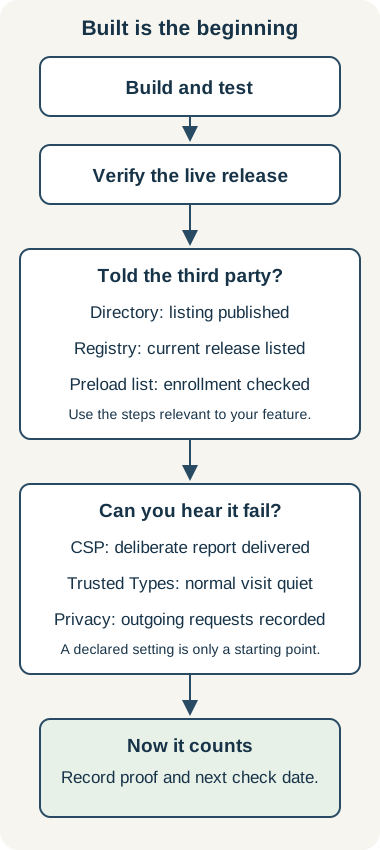
Build → Test → Verify live
                  ▼
      Told the relevant third party?
      ├ Directory publication
      ├ Registry release update
      └ Preload enrollment
                  ▼
      Can you hear it fail?
      ├ CSP report delivered
      ├ Trusted Types normal visit quiet
      └ Privacy requests recorded
                  ▼
      Counts: proof and next check date
Who does this: the owner chooses the promise; the developer records the before-and-after evidence. Done when: the deployed behavior and any required outside record agree, with untested cases named. This is a maintenance method, not a requirement to adopt every optional feature below.
MCP changed while the old handshake kept working
Model Context Protocol, or MCP, lets an assistant ask a server for named tools and use them. A tool might return opening hours or available accommodation. A connector is the host application's connection to that server; it is not the server itself. The endpoint is the address receiving the requests.
The 2026-07-28 changelog describes a substantial change: stateless requests replace the initialization handshake on the new protocol path. Stateless means each request carries the information needed to process it, without a prior conversation setup. server/discover tells a client what the server supports. Older clients still need their older exchange.
Our November 19 measurement at 20:00 UTC found lodging endpoints that answered initialization with the older revision regardless of what was requested. Asked for discovery, they returned method not found. Their ordinary tools could still work for older clients. That makes this a compatibility gap, not evidence that the business's booking operation was universally broken.
Check in two minutes: have your developer send the kit's server/discover request to your own endpoint, then request tools/list using the new revision without first initializing. Read the actual result. A version string in a public card cannot substitute for a successful exchange. The lifecycle and HTTP transport define the wire behavior.
The fix adds the new path while preserving the old one. We recorded a request matrix, a table of inputs and expected answers: ordinary requests, boundary values, invalid arguments, unknown methods, malformed messages and older-client exchanges. Differences had to be explained. Tool names and input descriptions stayed stable because directory reviews and existing clients already depended on them.
One correction caught a browser-only failure. A terminal request worked, but the browser's preflight did not allow the required method and tool-name headers. Preflight is the browser asking permission before sending a cross-origin request. Cross-origin means the page and server have different origins. The fix needed the appropriate Mcp-Method and Mcp-Name permissions, then an actual browser request in Chromium, Firefox and WebKit. Merely adding a server test would have missed it again.
Another review clarified notifications, messages without a request identifier. They must not execute tools. Preserving an unsafe historical behavior is not a valid regression goal. Our prepared scanner correction also addresses an assumption: an older server may refuse a session-termination request with 405, so the scanner cannot then assume the session ended. That permission comes from the older transport specification, not from our preferred implementation.
Test and back test: discovery and a browser tool-list request pass on the new build and fail on the old server for the named incompatibility. Older-client tests still pass, with deliberate differences documented. Done when: the live exchange, preflight and public version descriptions agree. Never exercise a booking, hold, cancellation or email tool against a real business merely to check protocol support.
Structured output must contain the answer
An outputSchema describes the object a tool promises to return. structuredContent is that object in a result. Think of the text as a readable receipt and the structured object as labeled receipt fields. The MCP tools specification makes schemas optional and permits structured output to be any JSON value. Requiring a complete object was our stricter design choice; when a schema is declared, the result must conform.
Our first plan was too loose. It asked for amounts, dates, counts and links to agree with the prose. An implementation extracted those tokens into arrays. It passed a superficial completeness check while losing the meaning of the answer. A full property could lose its full status; a multi-step operation could lose the identifier needed for the next step.
Independent review rejected it. We changed the design so the function builds the text and object from the same business data. The object carries a defined status, named facts, applicable next steps and the exact existing text. That last field preserves the wording for a client using only the structured result. It is our compatibility choice; it is not a universal MCP field requirement.
Check in two minutes: inspect one tool definition and a saved result from a safe fixture. Hide the text block. Can you still tell what happened, what it costs and what to do next? A list of numbers is insufficient even when every number is correct.
Our tests compared every stated amount to the cent, along with dates, quantities, links and public identifiers. They validated each successful object against its schema and asked practical questions using the structured object alone. They also checked that the object introduced no fact absent from the text. An internal key or a customer's contact details do not belong there just because the function can access them.
The broader lodging release failed review again when one property kind returned a booking result that did not validate against its own schema. Testing the common path had left a variant uncovered. During mixed-version operation, an older downstream answer needs an explicit legacy status and its exact text; guessing named prices from prose would recreate the original mistake.
Who does this: the developer enumerates outcomes from the code, including refusals and partial availability. Test and back test: the complete-result assertions reject the old token arrays and pass the rebuilt objects. Done when: every supported outcome validates, keeps the approved wording and answers the reader's next question without private additions. Keep schemas compact enough that listing tools does not burden every conversation with repeated descriptions.
Give the server a recognizable identity
Machine names and release versions help software. A title, short description, website address and icon help the person deciding whether to connect. MCP's schema reference describes server identity and the metadata used by the newer protocol path.
Our older property servers supplied little beyond a name and version. We reused their existing public descriptions and icons instead of inventing a new identity for each technical surface. Optional identity fields are useful presentation information; absence alone should not be scored as a failed connection.
Check: compare the handshake identity, modern result metadata and public server card. Fix: generate them from the same public facts. Test and back test: assert the expected fields on both paths and show the old response lacks the additions. Done when: a person sees the same recognizable service, and a developer sees the same release version, wherever they connect. Fetch the icon separately before calling its address usable.
Interactive cards need a plain-text fallback
MCP Apps is an extension for displaying an interface alongside a tool result. A card could arrange available options into a readable table with links. The extension specification defines tool metadata, UI resources and the text/html;profile=mcp-app media type. The official Apps overview lists support in Claude, Claude Desktop, VS Code with GitHub Copilot, Microsoft 365 Copilot, Goose and other hosts. Those are documented integrations, not hosts we tested. Protocol support alone does not establish card support.
We have no completed card-build result to report. Our design is deliberately narrow: render only facts already present in the tool result; make no network requests; offer links rather than actions; never book, hold, cancel or write. Keep the ordinary text result useful when a host cannot display the card.
Check: look for the tool's declared UI resource, read that resource and inspect its media type. The extension permits UI-only resources to be omitted from resources/list; a missing listing entry alone is not proof of breakage. A declared resource that cannot be read is a different matter.
Who does this: the developer builds it; the owner checks the wording and link destinations. Test and back test: in a compatible host, compare rendered fields with the supplied result, deny network access and verify the text fallback. A deliberately missing resource must fail the resource check. Done when: those tests pass in each host you claim to support. A scanner reading the HTML cannot certify how the card behaves. Host-specific rendering remains unverified for our unfinished build.
Listings drift after a successful release
A registry is a machine-readable catalog of servers; a directory is a place people browse or search for them. Neither automatically follows every server deployment. The official registry documentation describes a separate publishing process.
The evening check found a lodging group's booking server listed one version behind its live answer. Other endpoint searches found no matching record within the search performed. That does not prove universal absence: a bounded search can miss a differently named entry. Compare the exact remote URL, not just a similar business name.
The one-line check: open the matching registry record and compare server.version with live serverInfo.version, after confirming that server.remotes[].url is your exact endpoint. The kit provides a read-only lookup command; it never publishes anything.
The fix belongs in the release tracker. After the owner-approved live release, assign someone to update the listing and read it back. Record pending review as pending. A record can be published without a directory recommending it, and a functioning server can exist without either.
Test and back test: compare captured old and new records against the same live identity; the old record should expose the mismatch. Done when: the latest matching record agrees and the next review date is assigned. Our inspection found the drift; it did not submit listings or promise approval, traffic or leads.
A security policy nobody hears
Content Security Policy, or CSP, tells a browser which resources and execution patterns a page permits. A collector receives reports when a rule is violated. Our initial sweep found policies without reporting destinations, so an owner could miss a blocked feature unless a visitor complained.
The fix connects three pieces: Reporting-Endpoints names the collector, the enforced CSP points reports there, and a separate report-only policy can test proposed restrictions. Report-only means observe what would be blocked without enforcing that trial restriction. The CSP specification and Reporting API explain the mechanisms. The kit keeps the existing enforced policy and adds reporting; it does not paste a generic replacement over working allowances.
Check in two minutes: inspect the response headers for your real page. A reporting declaration is only the first check. In an owner-controlled test environment, cause a violation the actual policy forbids and confirm delivery. Our first generic inline-script test was unsuitable for a policy permitting inline scripts. The test had to target something the site's rule really blocked.
The collector's field whitelist is small: report kind, effective directive, known document path, reduced blocked item, reduced source file, line, column, disposition, Trusted Types sink name and browser family. It keeps no full report body, IP address, cookie, referrer, query string, full browser identification string or sample text. The sink name is only the portion before the sample separator, never the potentially personal text after it.
Even that list needed review. An attacker can put personal-looking text in a URL path or hostname. Document paths must come from the site's known page inventory; unknown paths become other. Known same-origin source assets can retain paths; other source locations get only an approved hostname. Hostnames need a short fixed allowlist and a length bound, otherwise the hostname itself can carry arbitrary text. The stricter requirement remained a release correction where earlier collectors had accepted broader values.
The collector accepts both legacy CSP reports and Reporting API batches, limits body size and log volume, and answers accepted reports without a body. Platform-level rate limits need their actual deployed configuration checked. A review caught configuration keys that looked reasonable in code but did not use the host's expected format.
Test and back test: deliver deliberate reports in both formats; feed hostile paths and samples through local fixtures; confirm only allowed fields survive. The previous site should produce no collector delivery for the same deliberate violation. Done when: intended reports arrive, ordinary visits stay quiet and someone owns the review schedule. Hosting logs have their own retention and request metadata rules; an application whitelist cannot establish what the hosting provider retains.
Report-only still needs a quiet normal visit
Trusted Types controls values passed to dangerous browser operations, often called sinks. Assigning HTML through innerHTML is one example. A policy is the small function allowed to create a trusted value. The Trusted Types specification explains the API; adding a policy name does not magically sanitize arbitrary input.
We started with require-trusted-types-for 'script' in report-only mode. An early test missed a service-worker registration sink because its browser configuration disabled service workers. A service worker is a script that can handle a site's requests and cached responses. The test had removed the behavior it was supposed to observe.
Allowing workers exposed the problem. Other normal loads revealed analytics script URLs, language-switching code and a map library. A narrow policy accepting one fixed same-origin worker address can address that registration. Text insertion can often use textContent instead of HTML. A broad policy accepting every string would only hide the defect.
The small lodging site shipped CSP reporting without the Trusted Types trial header because its map library still triggered reports. The recovery housing site cleared its own first-load sinks and shipped the trial header. The storage and laundromat changes also needed fallback decisions and corrected privacy wording. Adding a stricter-trial sentence to a policy page is inaccurate when that trial header is omitted.
Check: test every page template, accepted analytics state, language and warm cache with service workers enabled. Record each sink, source file and line. Test and back test: under the diagnostic trial header, a deliberate unsafe assignment must be observable, while normal pages send no reports. A CSP-only fallback intentionally lacks that Trusted Types signal and must be labeled accordingly. The previous candidate should reproduce its ordinary-load sink. Include all supported engines; a WebKit-only style violation also matters to CSP reporting.
Done when: the inventory is understood and normal use is quiet. Enforcement needs another decision: safe replacements, narrowly reviewed policies, third-party compatibility and a tested rollback. Our older Trusted Types explanation and CSP strictness article provide background, but their broad introductory wording should not be read as a claim that any one header eliminates script attacks. This work measured reporting and compatibility, not universal protection.
The cookie page said one thing and the page did another
At 20:06 UTC on November 19, one site we maintain started analytics on its homepage and posts after a delay or interaction without checking the choice promised on its cookie page. Its correction is built and tested and not yet live. A recovery housing site checked saved consent but missed the browser signal its policy promised to honor; that correction is live. The problem was the disagreement between words and behavior.
Global Privacy Control, or GPC, is a browser signal expressing a privacy preference. The W3C specification defines the request header, JavaScript property and support resource. For this project, we chose to stop analytics and session recording whenever the signal is present. That is our implementation contract, not a claim that GPC universally means no analytics of any kind.
Our intended state table is below. The recovery housing site's policy is stricter before a choice: it loads neither service. A saved acceptance never overrides a current privacy signal.
Scroll to compare columns and rows when the table extends beyond the box.
| Visitor state | Google Analytics | Session recording | Banner |
|---|---|---|---|
| GPC, or promised Do Not Track, on | No requests | No requests | Hidden |
| Declined | No requests | No requests | Choice retained |
| No choice, no signal | Denied-storage consent mode where promised | Not loaded | Shown |
| Accepted, no signal | Analytics storage granted | Loaded | Dismissed |
Consent mode communicates a visitor's consent state to analytics software. In the advanced behavior described by Google, denied storage can still allow cookieless requests. Therefore “no cookies” and “no requests” require different tests. Our no-choice design permits the former only where the site's statement says so; a signal or decline permits neither. Advertising permissions remain denied. Microsoft's consent documentation must also match the recording implementation.
Check in two minutes: open developer tools, preserve the Network log, enable GPC and load a fresh page. Repeat with saved acceptance. Waiting for the initial page is insufficient: interact, scroll to lazy content and inspect the error page. The full test also records cookies and every outgoing request across all templates.
A test that intercepts analytics scripts can prove that the page attempted to load them, but it cannot prove what the real provider later stores or stops sending. Our recorded tests make that limitation explicit. Similarly, removing a script element does not unload code already running. Revocation on the same page needs its own verified implementation and network evidence.
The latest design reads navigator.globalPrivacyControl in the page. We rejected an extra server call on every visit merely to read the header, because it introduced another dependency and failure mode. Header-only clients remain outside that page-level test. Publish /.well-known/gpc.json with the specified support fields only after the claimed behavior passes; the file is a statement of support, not an enforcement switch.
California's browser requirement beginning January 1, 2027 concerns offering an opt-out preference signal. It is distinct from a website's existing duties and from the stronger no-request promise we selected. See the California Privacy Protection Agency's browser-requirements presentation. Do not turn a browser-product requirement into an invented deadline for every site's analytics configuration.
Test and back test: record signal-on, signal-plus-acceptance, decline, no-choice and acceptance states, then change choices without reloading. The old page must reproduce the named unwanted request, banner or retained-cookie defect. Done when: the network trace, cookies, banner and published explanation agree. The owner gives up some traffic measurement and session recordings; that is the consequence of honoring the stated choice, not a measurement failure to work around.
Say that analysis was written by AI in the markup too
A news site whose analysis is written by language models already displayed a human-readable disclosure. Its article markup lacked digitalSourceType, a Schema.org property describing digital origin. JSON-LD is the structured data block in the page; adding the property makes the same disclosure machine-readable.
The value required careful checking. An initial review accepted one term before a later review corrected its meaning. The current vocabulary distinguishes a composite containing generated elements from material edited using generative AI. For generated analysis combined with sourced material, the correction uses CompositeSyntheticDigitalSource, matching the IPTC composite definition. Pure model-generated work instead uses TrainedAlgorithmicMediaDigitalSource. Choose according to how the content was actually produced; similar-sounding enumeration names are not interchangeable.
Schema.org's current usage line says "Usage: < 1K Domains", a small reported footprint rather than a precise adoption count. We know of no consumer that reads this property for this purpose yet. We added it to keep the machine-readable description honest; we have no measured ranking, discovery or display benefit to claim.
Check: inspect the main article node in rendered JSON-LD. Fix: use one shared helper on every genuinely generated analysis page, leaving headline-only aggregation pages unmarked. Test and back test: execute each generator, inspect the resulting node and run validators before and after. A source-code search alone cannot prove the generator used the helper.
Done when: the appropriate value appears on the actual output, exclusions remain excluded and validators introduce no new issue. The news-site correction passed its local generator and regression checks and two independent reviews. In a signed-in browser, Google's Rich Results Test accepted the markup with the final values. The Schema.org validator accepted the property with the earlier value and could not be run again for the corrected one before this article, so we confirmed the corrected value in Schema.org's released vocabulary file instead. The change is approved for release. A later vocabulary change is a reason to reread the definition, even when the old value still parses.
The preload word is not enrollment
HTTP Strict Transport Security, or HSTS, tells a browser to use HTTPS for a domain. Preloading puts a domain into a list distributed with browsers, protecting visits before the browser has learned the site's header. The preload service separates eligibility, submission and inclusion. Its current guidance recommends HSTS but advises against routine preloading. Enrollment is not a universal improvement to apply just because an audit offers it.
A storage site's header included preload, but the service's status response was unknown. That proved it was not reported as enrolled by that lookup; it did not establish whether anyone had ever attempted a submission. Separately, a marketplace site lacked the directive. Its header correction is now live and its eligibility check is clean. Submission remains the owner's step.
Check in two minutes: inspect Strict-Transport-Security, then check the domain at the preload service. Keep the results separate. Before proposing enrollment, obtain a complete hostname inventory from the owner, including nested and internal services, and prove HTTPS works everywhere required. A public DNS scan cannot establish that inventory. Inspect the HTTPS redirect response itself as well as its destination.
Test and back test: compare the previous and corrected header, verify HTTPS across the inventory and reread eligibility. A header correction cannot make an unknown enrollment response pass. Done when: the owner has recorded a deliberate decision, and any claimed inclusion is confirmed separately. Do not submit as a casual scanner fix: the removal guidance explains the delay in browser propagation. Removing a word from today's header does not immediately remove yesterday's browser list entry.
Mail records turned up on the way
The same evening's work corrected an SPF record with a missing space and missing or report-less DMARC records. These were recorded as fixed at 20:42 UTC on November 19. We did not infer delivery success from those DNS edits.
DNS TXT records publish text settings for a domain. Sender Policy Framework, or SPF, describes authorized sending systems. DomainKeys Identified Mail, or DKIM, signs mail. Domain-based Message Authentication, Reporting and Conformance, or DMARC, checks whether authentication aligns with the visible sender and publishes policy. See SPF's specification and DMARC's specification.
Check in two minutes: query the domain's TXT records and _dmarc record. Inspect token boundaries rather than merely finding v=spf1. A string can contain the expected words while being invalid. The kit includes generic sending and non-sending examples, clearly labeled as DNS changes for the owner to review.
For a sending domain, begin by inventorying every legitimate sender and monitoring alignment reports before tightening policy. Check DKIM and indirect mail flows as well as SPF. For a domain that truly sends no mail, a reject policy and an SPF record authorizing no senders can be appropriate. Confirm that forms, billing systems and support tools do not secretly use it first.
Test and back test: a parser or record check should reject the malformed original and accept the corrected syntax. Authorized test mail and received authentication results are separate work. Done when: published records match the reviewed intent, reports reach a monitored destination and legitimate sending has been checked before enforcement. Our DMARCbis guide explains the newer policy details; this maintenance pass did not certify inbox placement.
A two-minute self-check for each gap
Two minutes is enough to find a lead, not to finish acceptance. Use the free Agent Endpoint Inspector for public discovery and, with authorization, its optional protocol checks. Use Mega Analyzer for a broader starting report. Their new standards rows are prepared but final release acceptance is incomplete; do not assume this article makes those additions live.
The existing CSP Strictness Audit examines policy declarations. Trusted Types Audit checks headers and sink patterns in the fetched content, so it cannot inventory every imported or dynamically executed script. Security Headers Audit inspects HSTS declarations; use the preload service to establish list status. None of these static observations proves report delivery or consent behavior.
Scroll to compare columns and rows when the table extends beyond the box.
| Gap | Run or open | A useful pass |
|---|---|---|
| MCP revision | Authorized discovery and tool-list requests | New path works without initialization |
| Structured result | Schema and a fixture result | Complete answer validates and agrees with text |
| Identity | Handshake, metadata and card | Public identity agrees across paths |
| Interactive card | Declared resource and compatible host | Readable resource, correct rendering, text fallback |
| Registry | Exact endpoint's latest record | Live and listed versions agree |
| CSP reports | Headers and deliberate local violation | Report reaches the intended collector |
| Trusted Types | Normal load plus deliberate sink | Ordinary visit quiet; violation observed under trial header |
| Privacy signal | Network log with signal and saved acceptance | No prohibited request or cookie |
| AI source | Main article's JSON-LD | Value matches production method |
| HSTS preload | Header plus public list lookup | Eligibility and enrollment described separately |
| Mail records | TXT and _dmarc lookup |
Valid syntax and intended sending policy |
What we would do differently
We would begin with the inconvenient page: the error page, accepted-consent state, map, alternate language and returning visitor's cache. Those variants exposed behavior hidden by a clean homepage screenshot. We would verify the test recorder too; service-worker requests can escape a routing callback used as an incomplete request log.
We would write the meaning of a result before writing its schema. “Every amount appears somewhere” sounds precise but fails the reader who needs to know whether a room is full. We would keep a client test that sees only the structured object, plus examples of refusals and mixed-version operation.
We would make policy wording part of release acceptance. A report-only header omitted for compatibility requires different disclosure from a shipped trial. A privacy page claiming advertising or externally hosted fonts that the site does not use also needs correction. Review the actual inventory with the owner rather than copying a reassuring paragraph.
Finally, we would let a stop remain a stop. The tools branch halted when its published baseline changed. Earlier lodging and reporting candidates received NO-GO reviews. A successful prior test cannot approve different bytes, and a READY label cannot overrule a later review. Keep the defect, corrected test and remaining uncertainty visible until the replacement passes.
For owners building this maintenance routine into a small site, The $97 Launch covers the wider launch process. The practical next task here is smaller: choose one row, assign a person and record the evidence that will count as finished.
Download the fix kit
- Newer Web Standards Fix Kit (.md): read-only checks, original configuration examples, tests that must fail before the fix, completion criteria and a one-page tracker.
Related reading
- What getting an MCP connector listed takes
- MCP servers for small businesses
- Agent endpoint evidence before verdicts
- Trusted Types and browser sinks
- CSP strictness
- The newer DMARC standard
- A site launch plan covering design, search and assistants
Fact-check notes and sources
Our case observations began November 19, 2026, between 19:48 and 20:07 UTC. Implementation reviews and the later release record supply the outcomes described here. Business identities, private operational records and deployment addresses are intentionally omitted. These are anonymized first-party observations; the public standards below support the technical rules, not independent verification of the private cases. No live booking, cancellation, form submission or email was used to research this article.
The following public sources were read directly on November 20, 2026; times are UTC. The kit's examples were checked with syntax parsers, not deployed as a working server. One external validator run remains to be repeated on the news-site change after release. Neither the article nor the tools certify legal compliance, mail delivery, analytics-provider behavior or universal host support.
- MCP: changelog, 02:39:04; versioning, through the lifecycle redirect at 02:39:37; discovery, 02:40:07; HTTP transport, 02:40:31; tools, 02:40:44; schema, 02:41:14. These distinguish required protocol behavior from our complete-object design.
- Compatibility and presentation: older transport, 02:44:08; Apps overview, 02:40:45; stable Apps specification, source read 02:44:06; registry publishing guide, 02:44:06; registry API contract, 02:41:14.
- Browser reporting: CSP, 02:39:04; Reporting API, 02:40:07; Trusted Types, 02:40:31. Our field whitelist and quiet-normal-visit requirement are project choices, not universal requirements of these standards.
- Privacy: GPC working draft, 02:39:04; Google consent mode, 02:39:37; Clarity consent API, 02:39:37. Clarity's denied state still permits limited tracking, which is why a no-request promise requires a gate before loading it.
- California: CPPA announcement, 02:40:31, and browser-requirements presentation, 02:40:44, supply the browser-product requirement and exact effective date.
- Content origin: digitalSourceType and its usage line, 02:39:04; trained algorithmic media, 02:41:14; composite synthetic media and IPTC composite definition, 02:44:06; released vocabulary, 02:44:19. We checked the released vocabulary as well as individual definition pages.
- Transport and mail: preload guidance, 02:40:07; removal, 02:39:04; SPF, 02:39:04; DMARC, 02:39:37. Monitoring first is a sending-domain rollout recommendation; no-send policies require a verified sending inventory.
This post is informational, not legal advice. Mentions of third parties are nominative fair use. No affiliation or endorsement is implied.
