
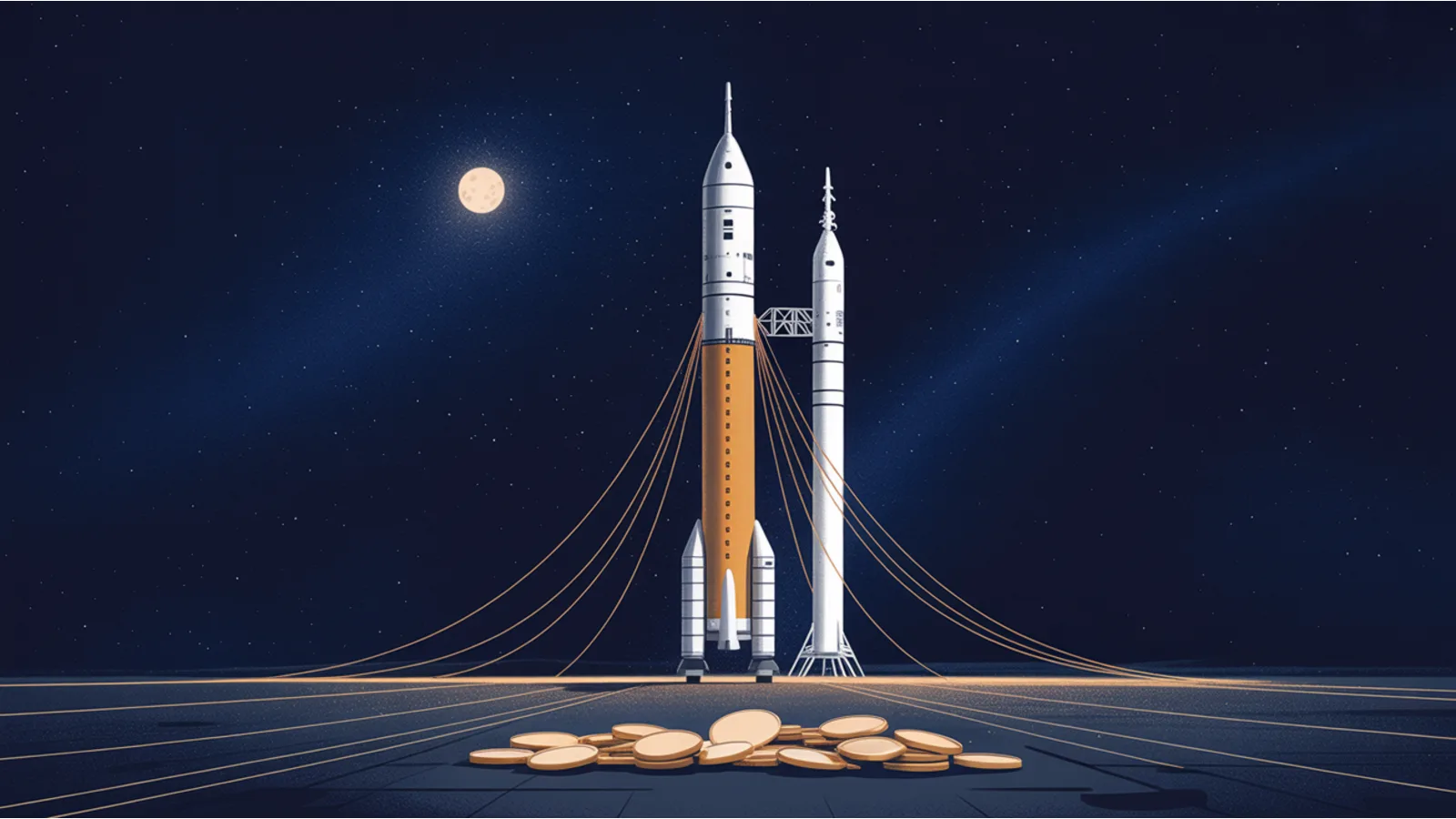
In 2005 NASA set out to retire the Space Shuttle and put astronauts back on the Moon. The program was called Constellation, and it was ambitious in the plainest sense: a new crew rocket, a new heavy-lift rocket, a new deep-space capsule, and a new lunar lander, all developed in parallel. Five years later, in February 2010, the White House proposed cancelling it. By the time that proposal became law that October, the program had spent roughly 9 billion dollars and had produced almost no operational flight hardware. Its single flying rocket had flown exactly once, on a suborbital test.
That is the headline most people remember, and it is accurate as far as it goes. But it is not the whole record. Constellation is one of the cleaner both-sides cases in federal spending oversight: an independent review found the program genuinely unaffordable as funded, and much of the money was not written off but redirected. The Orion capsule and the heavy-lift work did not die in 2010. They carried forward into the rockets and spacecraft that now fly under Artemis. This post walks the timeline, keeps the several different money figures strictly separate, and sets the honest critique next to the honest defense.
What Constellation was
Constellation was NASA's human-spaceflight program of record for the second half of the 2000s. It was announced in 2005 as the vehicle for a national goal that had bipartisan support: retire the aging Space Shuttle and return crews to the Moon, then push beyond. The program was built around four major pieces of hardware, according to NASA program documentation summarized by reference sources:
- Ares I, a crew launch rocket designed to carry astronauts to orbit.
- Ares V, a much larger cargo and heavy-lift rocket for the heavy equipment a Moon mission would need.
- Orion, the crew capsule, originally designated the Crew Exploration Vehicle and selected in 2006.
- Altair, the lunar lander that would actually set down on the surface.
It is worth stating up front what got built and what did not. Ares I reached a test flight. Orion reached hardware development and survived the program's cancellation. Ares V and Altair never reached serious hardware development before Constellation was cancelled. So when the record talks about what the roughly 9 billion dollars bought, it is talking mostly about Ares I test hardware, early Orion work, and the supporting infrastructure, not a Moon lander or a heavy-lift rocket that flew.
The timeline, dated
The story runs cleanly from announcement to cancellation to redirection.
- 2005: Constellation announced, structured around Ares I, Ares V, Orion, and Altair.
- 2006: Orion selected as the Crew Exploration Vehicle.
- August 2009: The Government Accountability Office publishes GAO-09-844, finding NASA lacks a sound business case, firm requirements, and a credible cost estimate for the program.
- 22 October 2009: The independent Augustine Committee releases its report, finding the human spaceflight program on an "unsustainable trajectory."
- 28 October 2009: Ares I-X, the single suborbital development test of an Ares I-class vehicle, launches from Kennedy Space Center.
- 1 February 2010: The Obama administration's FY2011 budget proposes cancelling Constellation.
- October 2010: The NASA Authorization Act of 2010 is signed, making the cancellation law and directing NASA toward a new heavy-lift path.
- 2011: Development begins on the Space Launch System, the congressionally mandated successor that inherits Constellation and Shuttle heritage.
- April 2026: Artemis II carries crew beyond low-Earth orbit on the hardware lineage that traces back to Constellation-era Orion and heavy-lift work.
Two of those dates are easy to collapse and should not be. The February 2010 budget only proposed cancellation. The program was not legally cancelled until the NASA Authorization Act of 2010 was signed that October. Between those two events the program's fate was contested in Congress, which is part of why Orion and heavy-lift work survived at all.
The money, kept in separate boxes
The single most common error in writing about Constellation is mixing up figures that measure completely different things. There are at least three distinct money categories in the record, and they range from about 9 billion to more than 97 billion dollars. They are not the same number seen from different angles. They count different things.
Money actually spent to date. When the White House proposed cancellation, the press characterized Constellation as a roughly 9 billion dollar investment to date. Space.com framed it as "a 9 billion dollar investment" and "a five-year, 9 billion dollar effort" at the February 2010 cancellation. This is a spent-to-date figure, not a projection of what the program would eventually cost.
A broader spent accounting. A wider tally puts spending higher. The Planetary Society and reference sources report about 11.9 billion dollars spent from 2005 to 2009 against an 8.8 billion dollar request, an overrun of roughly 3.1 billion dollars over the five-year budget. This is still money spent, but it covers a broader scope than the roughly 9 billion dollar press figure. Both numbers are real. They measure different boundaries around the same program, and they should not be averaged together into a single made-up figure.
Money obligated in contracts, and money projected. GAO-09-844, published in August 2009, is the primary oversight document and it introduces two further numbers that are neither of the spent figures above. The GAO reported that NASA had already obligated more than 10 billion dollars in contracts. Separately, it estimated Ares I and Orion alone could cost up to 49 billion dollars, part of an estimated total program cost of more than 97 billion dollars through 2020. That 97 billion dollar figure is a projection through 2020. It is not money that was spent. The only hard "already committed" number in the GAO report is the more-than-10-billion obligated in contracts.
So the clean way to hold it: roughly 9 billion (or about 11.9 billion on the broader accounting) was actually spent; more than 10 billion was obligated in contracts; and more than 97 billion was the projected lifetime total the program never reached because it was cancelled first.
What flew: Ares I-X
Constellation's one flying vehicle went up on 28 October 2009. Ares I-X was an uncrewed suborbital development test, launched from Kennedy Space Center Launch Complex 39B. It reached roughly 150,000 feet, which NASA reported as about 28 miles, over a flight lasting about 369 seconds to first-stage splashdown.
Two caveats keep this honest. First, it was suborbital, a development test, not an orbital or operational flight. The Ares I never flew an operational mission. Second, Ares I-X was not even the full Ares I design. It used a four-segment Shuttle-derived booster with a dummy upper stage rather than the five-segment vehicle Ares I was meant to become. And the roughly 369-second flight time runs all the way to the first stage splashing down under parachutes. Powered ascent lasted only about two minutes. It was a real test that returned real engineering data on ascent control, stage separation, and booster recovery, but it was one suborbital shakedown, not a Moon rocket reaching space.
The oversight verdict: unsustainable as funded
The document that most directly shaped the cancellation was not a GAO audit but an independent review. In 2009 the White House chartered the Review of U.S. Human Space Flight Plans Committee, chaired by former Lockheed Martin chief executive Norman Augustine and universally known as the Augustine Committee. It released its report on 22 October 2009.
Its central finding was blunt and often quoted: the U.S. human spaceflight program was on "an unsustainable trajectory." The committee judged Constellation so far behind schedule, so far over budget, and so underfunded that its goals were not achievable under the FY2010 budget. Its headline conclusion on the money was that a viable exploration program needed roughly 3 billion dollars per year in additional funding.
That is the crux of the critique, and it is not the same as saying the mission was pointless. The committee's finding was a mismatch between ambition and money: the destinations were reasonable, but the budget assigned to reach them was not enough to do so on any credible schedule. GAO-09-844 had said much the same thing in audit language two months earlier, warning that NASA was obligating billions without a sound business case or a firm cost estimate underneath it.
The critique and the defense, side by side
The honest critique
Roughly 9 billion dollars was spent (about 11.9 billion on the broader accounting, with a 3.1 billion dollar overrun on a five-year budget) on a Moon-return program that was cancelled in 2010 without producing operational flight hardware. The one vehicle that flew, Ares I-X, was a single suborbital test using a stand-in booster and a dummy upper stage. Independent oversight had already flagged the problem before cancellation: GAO-09-844 found no sound business case, firm requirements, or credible cost estimate even as NASA obligated more than 10 billion dollars in contracts and projected a total north of 97 billion dollars through 2020. The Augustine Committee found the whole trajectory unsustainable and underfunded by about 3 billion dollars a year. In the plainest terms, the goals never matched the money, and the gap was visible on paper years before anyone lit a rocket.
The honest defense
Human exploration beyond low-Earth orbit is a genuine, long-standing, bipartisan national goal, and the Constellation cancellation was a redirection rather than a write-off. Much of the investment survived. The Orion crew capsule, first selected in 2006, was carried forward in redesigned form. The heavy-lift development work seeded the Space Launch System, which began in 2011 as a congressionally mandated successor and now flies under the Artemis program. In April 2026 an SLS rocket carried an Orion crew beyond low-Earth orbit on Artemis II, the first crewed flight of a hardware lineage that traces directly back to Constellation-era Orion and heavy-lift work. The Augustine Committee's core finding was not that the mission was worthless but that it was underfunded; the failure was one of funding versus ambition, not of purpose. Even the lone test flight returned usable engineering data.
Both verdicts are true at once. Constellation was unaffordable as funded and was rightly flagged by oversight before it was stopped. And Constellation was not simply money set on fire, because its two most durable pieces, Orion and heavy-lift, went on to fly.
A note on the successor
One distinction matters enough to isolate. The Space Launch System is Constellation's successor, not a part of Constellation. SLS development began in 2011, after the cancellation, under a fresh congressional mandate. Its heritage is mixed: it draws on Ares V-derived heavy-lift concepts, but it also relies heavily on Shuttle-derived hardware, including RS-25 engines and solid rocket boosters. So while it is fair to say Constellation's heavy-lift investment was preserved, it is not fair to call SLS a Constellation rocket or to credit all of its lineage to the cancelled program. Orion is the cleaner survival story: conceived under Constellation, redesigned after 2010, and still flying.
Fact-check notes and sources
- Constellation announced in 2005; elements were Ares I (crew), Ares V (cargo/heavy lift), Orion (crew capsule), and Altair (lunar lander); Altair and Ares V never reached hardware development. Program concept and elements per NASA program documentation as summarized at Wikipedia: Constellation program.
- Cancellation proposed 1 February 2010 in the FY2011 budget; enacted by the NASA Authorization Act of 2010, signed October 2010 (two distinct dates). Per Space.com coverage of the FY2011 budget and the Augustine Committee record.
- Press characterized Constellation as a roughly 9 billion dollar investment to date at the February 2010 cancellation (a spent figure, not a projection). Per Space.com.
- Broader accounting: about 11.9 billion dollars spent 2005 to 2009 against an 8.8 billion dollar request, a 3.1 billion dollar overrun. Per The Planetary Society, "Horizon Goal" part 2 and Wikipedia: Constellation program.
- GAO-09-844 (August 2009): no sound business case; more than 10 billion dollars obligated in contracts; Ares I plus Orion estimated up to 49 billion dollars of a more than 97 billion dollar projected total through 2020. The 97 billion figure is a projection, not money spent. Per GAO-09-844 (full PDF at gao.gov/assets/gao-09-844.pdf).
- Augustine Committee released its report 22 October 2009, found the program on an "unsustainable trajectory," and concluded roughly 3 billion dollars per year in additional funding was needed; chaired by Norman Augustine. Per SpacePolicyOnline and the OSTP summary of the committee's findings.
- Ares I-X: a single uncrewed suborbital development test launched 28 October 2009 from Kennedy Space Center Launch Complex 39B, reaching about 150,000 feet over about 369 seconds to first-stage splashdown; powered ascent lasted only about two minutes; it used a four-segment Shuttle-derived booster with a dummy upper stage, not the full Ares I design. Per Wikipedia: Ares I-X, summarizing NASA materials.
- Orion (selected as the Crew Exploration Vehicle in 2006) was carried forward and redesigned after 2010; heavy-lift work seeded the Space Launch System, whose development began in 2011 and which incorporates both Ares-derived and Shuttle-derived hardware. Per Wikipedia: Orion (spacecraft) and Wikipedia: Space Launch System.
- Artemis II carried crew beyond low-Earth orbit in April 2026 (launched 1 April, lunar flyby 6 April, splashdown 10 April), the first crewed flight of the SLS/Orion lineage. Per Wikipedia: Artemis II.
Related reading
- The Superconducting Super Collider: a physics megaproject cancelled mid-construction, another study in ambition outrunning its budget.
- The NPOESS and JPSS weather satellite saga: a program restructured after cost growth and management findings, and what survived the reset.
- TSAT, the Transformational Satellite program: a cancelled next-generation system whose capability goals outlasted the program itself.
- The full public-money programs index: every entry in this oversight series in one place.
This post is informational and journalistic, not legal or financial advice. It describes public programs and documented events; mentions of third parties are nominative fair use and no affiliation is implied.
