
On November 12, 2026, MIT News published a profile of Jake Hecla, an MIT alumnus (class of 2017) who is now an assistant professor in Nuclear Science and Engineering and the Charles Stark Draper Career Development Professor of Aeronautics and Astronautics. His research covers three problems that sound unrelated and are not:
- How to get rid of the heat from a nuclear reactor in space, where there is no air to carry it away.
- How to work out what a nuclear-powered weapon is doing from the outside, using Russia's Burevestnik cruise missile as the test case.
- How to tell from orbit whether a satellite is carrying a nuclear weapon, a question that a Russian satellite launched in 2022 made urgent.
All three come down to the same physics: reactors and nuclear material give off heat and radiation in ways you can model, manage and measure. This article explains how each piece works, where it sits in the space nuclear programs the US government restarted in 2025 and 2026, and how defense contractors, sensor makers and startups could work with it.
Why this matters now
Space nuclear power has gone from studies to procurement in about eighteen months:
- July 2025: a NASA directive, as reported by NPR, called for a lunar reactor of at least 100 kilowatts electric (kWe), launched by 2030.
- January 2026: NASA and the Department of Energy signed a memorandum of understanding to develop a lunar surface reactor by 2030.
- April 14, 2026: the White House issued a space nuclear memo (NSTM-3) that sets up "parallel and mutually-reinforcing" NASA and Department of War reactor design competitions. It requires mid-power reactors of at least 20 kWe that run at least 3 years in orbit and 5 years on the Moon, with at least one design extensible to 100 kWe. The Department of War is to pursue its own mid-power in-space reactor by 2031.
- 2026: NASA announced Space Reactor-1 Freedom, which it calls "humanity's first fission-powered interplanetary spacecraft," targeting launch in late 2028. It will demonstrate nuclear electric propulsion on the way to Mars and inform Lunar Reactor-1, the Moon base power system.
NSTM-3 names the engineering risk areas it wants addressed, and one of them is "reactor and radiator design." That is the first piece of Hecla's work.
Part 1: getting rid of the heat in space
The problem
A space reactor makes heat. To get electricity, you run that heat through a Brayton or Rankine cycle, the same families of thermodynamic cycles used in power plants. MIT's profile notes these deliver "efficiencies of around 30-40 percent in terrestrial applications," which means most of the reactor's heat has to be thrown away.
On Earth, air and water carry waste heat off. In space there is nothing to carry it, so the only way out is thermal radiation. The power a surface radiates rises with the fourth power of its temperature (the Stefan-Boltzmann law), and at a fixed temperature the radiator area you need grows in step with the heat you must reject. Double the power, double the radiator. For megawatt-class systems, radiators become huge, heavy panels. A 1987 NASA memo put the best conventional technology, heat-pipe radiators, at "around 5 kg/m2."
How a liquid droplet radiator works
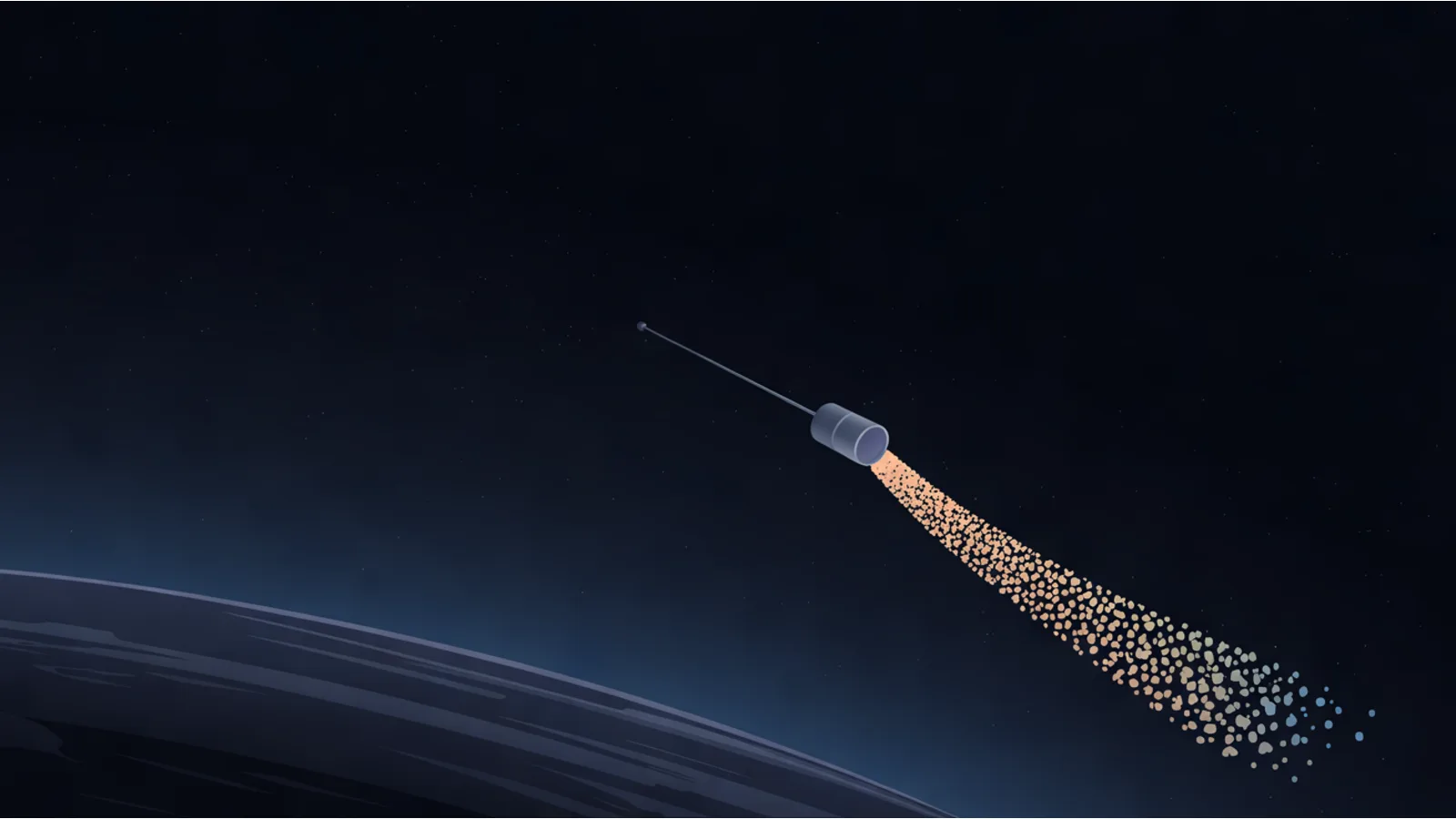
The liquid droplet radiator (LDR) replaces solid panels with a spray. MIT describes it this way: coolant is sprayed from an emitter toward a collector as sheets of tiny droplets. The droplets radiate heat as they fly across the gap, hit the collector, and the cooled liquid is pumped back to the heat source to go around again.
Why that saves mass: a sheet of millions of tiny droplets has an enormous surface area for very little material, and there is no structure to build. A 1981 study for NASA Marshall calculated whole-system specific masses for droplet radiators of about 0.06 to 0.12 kg per kW of heat rejected for tin at 1,000 K, and concluded that droplet systems "would have a mass that is an order of magnitude smaller than existing systems." MIT's profile makes the same order-of-magnitude claim for Hecla's target: it "could reduce the mass of the cooling system for a future nuclear electric power space reactor by an order of magnitude."
The idea is old. NASA's 1987 status memo says it was "first suggested in 1978," credits work at the University of Washington, and lists a funding base that shows defense interest from the start: the Air Force Rocket Propulsion Laboratory, NASA's Lewis, Langley and Marshall centers, the Air Force Office of Scientific Research, DOE, and in-house research money at Grumman, Spectra Technology and McDonnell Douglas. The same memo found that a triangular droplet sheet "can be 40 percent less massive than a rectangular LDR."
The hard part: catching every droplet
If an LDR were easy, it would be flying. The problem is losing coolant. Droplets drift because they pick up electric charge, splash when they hit the collector, or miss because the emitter is slightly misaligned. Every lost droplet is coolant you had to launch.
The tolerances are brutal, and the two published numbers differ:
Scroll to compare columns and rows when the table extends beyond the box.
| Source | Mission life assumed | Acceptable loss |
|---|---|---|
| MIT profile of Hecla (2026) | 10 years | about 1 droplet in 1,000,000 |
| NASA TM-89852 (1987) | 30 years | about 1 droplet in 100,000,000 |
The difference mostly reflects the assumed mission length and design, so neither is wrong. Both make the point. The radiator cycles its coolant every few seconds, so even a tiny loss rate compounds. The NASA memo gives the scary example: with 100,000 droplet streams, misdirecting just one "yields a mass loss in two weeks approximately equal to the mass of the entire droplet sheet." The good news from the same memo: University of Washington collector tests had measured loss rates below 1 in 100,000,000.
Hecla is investigating collection techniques, including "electromagnetic collectors that can improve retrieval efficiency, and even allow maneuverability while the radiator is in operation." That last part matters. The 1987 memo noted that electric-field gutters like those in inkjet printers are "very complex" in space "due to the nature of the space plasma and solar wind," so a collector that actively steers droplets is a real step, not a tweak. Being able to maneuver with the radiator running is also what a military user would ask for first.
I did not find a published Hecla paper on the droplet work yet, so the details of his collector designs are not public.
Why the military angle is built in
The 1987 NASA memo made a survivability argument that still holds. "A 1000 m2 radiator limits maneuverability," and "a large area conventional radiator would be an inviting target for hostile threats." It listed space-based radar and particle-beam vehicles among the candidate missions. A radiator that can be switched off, retracted or steered changes both problems.
Where droplet radiators could plug in
These are the programs a contractor working on space thermal systems would be pitching into.
NASA Fission Surface Power. In June 2022 NASA, through Idaho National Laboratory (INL), gave three teams about $5 million each for 12-month concept work on a 40 kW-class lunar system lasting at least 10 years: Lockheed Martin with BWXT and Creare; Westinghouse with Aerojet Rocketdyne; and IX (Intuitive Machines and X-energy) with Maxar and Boeing. In January 2025, Westinghouse announced an INL contract to continue its design.
NSTM-3 competitions. The April 2026 memo is the big one for industry. It calls for firm fixed-price contracts paid "only on successful completion of interim and final milestones," lets vendors propose their own milestones, and keeps government use and march-in rights under 37 CFR 401.14. NASA must downselect to no more than two designs within a year. For the Department of War side, year one pools defense space nuclear funding into NASA's program, and from year two the department works with at least two competing vendors. The memo also tells the department to "encourage proposals from existing NASA FSP/NEP program participants," which is a direct crossover path for the companies above.
SR-1 Freedom and Lunar Reactor-1. NASA Glenn said in October 2026 that Sierra Lobo will provide SR-1 Freedom's closed Brayton cycle power conversion system and that INL is designing the reactor. NASA's mission page lists the power system at 20 kWe. A draft NASA Glenn solicitation called SPARC (Space Power and Reactor Capabilities), reported in September 2026, pairs a multiple-award contract with a first task order for Lunar Reactor-1. I could read only secondary coverage of the draft, and no award had been announced.
AFRL JETSON. The Air Force Research Laboratory's Joint Emergent Technology Supplying On-Orbit Nuclear power effort, run from Kirtland Air Force Base, picked Lockheed Martin, Westinghouse Government Services and Intuitive Machines in 2023. Its solicitation explicitly asked for "thermal regulation" alongside power conversion and shielding. Lockheed's high-power award was $33.7 million for a reactor-driven Stirling system of 6 to 20 kWe, building on NASA's 2018 KRUSTY ground test. I found no public status update on the high-power track after 2025.
What ended. DARPA's DRACO nuclear thermal rocket program page now reads "This program is now complete." Breaking Defense reported in 2025 that DARPA's deputy director said falling launch costs made it "less and less of a positive ROI." Don't build a pitch around nuclear thermal propulsion demos right now. Power systems are where the money is.
One caution for anyone writing proposals: the power target has moved several times. Kilopower aimed at up to 10 kWe, Fission Surface Power at 40 kW class, the July 2025 directive at 100 kWe or more, and NSTM-3 at 20 kWe or more with a path to 100. Quote the document you are responding to.
Part 2: reading a nuclear-powered missile from the outside
The Burevestnik
In March 2018, Vladimir Putin announced "a small-scale heavy-duty nuclear energy unit" that could be installed in a cruise missile, giving it nearly unlimited range. Russia calls it the 9M730 Burevestnik, and its NATO name is Skyfall.
On August 8, 2019, an explosion near Nyonoksa on the White Sea killed at least five Rosatom scientists. Russia's Defense Ministry first reported two dead. A Sarov institute official spoke of "radioactive materials, including fissile and radioisotope materials," and Russia's weather service later reported short-lived strontium, barium and lanthanum isotopes in samples. MIT's profile says the plume "indirectly" confirmed Russia was serious.
In an October 2025 meeting published by the Kremlin, Chief of the General Staff Valery Gerasimov told Putin that a test on October 21 covered 14,000 kilometers in about 15 hours, and Putin ordered preparations to base the missile in the armed forces.
What Hecla and Kemp worked out
As a Stanton Postdoctoral Fellow at MIT's Laboratory for Nuclear Security and Policy from 2023 to 2025, Hecla worked with R. Scott Kemp on the missile's performance envelope. Their paper, posted in June 2026, describes "a nuclear-aircraft modeling toolkit" and concludes:
- The missile is subsonic, about 9.5 meters long with a 5.6-meter wingspan.
- It is likely powered by a direct-cycle nuclear turbojet. Their calculations "almost entirely exclude the possibility of a nuclear ramjet."
- The reactor runs at about 4.3 megawatts thermal at cruise, with peaks above 15 megawatts during climb and terminal maneuvers.
- Escaping neutrons generate "in excess of 5 TBq of gaseous radionuclides per MW-hr of flight," including argon-41, krypton-85m, krypton-83m and carbon-14, "some of which may be detectable using existing monitoring networks."
NPR reported that Hecla built a 3D model of the missile from Russian video, using objects of known size in the frame, such as a utility desk and a fire extinguisher, to set the scale. The paper's verdict is that Burevestnik "does not appear to be a strategic game-changer" but is "a costly, hazardous, and symbolically charged system with the potential to kick off a broader aerospace nuclear-propulsion race." Hecla told NPR: "We are able to routinely shoot down cruise missiles today, and there is no reason to think this will be particularly more difficult to do."
Why a model like this is useful
The radionuclide estimate is the practical output. If a flight leaves a predictable trail of specific isotopes, then air-sampling aircraft and ground monitoring stations can be told what to look for and in what quantities. The paper notes that publicly broadcast aircraft tracking data showed US WC-135 Constant Phoenix sampling aircraft moving to the region around Russia's test dates. A signature model turns "something happened" into "this is what flew, at roughly this power, for roughly this long." MIT says the same information could support limits or bans on such systems, or new countermeasures.
Part 3: is that satellite carrying a nuclear weapon?
The concern
Article IV of the 1967 Outer Space Treaty bars parties from placing "in orbit around the earth any objects carrying nuclear weapons." In February 2024, the White House confirmed that Russia was developing an anti-satellite capability, which an official told NPR was space-based and nuclear-related. In April 2024, National Security Advisor Jake Sullivan said "the United States assesses that Russia is developing a new satellite carrying a nuclear device," after Russia vetoed a UN Security Council resolution reaffirming the treaty. The vote was 13 in favor, Russia against, and China abstaining. In August 2024, a senior Pentagon space policy official said such a weapon "could potentially wipe out an entire orbit of assets."
That is not hypothetical physics. NASA's history of the 1962 Starfish Prime test, a 1.4-megaton detonation about 400 km up, records "the loss of seven satellites within months after the test, primarily from solar cell damage," at a time when there were very few satellites to lose.
MIT's profile points to Kosmos 2553, launched by Russia in 2022 and "believed by American intelligence to contain components of a nuclear weapon." It sits around 2,000 km up in a high-radiation band, and the tracking firm LeoLabs reported in 2025 that it had begun tumbling in November 2024.
How you would detect a weapon from orbit
The problem: a weapon in orbit isn't operating, so it isn't glowing with radiation the way a running reactor does. You have to make the fissile material reveal itself.
MIT's profile says Hecla and colleagues are "devising techniques to detect the presence of nuclear weapons by studying the gamma-induced neutral field from satellites," and want to build "a highly sensitive compact neutron telescope to detect and locate the source of neutrons." The wording suggests a gamma-induced neutron field, given the neutron telescope in the next sentence, but MIT has not published details of Hecla's approach, and I did not find a paper on it.
The closest published MIT work is by Areg Danagoulian, Hecla's undergraduate research mentor. His paper, published in Nature in 2026, uses a free particle source: high-energy protons trapped in the inner Van Allen belt hit the material in a satellite and knock neutrons out of heavy nuclei (spallation). Fissile material responds differently. The calculations show "a 9U CubeSat sized detection platform can identify a thermonuclear weapon from the distance of 4 km in approximately one week of observation." MIT News summarized it as 99 percent accuracy within 4,000 meters over about a week, or about an hour at 1,000 meters. Danagoulian's paper also notes that, until now, "no methodologies of verification have been proposed in the open peer reviewed literature."
An October 2026 preprint by Patrick Huber, not an MIT author, proposes the active version: a compact accelerator fires a photon beam to induce fission, and inspector satellites detect the neutrons. Using Starlink's constellation as the example, it estimates 20 to 70 inspector platforms could cover the fleet with 90 percent detection probability against a single warhead.
For comparison, a 1990 study found unshielded warheads detectable on the ground at "tens of meters," while an operating SP-100 reactor in orbit could be seen by a gamma-ray telescope "at thousands of kilometers." A running reactor is loud. A dormant warhead is quiet, which is why inspector platforms have to get close.
The precedent
Space-based nuclear detection is not new, only this mission is. The US launched the first Vela satellites on October 16, 1963, a week after the Limited Test Ban Treaty took effect, to see whether satellites could detect nuclear explosions in space. Today, Global Burst Detector sensors built by Sandia and Los Alamos ride on GPS satellites about 12,550 miles up, and NNSA has delivered the fifth next-generation unit to the Space Force. What doesn't exist yet is anything built to inspect another country's satellite up close.
Part 4: antineutrinos and verification
Hecla's 2023 Berkeley dissertation, "Optical Diagnostics for Antineutrino Detector Media," advised by Kai Vetter, measured how light travels through water-based liquid scintillator, "a leading candidate fill material for nonproliferation-focused antineutrino detectors." Reactors emit vast numbers of antineutrinos, and as an NNSA-commissioned study (Nu Tools) put it, "neutrinos propagate in straight lines and cannot be shielded."
The catch is size and range. Nu Tools says a 1 to 10 ton detector about 100 m from a reactor can track its power, fissile content and burn-up. Detecting or ruling out any reactor above a power threshold at about 10 km needs 100 to 1,000 tons. It concluded that the required size, dwell time and backgrounds "preclude consideration of neutrino detectors for non-cooperative reactor monitoring or discovery," and saw the real use in "future nuclear deals and advanced reactors." A 2022 study with Hecla as co-author found that a 1-kiloton gadolinium-doped water detector "can exclude gigawatt-scale nuclear reactors up to tens of kilometers within a year." The planned WATCHMAN detector at Boulby in the UK was cancelled in 2022 when the nearby Hartlepool reactors were slated for early closure. A 30-tonne demonstrator, BUTTON-30, carries on with Hecla among its authors.
As an undergraduate, Hecla worked with Danagoulian on warhead verification using nuclear resonance, a method in which "all information is encrypted in the physical domain in a manner that amounts to a physical zero-knowledge proof system." MIT's lab describes the idea simply: "Participants do not need to trust each other's devices; they only need to trust their understanding of physics."
How defense industry partners could use this work
Some of these research lines are in papers and some are early. Here is where each could meet a company, with the program hooks above.
1. Space reactor primes and thermal subsystem suppliers. The NSTM-3 competitions, SR-1 Freedom, Lunar Reactor-1 and JETSON all need heat rejection, and radiator mass is a direct cost in launch dollars. A team bidding a mid-power reactor could carry a droplet radiator as a lighter option and fund the collector work as risk reduction. Lockheed Martin, Westinghouse, BWXT, Sierra Lobo, Creare and the IX team are the companies already in these programs, and NSTM-3 explicitly invites existing FSP and nuclear electric propulsion participants into the Department of War competition.
2. Military spacecraft that must maneuver. A steerable, retractable radiator answers the survivability problem NASA flagged in 1987. A defense customer flying a reactor-powered bus for high-power payloads such as radar or electric propulsion would care about that more than NASA does.
3. Radiation sensor makers and CubeSat builders. Compact neutron detectors, directional scintillator panels and diamond detectors, the hardware in Danagoulian's design, are products. So is a neutron telescope that fits on a small satellite. Companies that build hosted payloads, or that already supply detectors to NNSA, have a natural opening.
4. Space domain awareness companies. Firms such as LeoLabs already track objects like Kosmos 2553 by radar. Pairing orbital tracking with close-approach radiation measurements is the logical next product for an inspection or verification mission.
5. Monitoring and intelligence analytics. The Burevestnik signature model is a template: estimate the reactor's power and neutron leakage, then predict the isotopes and quantities that sampling aircraft and ground stations should see. Contractors supporting nuclear explosion and radionuclide monitoring could apply the same approach to other exotic nuclear systems.
6. Arms control verification technology. Nuclear resonance and epithermal neutron methods for confirming a warhead without revealing its design are a niche, but the customers are real: NNSA and treaty verification bodies.
7. Spin-offs outside nuclear. Hecla co-authored a 2018 MIT, Massachusetts General and NASA paper on stationary CT scanning for space, which removes the rotating gantry that drives mass and power. The startup that came out of that research group, Advanced Tomography Systems, shows only a "Coming Soon" page.
The doors in
- STTR for startups. The Small Business Technology Transfer program requires a research institution partner. The small business must do at least 40% of the work and the institution at least 30%. As of October 16, 2026, agencies can make Phase I awards up to $335,937 and Phase II up to $2,239,578 without SBA approval. Congress reauthorized SBIR and STTR through September 30, 2031 after a six-month lapse.
- NNSA university consortia. NNSA renewed $25 million over five years for the Berkeley-led Nuclear Science and Security Consortium of nine universities, including MIT, and six national labs. Hecla presented his Berkeley work at one of its showcases in 2020. The Michigan-led Consortium for Monitoring, Technology, and Verification is the other channel. Companies typically meet these groups as lab collaborators or as hires.
- Facilities. MIT's Nuclear Reactor Laboratory runs a 6 MW research reactor "used by... researchers in government and industry," and it is a partner facility of DOE's Nuclear Science User Facilities program, which is how outside teams get irradiation time.
- Defense prototyping. The Defense Innovation Unit, now branded the Department of War Innovation Unit, uses open solicitations and other transaction authority to award "prototype contracts in months, not years."
- Direct sponsored research with the MIT groups involved, through MIT's normal research agreements.
One thing to read before you sign: NSTM-3's terms keep government use and march-in rights. Plan your IP strategy around them rather than discovering them at negotiation.
A note on Chernobyl
The profile explains where Hecla's commitment comes from. As an undergraduate he visited the Chernobyl exclusion zone several times, and since 2017 he has been scientific adviser to Clean Futures Fund, a US nonprofit focused on the Chernobyl plant and its communities. It supplies basic essentials, protective equipment and detection gear, and runs a well-known program to spay, neuter and vaccinate the dogs living there. His master's work at Berkeley used a free-moving detector to build 3D radiation maps so workers could limit their exposure, and his 2020 consortium talk shows a reconstruction of a demolition claw at the site. "It's an enormously challenging environment," he told MIT, "where a small amount of well-informed work can have an outsized impact."
What is not public yet
- No published Hecla paper on the droplet radiator or electromagnetic collectors.
- No published paper on his satellite neutron detection approach or the compact neutron telescope.
- No public status update on AFRL JETSON's high-power track after 2025.
- No awarded contract yet under NASA's draft SPARC solicitation as of the latest coverage I could find.
The defense applications above are mapped from the published work and the program documents. None of them are announced partnerships.
Fact-check notes and sources
- The profile, appointment, LDR description, loss rate, order-of-magnitude claim, Stanton fellowship, satellite detection wording, quotes: MIT News, Addressing nuclear challenges, from radiation detection to power in space, November 12, 2026.
- Space nuclear policy: White House OSTP, NSTM-3, April 14, 2026 (competitions, power and life requirements, radiator design as a risk area, fixed-price milestone terms, 37 CFR 401.14 rights, the 2031 Department of War target, the FSP/NEP crossover). NPR, NASA plans to put a nuclear reactor on the moon by 2030, for the July 2025 directive (I did not read the directive itself). NASA, NASA, Department of Energy to Develop Lunar Surface Reactor by 2030.
- SR-1 Freedom and LR-1: NASA, Space Reactor-1 Freedom and NASA Glenn, SR-1 Freedom Advances With Progress on Nuclear Power Module, October 20, 2026. SPARC draft: New Space Economy, What does NASA's SPARC lunar reactor procurement reveal (secondary; the solicitation itself was not read).
- Droplet radiator history and numbers: K. Alan White III, Liquid Droplet Radiator Development Status, NASA TM-89852, 1987 (1978 origin, funders, 5 kg/m2, 40 percent, 1 in 10^8 over 30 years, the two-week example, electric-field gutters, survivability). Karl Knapp, Lightweight Moving Radiators for Heat Rejection in Space, 1981, for kg/kW figures (a scanned document; the table is legible).
- Fission Surface Power and JETSON: NASA, Artemis concept awards for nuclear power on the Moon, June 2022. Westinghouse, contract to continue development, January 2025. Breaking Defense, AFRL picks 3 contractors for JETSON. Lockheed Martin, JETSON High Power award. NASA, KRUSTY demonstration, 2018.
- DRACO: DARPA, DRACO program page; Breaking Defense, DARPA's DRACO nuclear propulsion project roars no more, June 2025.
- Burevestnik: Kremlin, 2018 address and October 2025 meeting. Hecla and Kemp, Modeling the Performance of the Burevestnik Nuclear-Powered Cruise Missile, arXiv, June 2026. NPR, Russia's nuclear-powered 'Skyfall' missile is dirty and dangerous, June 18, 2026. Bellona, Russia says small nuclear reactor blew up, 2019 (deaths, initial count, the Sarov quote). Meduza, Roshydromet isotope findings, 2019. The WC-135 point is the paper's own claim.
- Nuclear weapons in orbit: UNOOSA, Outer Space Treaty. NPR, Russia is working on a weapon to destroy satellites, February 2024. White House archive, Sullivan statement on Russia's veto. UN News, Security Council vote. CSIS, conversation with Vipin Narang, August 2024. E.G. Stassinopoulos, The STARFISH Exo-atmospheric, High-altitude Nuclear Weapons Test, NASA Goddard. Kosmos 2553 orbit and tumbling: SatNews, Russian satellite tumbling out of control (citing Reuters) and Payload, Out-of-control Russian satellite. US officials refer to "a new satellite"; the link to Kosmos 2553 is from MIT and press reporting.
- Detection methods: A. Danagoulian, Verification of the Outer Space Treaty with Cosmic Protons (Nature, 2026). MIT News, MIT researcher proposes a way to detect nuclear weapons in space, July 8, 2026. P. Huber, arXiv:2610.04016, October 2026. Fetter et al., Detecting Nuclear Warheads, 1990. Primack et al., Detection of Space Reactors by their Gamma-ray and Positron Emissions, 1989. Sandia, Happy 60th birthday to Vela. NNSA, Next-generation Global Burst Detector.
- Antineutrinos and verification: Hecla, Optical Diagnostics for Antineutrino Detector Media, UC Berkeley, 2023. Nu Tools final report, 2021. Akindele et al., Exclusion and Verification of Remote Nuclear Reactors with a 1-Kiloton Gd-Doped Water Detector, 2022. Acceptance tests of Hamamatsu R7081 photomultiplier tubes, 2023 (WATCHMAN cancellation). The BUTTON-30 detector at Boulby, 2025. Hecla and Danagoulian, Nuclear Disarmament Verification via Resonant Phenomena, 2017. MIT LNSP, Treaty verification. Hecla, NSSC Virtual Scholar Showcase talk, 2020.
- Partnering routes: SBIR.gov, About (award caps) and eligibility FAQ (STTR work split). CRS, Insight IN12705 (reauthorization). NNSA, consortium grant renewal. MIT, Nuclear Reactor Laboratory. DIU, About.
- Spin-offs and Chernobyl: Cramer, Hecla et al., Stationary Computed Tomography for Space and other Resource-constrained Environments, Scientific Reports, 2018. Advanced Tomography Systems. Clean Futures Fund.
Related reading
- Magnetite: How MIT Lincoln Lab's Secure Embedded OS Works: the other MIT defense technology announced the same day, for satellite and drone computers.
- The Space Test Program: how experimental military payloads actually get to orbit.
- FOGBANK: The Bomb Material the Government Forgot How to Make: what happens when nuclear know-how is not kept alive.
- The high-risk research bet: how DARPA and AFRL are built for a few huge wins and many failures: the research system DRACO and JETSON came out of.
- The 2 Billion Dollar Cat Litter: how one radioactive release shut the only US deep nuclear waste repository.
This post is informational, not engineering, legal or export-control advice. Program details and contract terms change, so check the current solicitation before relying on them. Mentions of MIT, NASA, DOE, NNSA, DARPA, AFRL, Lockheed Martin, Westinghouse, BWXT, Sierra Lobo, Creare, Aerojet Rocketdyne, Intuitive Machines, X-energy, Maxar, Boeing, LeoLabs, Starlink, Rosatom, Clean Futures Fund and Advanced Tomography Systems are nominative fair use. No affiliation is implied.
