
A small brand can prepare for assistant shopping by improving its product data and using the commerce features its platform actually supports. Getting onto Kroger or Whole Foods shelves and enabling the brand's own agent checkout are separate achievements. This week, check your channel eligibility, reconcile one product's information across systems, and identify who will handle the order, payment and refund. The evidence below shows where adoption is real, where it is declared, and where access remains limited.
We looked for an overlap: a food, beverage or personal-care brand with a documented new retail placement during 2026, plus public evidence of agentic commerce on its own store. Agentic commerce means software helps carry out shopping tasks, such as finding an item, preparing a cart or initiating an authorized purchase. A retailer's assistant selling a brand's product does not establish that the brand has connected its own store.
That distinction changes what an owner should copy. A shelf placement involves the retailer's buying and supplier process. A direct sale involves the brand's catalog, fulfillment and payment arrangements. A shopper can encounter the same product through both routes, with different sellers, stock, prices and return policies.
The four protocols in plain words
A protocol is an agreed format for systems to exchange information. Think of a purchase order that both businesses know how to read. These protocols cover different parts of commerce; supporting one does not automatically qualify a store for every assistant.
Scroll to compare columns and rows when the table extends beyond the box.
| Protocol | What it does | Stewardship and current status | Owner's practical question |
|---|---|---|---|
| ACP, Agentic Commerce Protocol | Connects agents and merchants for commerce, including catalog and checkout exchanges | OpenAI and Stripe; the public repository labels it beta and identifies the April 17, 2026 snapshot as its latest stable version | Which assistant program accepts my catalog and checkout? |
| UCP, Universal Commerce Protocol | Describes supported shopping capabilities and how an agent can use them | Google and commerce partners; a published, versioned open specification, with platform access controlled separately | Which capabilities does my store really provide? |
| AP2, Agent Payments Protocol | Carries verifiable permission for agent purchases and payments | Originated at Google; current documentation identifies v0.2 and continued standardization within FIDO Alliance | What proves the buyer authorized this purchase and amount? |
| MCP, Model Context Protocol | Lets an assistant discover and call named functions, such as product lookup | The open MCP project; published protocol and implementations, with each connector's access rules separate | What can this connection read or change? |
An MCP server offers those functions, called tools. A connector links an assistant to that server. A product lookup tool might return the size and stock status of a jar. A purchase tool has a much greater effect and needs authorization enforced by the receiving system. MCP supplies the tool interface; payment processing still needs a commerce and payment implementation.
A product feed is a structured catalog supplied to another system. It describes individual items and variants, such as a single bottle versus a multipack. OpenAI's product reference separates discovery fields from checkout requirements. A searchable item is not automatically purchasable inside an assistant.
A UCP profile is a public description at /.well-known/ucp, a standard location under a store's domain. It names capabilities, protocol versions, service addresses and payment handlers. A payment handler describes a supported way to pass payment information. Publishing the file is a declaration, comparable to posting which payment methods your counter accepts. It does not prove that a transaction will succeed. The UCP specification explicitly distinguishes provenance from trust.
AP2 addresses the buyer's authority. Its current documentation describes Checkout Mandates for purchase details and Payment Mandates for payment authorization. A mandate is a digitally signed permission record, with constraints or a finalized transaction. That is different from allowing an assistant to invent permission because a conversation sounded enthusiastic. See the AP2 documentation for the current terminology.
Google introduced UCP on January 11, 2026, co-developed with Shopify, Etsy, Wayfair, Target and Walmart. Its August 25 release is a published specification; Google's checkout program still has phased access. Google introduced AP2 on September 16, 2025 and announced its donation to FIDO Alliance with v0.2 on April 28, 2026. Neither protocol's publication amounts to general merchant enrollment.
Card networks add another layer. Visa's Trusted Agent Protocol describes recognizing approved agents through signed requests; its October 2025 release notes label documentation availability Public. Visa Intelligent Commerce requires program onboarding for production. Stripe's March 3, 2026 update documents support for Visa Intelligent Commerce and Mastercard Agent Pay in its Shared Payment Token work. Accepting a Visa or Mastercard at your existing checkout does not by itself activate these programs.
Mastercard's April 29, 2025 Agent Pay introduction describes agentic tokens and work with partners including Microsoft. It establishes the program's launch. It does not open enrollment to every merchant.
Read today's program rules alongside the launch story
ACP's first released snapshot is dated September 29, 2025 in its repository. The original Instant Checkout story should not be treated as an unchanged enrollment promise. Shopify's March 24, 2026 announcement describes ChatGPT discovery followed by the merchant's checkout in an in-app browser, or a separate tab on desktop. That is different from a universal embedded payment program.
OpenAI's own March 24 update explains the shift toward product discovery and merchants' checkout experiences, while preserving deeper integrations through apps. Its September 29, 2025 launch had introduced Instant Checkout with Stripe. Use the later documentation when deciding what to build today.
The current ChatGPT checkout reference calls external checkout the recommended, generally available approach for plugin developers. Current approval is limited to physical-goods purchases. It also documents checkout using payment methods already saved with a merchant and a ChatGPT payment sheet in private beta for selected marketplaces. Those are distinct access paths.
Delegated payment means the assistant passes restricted payment authority to the merchant or its payment service provider, the company processing the transaction. OpenAI's payment specification describes an allowance with amount and expiry constraints. The merchant still determines whether to accept the order. Avoid translating a token, a temporary payment reference, into permission for unrestricted future charges.
From shelf to agent checkout
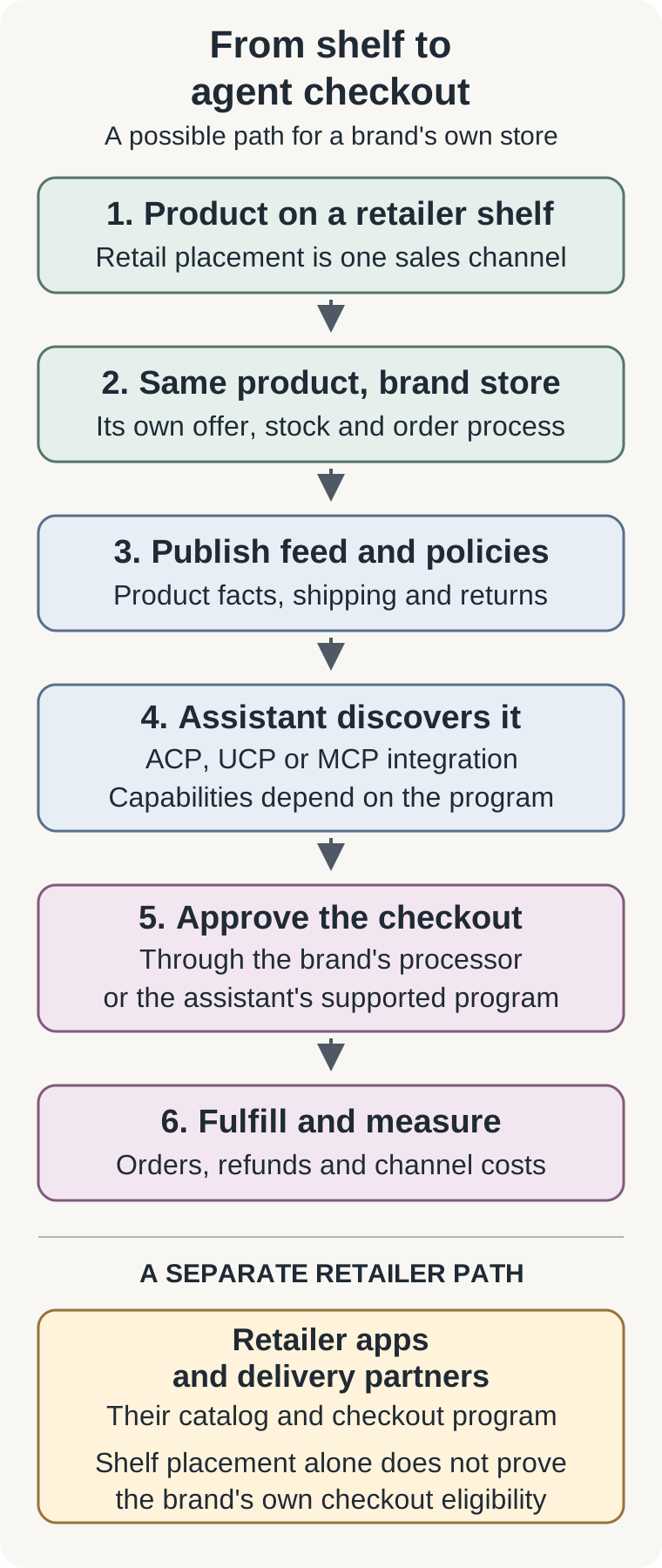
From shelf to agent checkout

Product on a retailer shelf
             ▼
Same product in the brand's store
             ▼
Product feed and policies published
             ▼
Assistant discovers it: ACP, UCP, MCP
             ▼
Customer reviews and authorizes checkout
Brand processor or assistant program
             ▼
Order fulfilled, refunded if needed, measured

Separate path:
Retailer app or delivery partner → retailer inventory
                               → its own order flow
The diagram shows one practical sequence. Shelf placement is not required before selling through an assistant, and a brand can start with its own online store. Nor does the product have to carry every protocol: use the interfaces your selected channel supports.
What Kroger and Whole Foods have actually announced
Kroger: its shopping assistant and the partner routes
Kroger's January 11, 2026 announcement described using Gemini Enterprise for Customer Experience in a personal shopping assistant. That is Google Cloud technology inside Kroger's service. It does not establish checkout from the consumer Gemini app or adoption of a particular commerce protocol.
The later July 28 Kroger announcement says its AI Shopping Assistant is available across Kroger Family of Companies websites and apps. It describes meal planning and cart building from preferences, a photographed list or a recipe link. The same release identifies DoorDash, Instacart and Uber Eats as marketplaces carrying its assortment. These are company statements about available experiences; we tested no transactions.
For the Instacart path, there is direct protocol evidence: Instacart's December 8, 2025 announcement names ACP and Stripe in its embedded ChatGPT checkout. The customer connects an Instacart account and reviews the cart before payment. That documents the partner's integration; it does not make each Kroger supplier an ACP merchant. Account, location and item availability still matter. OpenAI's March 24, 2026 update later moved most ChatGPT purchases back to merchants' own checkout, and we did not confirm whether Instacart's in-chat payment still works as announced.
DoorDash's December 17, 2025 announcement also names Kroger in its grocery selection. Its described flow builds the shopping selection in ChatGPT and opens the cart in DoorDash for review and purchase. The launch began with selected users and carries location-dependent availability. This is a partner route, with a different checkout boundary from Instacart's announced embedded experience.
Whole Foods: Amazon's grocery experience
Amazon's January 5, 2026 Alexa.com announcement describes turning meal plans into Amazon Fresh or Whole Foods carts. Its Alexa+ feature guide, updated July 24, 2026, describes grocery ordering through those integrations. Amazon's May 13, 2026 shopping announcement combines the Rufus shopping assistant and Alexa+ into Alexa for Shopping. Keep those names and dates clear when reading older articles.
Buy for Me is a different path. Amazon's April 3, 2025 launch explanation describes a customer authorizing Amazon to buy an eligible item on another brand's website. The brand handles delivery, returns and customer service. It is not evidence that Whole Foods suppliers have adopted ACP, UCP or AP2. We found no announcement in the retailer sources reviewed that establishes a Whole Foods rollout of those named protocols.
Getting onto shelves still has its own process
Kroger's supplier page directs prospective vendors to Supplier Hub and its qualification process. Its Go Fresh & Local page describes a route for local and regional fresh suppliers, but the displayed cohort is historical. Do not treat that page as an open application window for this year.
Whole Foods' potential-supplier page describes supplier registration, product submission and requirements including quality standards, food safety and business requirements such as liability insurance. Some application dates on the page are older; confirm the current intake with the retailer. Its September 24, 2026 LEAP announcement is particularly useful: the Early Growth participants were not yet on shelves, and placement would be evaluated after the program.
Who does this: the brand owner or wholesale lead. Done when: the retailer has communicated the actual next step and its requirements. A submitted supplier form, accelerator acceptance and a confirmed retail launch are different milestones. Have an assistant prepare the information; the responsible person reviews and submits it.
Eight brands with retail-placement and public-profile evidence
The table pairs documented 2026 placements with a single read of each brand store's public UCP file. All read times below are November 7, 2026, UTC. Placement statements come from issuer releases except BEFORE, reported by Mass Market Retailers. They establish the announced scope. They say nothing about present stock at every location.
Each linked profile parsed as JSON and declared UCP 2026-08-25, checkout, cart, order, catalog search and lookup, plus Google Pay, Shopify card and Shop Pay handlers. These are our observations of declarations. All eight files used Shopify's own capability names and Shopify-hosted service addresses, which fits Shopify's statement that agentic storefronts are active by default for eligible stores. So they show what the platform publishes; they do not establish who enabled the feature or whether the brand deliberately opted in.
Scroll to compare columns and rows when the table extends beyond the box.
| Brand and product | Retail placement and source read | Public UCP profile and read | What is not established |
|---|---|---|---|
| Prima, protein bars | Kroger and banners, July 13, 2026; read 21:07:01 | Profile, 21:07:45 | Assistant approval, eligible items and completed orders |
| MASA, Original and Lime tortilla chips | Whole Foods, June 22, 2026; read 21:07:03 | Profile, 21:07:45 | Assistant approval, eligible items and completed orders |
| Unreal Snacks, Peanut Butter Drops | Whole Foods retail-exclusive launch, June 2, 2026; read 21:07:05; release also documents direct sales | Profile, 21:07:46 | Current direct stock, item-level assistant eligibility and completed orders |
| happy, Cold Brew and Perfect Vanilla Cold Brew, 48 oz | Kroger first rollout during April; announced April 13, 2026; read 21:07:07 | Profile, 21:07:46 | Direct availability of this refrigerated format and supported delivery regions |
| Gymkhana Fine Foods, simmer sauces and marinades | US Whole Foods launch, April 30, 2026; read 21:07:08 | Profile, 21:07:46 | US assistant eligibility or equivalence to the brand's other regional assortment |
| BEFORE, toothpastes and mouthwashes | US Whole Foods national launch, September 21, 2026; read 21:07:15 | Profile, 21:07:46 | Item-level eligibility, assistant approval and completed orders |
| True Sea Moss, flavored Sea Moss Gels | Select Whole Foods stores, supplement section, April 22, 2026; read 21:08:14 | Profile, 21:08:35 | May fall under OpenAI's prohibited supplements category; Google eligibility, regional availability and completed orders |
| GoMacro, MacroSquares snack bars | Whole Foods nationwide exclusive launch, June 8, 2026; browser read 21:18:00 | Profile, 21:09:01 | Current direct assortment, item-level assistant eligibility and completed orders |
For every row, the profile is store-level evidence. We did not read its catalog through a tool, establish that the shelf product is offered directly, verify a feed's accuracy, test checkout, or measure assistant-attributed sales. Product names identify the announced retail placement; they are not health, ingredient or efficacy endorsements. The list is a documented sample of retailer suppliers and makes no claim to be complete.
The practical lesson is the amount of commerce structure a platform can publish for a smaller brand. Catalog and checkout capabilities can appear together with payment configuration. The remaining work is channel admission, accurate item data and operational handling. A public declaration is useful evidence, while a customer's completed order would establish something more.
The most complete public patterns to study
Instacart's documented grocery flow connects a catalog, local availability, cart review, payment and fulfillment in one company-described implementation, as announced in December 2025. That is the strongest end-to-end grocery example in this review. The judgment rests on Instacart's own description; we ran no transaction test and do not rank performance. OpenAI's March 24, 2026 update moved most checkout back to merchants, so confirm the current flow first. The parts worth copying are the continuity between choosing and fulfilling, and the explicit customer review.
The brand profiles above are good examples of publicly declared capabilities. They are weaker evidence of completed commerce because the file alone cannot demonstrate stock, policy handling or successful payment. No brand in this sample was independently verified across a product feed, assistant checkout, returns and completed fulfillment. We therefore do not award a fully tested designation.
Square's local-food implementation addresses a different small-business need. Its July 1, 2026 announcement describes ChatGPT and Claude integrations feeding orders into the seller's existing operations and names Partners Coffee as a development collaborator. Its current eligibility page limits the initial route to eligible US food and beverage businesses. This is useful evidence for a cafe, without treating it as support for every packaged-goods retailer.
What your platform supports, and what you must confirm
Availability below means what the cited public documentation describes on the review date. It does not verify a particular merchant account. Shipping, tax, returns, payment support and category eligibility need to agree before checkout is offered.
Scroll to compare columns and rows when the table extends beyond the box.
| Platform | Documented route and status | Prerequisites or limits | First owner action |
|---|---|---|---|
| Shopify | ChatGPT is a discovery referrer with merchant-store checkout; Google direct checkout is rolling out | Products must qualify for Shopify Catalog; channel and account requirements remain separate | Review Agentic Storefronts settings and product eligibility |
| WooCommerce | WooCommerce AI help documents a UCP enablement switch; its marketing status table still lists UCP and ACP as forthcoming | Active WooCommerce, authorized administrator or manager, WordPress.com connection, external service onboarding and a supported payment method | Have the developer confirm the installed integration and service access; do not assume platform-wide availability |
| BigCommerce | Its current commerce page labels Agentic Shopping Early Access and describes available storefront MCP tools. On October 21, 2026, Commerce.com and Cloudflare turned WebMCP on by default for eligible BigCommerce stores, with checkout kept on the storefront (release) | Catalog/cart tooling does not establish universal ACP or UCP checkout admission | Ask which live channel, checkout route and merchant requirements apply to the account |
| Square Online | Eligible US food and beverage sellers can use AI ordering; retail, services and appointments are listed as coming soon | Active Square Online Ordering profile; Ask Maps has additional Google profile and ordering requirements | Review the AI assistants controls and verify pickup/delivery facts |
| Wix | PayPal Agentic Commerce Services is a gradual beta | US business, USD sales, Wix Stores and PayPal; digital and subscription products excluded | Check whether the channel is available to the store and review its connection status |
| Custom with Stripe | Managed retail checkout is labeled Frontier; catalog documentation is labeled Private preview | Supported country, activated account, catalog, policies, tax and fulfillment handling; custom paths have separate limits | Obtain program access and choose managed checkout or an approved integration before building |
Google's current Merchant Center help describes selected merchants and eligible products in the US, Canada and Australia, an interest process, payment-provider requirements and checkout-eligibility product data. Google AI Mode and Gemini are the named shopping surfaces. A valid UCP implementation still needs the program's onboarding.
For existing Shopify stores, Catalog requirements include Starter or higher, a store outside private mode, and products with a title, image, positive price and publication to a supported channel. Account-standing requirements also apply. The separate Agentic plan supports an existing external store and has different setup requirements. Shopify's overview distinguishes default activation for eligible stores from that plan's direct-checkout defaults. Check the actual channel controls rather than assuming every feature is active.
For Stripe, the retail overview distinguishes Stripe-managed checkout, merchant customization and the merchant's own UCP checkout. It lists the US, Canada and selected European countries for the managed route; handling every checkout event yourself is a separate US private preview. Ask about your exact country and setup.
There are documented fee statements without a universal price comparison. Square says its existing online processing rate applies and it adds no Square platform fee for AI discoverability. Wix says the PayPal beta adds no fee beyond regular PayPal transaction fees. Those statements do not remove other operating costs or establish other providers' charges. Use your agreement for the actual amounts.
Under what circumstances should you adopt?
This is our decision guide, based on the boundaries above. Start with the transaction you can already fulfill reliably.
Scroll to compare columns and rows when the table extends beyond the box.
| Your situation | Recommended next step | Wait when |
|---|---|---|
| Physical goods already sold online | Improve catalog data, then pilot a supported discovery or checkout channel | Stock, shipping, tax or refunds cannot be reconciled |
| Already on Shopify | Review channel eligibility and the platform-managed catalog before commissioning custom infrastructure | The desired assistant or checkout mode is unavailable to the account |
| Alcohol, supplements or CBD | Check the channel policy first; OpenAI prohibits alcohol and supplements under its current commerce policy, while CBD needs careful policy review | The category is prohibited or the specific product's eligibility remains unclear |
| Local pickup only | An eligible Square food seller can investigate its documented route; other businesses should start with location-aware order links | The channel cannot preserve the location, pickup window or fulfillment method |
| Service business | Start with accurate service details and a person-reviewed request or booking route | A proposed physical-goods checkout would misrepresent the service |
| Lodging | Follow the specific lodging integration and waitlist; use the big-brand patterns and directory guide for discovery | A developer offers retail checkout as proof of hotel support |
| No functioning online sales process | Make the existing offer and order process work first | There is no owner for fulfillment, support or maintenance |
UCP does have draft lodging booking work. Google's integration landing page offers a lodging route and waitlist, while identifying food capabilities as forthcoming. Retail, lodging and local-food development should not be collapsed into one availability claim.
A practical first implementation
1. Owner: choose one channel and a bounded assortment. Write down the buyer's country, product categories, supported payment provider and who is responsible for the sale. Confirm permission to use the program. Done when: the platform's documentation and account status support the proposed route, with unresolved items written down.
2. Catalog lead: reconcile the actual purchasable item. Match the title, size, pack count, image and GTIN, the global product identifier used for barcodes. Preserve leading zeros and do not invent an identifier. Separate a retail single unit from a direct-store case. Add current price, currency, availability and the source's observation time. Use the destination's feed schema, rather than renaming fields by guesswork. Done when: the feed, product page and checkout describe the same selection.
3. Web person: inspect the public declaration and policies. For your own store, read the profile once and check its version, capabilities and advertised addresses against your provider's setup. Confirm shipping areas, delivery conditions, return terms and support are publicly understandable. Do not copy a profile from another merchant. Done when: every advertised capability has a real implementation and someone owns its upkeep.
4. Developer and operations lead: validate the approved integration. Use the provider's authorized testing process for unavailable items, changed prices, payment declines, duplicate requests and refunds. A webhook is a notification one system sends another when an event occurs; ensure order notifications reach fulfillment reliably. Done when: one order cannot accidentally become two, failed payment cannot be called paid, and support can identify the correct seller and channel. These are recommended acceptance checks; this research performed no purchases.
5. Owner: review the first operating period. Choose the review period before launch and compare completed orders, support burden and net contribution. Keep discovery-only traffic separate from embedded checkout. Done when: the decision to continue, adjust or pause rests on reconciled orders and costs rather than assistant mentions.
Revenue: follow the seller, the payment and the completed order
The merchant of record is the business responsible for the sale in the transaction arrangement. OpenAI's commerce explanation says OpenAI does not take that role in ACP: the merchant uses its payment provider and handles the order. Google's UCP checkout guidance similarly says the participating merchant remains the seller of record. Do not assume the same contract applies to every marketplace or delivery order.
For a brand, wholesale revenue from a retailer and direct revenue from its own store belong in separate records. An assistant-generated retailer basket might help sell the brand's products without creating a direct customer relationship for that brand. Conversely, a direct order can bring fulfillment, support and returns work that the retailer previously handled. More orders can still produce less contribution if shipping and support costs rise.
Amazon's shopping overview reports that shoppers using Rufus were more than 60% more likely to convert. That is a company-reported association from a November 2025 overview. It was not independently measured, does not show cause, is not a Whole Foods result and is no forecast for a small brand. The retail-placement announcements cited here establish distribution developments; they do not establish revenue caused by ACP, UCP or MCP. We found no channel-specific agent-checkout revenue figure for the included brands in those announcements.
Use a measurement sheet before enabling another channel. Separate assistant referrals that finish on your website from orders completed through an embedded program. Record the platform's actual channel label, your order identifier, order value excluding collected tax, refunds, processor costs, platform charges under your agreement, fulfillment costs and support time. Keep an unknown channel bucket rather than assigning every unattributed order to AI.
Reconcile against settled orders, not clicks, carts or tool calls. Deduplicate on the order identifier, then revisit the period after refunds and disputes have arrived. A chargeback is a payment disputed through the card system; it can change the economics after the original sale. Compare similar periods and record promotions, stockouts and new retail placements that might explain a change. The kit provides a blank sheet and a contribution calculation, with no sales promise.
The risks deserve an owner
Impersonation listings. A familiar logo or name in a directory is insufficient. Confirm the maker through the company's own site or platform documentation. A directory is a listing service; a registry is an index of technical entries. Neither guarantees the seller's identity or the safety of every action. Our listing guide explains the distribution work separately.
Stale prices and stock. Assign responsibility for updates and keep an observation time in the source data. Revalidate totals and availability when the customer reaches checkout. The OpenAI feed onboarding guide recommends full snapshots at least daily; that does not make yesterday's quantity reliable for a fast-selling item today. Use the platform's supported update method.
Ingredients and allergens. Publish the approved package wording for the exact variant and market. Do not have an assistant infer an allergy claim from a product photo, a recipe or a similarly named flavor. Store the source and review date, and provide a route to a person when the label does not answer the question. These are our recommended operating checks. They are not nutrition or medical advice.
Returns and disputed authorization. Keep the checkout terms, buyer approval and order state consistent with the provider's requirements. Decide who handles substitutions, partial fulfillment and refunds. An AP2 mandate or delegated payment token does not by itself establish the outcome of every dispute. Have your processor explain the applicable evidence and liability arrangements.
Regional and category limits. An assistant available in a customer's country may not accept your business, payment method or product. OpenAI's commerce policy, updated September 29, 2026, prohibits alcohol and supplements, including ingestible products promoted for health-related effects, along with other categories. CBD eligibility should be checked against the actual policy and product; we do not infer a blanket rule from a protocol file. These are channel rules. We make no finding that any named brand has violated them.
The adoption kit
- Agentic checkout protocols adoption kit (.md): a protocol card, platform checklist, product-data worksheet, adoption decision tree, public-file checks, brand evidence and revenue measurement sheet.
The kit's examples are original and illustrative. Its public-file checks are reads of your own store, with no cart creation, purchase, registration or payment. A developer still needs an authorized test environment to validate the actual checkout and failure paths.
If you are working out which small offer deserves the investment first, The $97 Launch fits this stage. Give the first channel a measurable purpose and someone responsible for maintaining it.
Related reading
- Big brands, AI agents and what a small shop can copy
- MCP directories and listing steps
- Connectors for nonprofits, events and WordPress
- Devpost projects and real revenue
- Claude Code and Codex projects: what to borrow
- Website practices for accessibility, search and AI
- Lodging sites, AI agents and booking boundaries
Fact-check notes and sources
Checked November 7, 2026. Announcement dates, current documentation and our observations of public profiles are identified separately. We did not call another company's MCP tools, create a cart or complete a purchase. No third-party code was copied or proposed for reuse. Pricing amounts and undocumented revenue claims are omitted.
All source reads listed here occurred on November 7, 2026. Brand placement and profile read times appear in the evidence table. Browser observations supplement direct reads where needed. ACP repository content and UCP release metadata were read through their official public source interfaces.
An independent accuracy review re-read the directly readable sources on November 7, 2026, between 21:29 and 21:42 UTC, and each brand's UCP file once at 21:40 UTC; the claims here matched those reads.
- ACP: public repository, read 21:07:45 UTC.
- UCP: open specification, read 21:08:13 UTC.
- AP2: current documentation, read 21:08:22 UTC.
- Model Context Protocol: MCP project, read 21:06:49 UTC.
- OpenAI: product reference, read 21:06:45 UTC.
- Google Developers Blog: introduced UCP on January 11, 2026, read 21:06:48 UTC.
- UCP on GitHub: August 25 release, read 21:09:10 UTC.
- Google Cloud: introduced AP2 on September 16, 2025, read 21:06:53 UTC.
- Google: announced its donation to FIDO Alliance with v0.2 on April 28, 2026, read 21:09:07 UTC.
- Visa: Trusted Agent Protocol, read 21:06:58 UTC.
- Visa: October 2025 release notes, read 21:07:31 UTC.
- Visa Intelligent Commerce, read 21:08:20 UTC.
- Stripe: March 3, 2026 update, read 21:09:15 UTC.
- Mastercard: April 29, 2025 Agent Pay introduction, browser read 21:18:59 UTC.
- Shopify: March 24, 2026 announcement, read 21:16:50 UTC.
- OpenAI: March 24 update, browser read 21:16:30 UTC.
- OpenAI: September 29, 2025 launch, browser read 21:16:09 UTC.
- OpenAI: ChatGPT checkout reference, read 21:06:43 UTC.
- OpenAI: payment specification, read 21:06:46 UTC.
- Kroger: January 11, 2026 announcement, read 21:08:15 UTC.
- July 28 Kroger announcement, read 21:08:16 UTC.
- Instacart's December 8, 2025 announcement, read 21:08:48 UTC.
- DoorDash: December 17, 2025 announcement, browser read 19:02:59 UTC.
- Amazon: January 5, 2026 Alexa.com announcement, read 21:07:37 UTC.
- Amazon: Alexa+ feature guide, updated July 24, 2026, read 21:08:21 UTC.
- Amazon: May 13, 2026 shopping announcement, read 21:08:19 UTC.
- Amazon: April 3, 2025 launch explanation, read 21:07:41 UTC.
- Kroger: supplier page, read 21:09:32 UTC.
- Kroger: Go Fresh & Local page, read 21:08:17 UTC.
- Whole Foods Market: potential-supplier page, read 21:07:13 UTC.
- Whole Foods Market: September 24, 2026 LEAP announcement, read 21:07:12 UTC.
- Square: July 1, 2026 announcement, read 21:07:25 UTC.
- Square: current eligibility page, read 21:07:26 UTC.
- Shopify Help Center: ChatGPT is a discovery referrer with merchant-store checkout, browser read 21:16:51 UTC.
- Shopify Help Center: Google direct checkout is rolling out, browser read 21:17:07 UTC.
- WooCommerce AI help documents a UCP enablement switch, read 21:06:43 UTC.
- WooCommerce: marketing status table, read 21:08:15 UTC.
- BigCommerce: current commerce page, read 21:14:00 UTC; Commerce.com and Cloudflare WebMCP release of October 21, 2026, browser read 21:18:25 UTC.
- Wix: PayPal Agentic Commerce Services, read 21:06:44 UTC.
- Stripe: Managed retail checkout, read 21:09:06 UTC.
- Stripe: catalog documentation, read 21:08:10 UTC.
- Google Merchant Center Help: current Merchant Center help, read 21:06:49 UTC.
- Shopify Help Center: Catalog requirements, browser read 21:17:11 UTC.
- Shopify's overview, browser read 21:16:46 UTC.
- Stripe: retail overview, read 21:08:09 UTC.
- UCP: draft lodging booking work, read 21:09:11 UTC.
- Google for Developers: integration landing page, read 21:06:51 UTC.
- OpenAI: commerce explanation, read 21:06:42 UTC.
- Amazon: shopping overview, read 21:07:39 UTC.
- OpenAI feed onboarding guide, read 21:07:42 UTC.
- OpenAI: commerce policy, updated September 29, 2026, browser read 21:16:13 UTC.
Published evidence covers 67 distinct public sources: 59 announcement or documentation pages and eight brand profiles. Of those sources, 57 were read directly and 10 through a normal browser, with none left unread. Additional candidate pages without complete evidence were excluded. Account-specific approval, current item stock, live checkout and attributable sales remain unverified. No access restrictions were circumvented.
This post is informational, not legal advice. Mentions of third parties are nominative fair use. No affiliation or endorsement is implied.
