

Start with Devpost projects that describe a customer, a payment and the work behind it. The Build with Gemini XPRIZE is a useful starting point because its rules asked for business evidence. Small business owners and nonprofit teams can learn more from an honestly reported first sale than a popular demo. This week, choose one recurring customer problem, define a paid pilot, and keep the evidence from the beginning.
Devpost is a place where builders publish projects and enter hackathons, competitions to build something within a defined period. A prize recognizes a submission under particular rules. Customer revenue answers a different question: did someone pay for the product or service? The XPRIZE competition made that second question central. Its submission period ran from May 19 to August 17, 2026, and its business criteria required real users and revenue during the competition window. Official rules.
That makes this, in our view, the clearest public record in this selection of small AI businesses trying to serve paying customers. It does not make their financial statements public or audited. Several entries offer much stronger evidence than others, and one prize recipient explicitly reports no outside customer revenue.
What XPRIZE required, and what readers can actually verify
The competition asked teams to explain the division between people and AI agents. An agent is software that uses an AI model to carry out a sequence of tasks, such as preparing a report and checking it against stored records. The requirements included a Google Cloud product and, for projects using large language models, at least one Gemini API call in the deployed application. An API is a defined way for software to request a service. Competition requirements.
The equally weighted judging criteria were Business Viability, AI-Native Operations and Category Impact. The rules define AI-native operations as running the business through AI: judges assess how far AI is live in production and executes key decisions. Business viability included revenue and whether the underlying model could last. Judging rules.
The advertised cash pool was $2 million: $500,000 for first place, $200,000 for second, $100,000 each for third through fifth, fifteen runner-up awards of $50,000, and five category awards of $50,000. Those are prizes, separate from the revenue figures below. Prize structure.
Teams were asked for revenue evidence such as a Stripe dashboard export or bank statement and a simple profit and loss statement, which compares income with expenses. They also had to disclose marketing and customer acquisition spending even when it was zero, provide customer and product evidence, and separate related-party revenue. That last category includes money from people or organizations already connected to the entrant. The rules allowed further financial checks and verification calls. We cannot see those private submissions or establish which checks happened for each winner. Submission requirements.
We use four evidence labels throughout:
Scroll to compare columns and rows when the table extends beyond the box.
| Tier | What it establishes | What it does not establish |
|---|---|---|
| A: team-reported customers or revenue | A public claim made for a competition requiring financial evidence | An independent audit, current revenue or profit |
| B: live paid offer | A current product page, paid plan or sales offer we inspected | That anybody bought it |
| C: model described | A proposed way to get paid, without sufficient payment evidence in our review | A working commercial business |
| D: explicitly no revenue | The team expressly says it has no outside customer revenue | That the engineering has no value |
These labels describe the evidence we have, rather than a ranking of product quality. A tier A claim can be historical even when its website still works. A checkout page does not move a project into tier A. A clinic using its founder's own software does not by itself establish an independent software sale.
Twelve business lessons from the winners
The competition write-ups were read on November 7, 2026, within the recorded 18:55:53 to 18:56:33 UTC review window. Current public product checks are listed at the end. The business lessons and suggested approval boundaries below are ours unless expressly attributed to the team.
ActinGym: feedback actors will pay to receive
Tier A: team-reported revenue. ActinGym sells feedback on actors' self-taped performances. Its competition write-up reports $8,149 independent revenue, 133 paying customers, and no payment refunds or chargebacks, confirmed in the rendered page at 19:01:04 UTC on November 7. The App Store listing provides a separate current product check. Team write-up.
The AI analyzes performances and prepares coaching. The team's described safeguards use deterministic checks, meaning fixed code applies the same rules to the same inputs, to test the analysis and restore a customer's credit when an analysis fails. The founder sets the method and safeguards, speaks with customers and makes final decisions. ActinGym's account.
The lesson is a paid feedback loop around a specific activity. A customer pays for a useful next practice session. If you charge for AI output, define what counts as a failed delivery and what the customer gets back.
Spoken Letter: the relative buys the gift
Tier A: team-reported revenue. Spoken Letter helps relatives record stories for a child's Yoto audio player. The distant family member pays for gift credits. The team reports $252.23 total revenue against $305.38 expenses during the program window, while July alone was cash-positive by $39.98. A good month and a loss across the whole period can both be true. Team write-up.
The team's account says Gemini shapes the script and the relative reads it, and nothing reaches the child until the family's account owner delivers it. Its current product page describes the family storytelling offer. The team's marketing account also describes a $600 campaign, but we do not equate a campaign budget with reconciled spending or claim a campaign return without its dates and attributable receipts. Spoken Letter's account.
The lesson is to identify the payer precisely. The person benefiting, the person using the product and the person paying can be different people. Keep marketing expenses visible even when they exceed early sales.
NoBanks Nearby: sell the art, keep the business rules fixed
Tier A: team-reported revenue. This art business reports $259.13 after platform fees from four strangers, with another $100 sale itemized separately and zero related-party revenue. Those figures have different stated bases; we do not silently add them into a new gross-sales total. Team write-up.
Collectors buy the art. AI handles much of the listing, copy and operational preparation. The public project documentation describes fixed price, shipping and cash rules, plus operator review and an opportunity to stop publication. The human remains the artist and the responsible seller.
The lesson is that the original product can remain a human craft. The agent's useful job may be handling the surrounding paperwork. For your own business, make discounts, shipping limits and publication approval explicit before connecting an assistant to a storefront.
Ten Minutes Wiser: small receipts still count
Tier A: team-reported revenue. This learning product reports $42 total revenue, consisting of $37 from 29 independent customers and $5 from related parties. It also reports an email campaign with 190 delivered emails, 44 visits, 14 paid signups and $16 attributed revenue. These early numbers have clearly different denominators. They do not establish a mature subscription business. Team write-up.
Learners receive short lessons and personalized learning sequences. AI researches and prepares material; the founder defines quality thresholds, reviews escalations, approves campaigns and budgets, and handles customers. Team account. Current status matters: at 19:01:01 UTC on November 7, the product page said new content, registrations and purchases were temporarily paused. Existing lessons remained visible. Tier A here describes historical receipts; purchasing is currently paused.
The useful lesson is honest measurement. Twenty-nine independent customers teach something that a large visitor count cannot. They do not yet tell you retention, repeat purchases or whether the work can pay the founder.
Pantry Insight: one organization can be a market test
Tier A: team-reported revenue. Pantry Insight describes a $2,500 consulting contract, $1,500 collected and the balance invoiced. A contract amount and cash collected are different facts. The buyer is a food pantry that needs usable reporting, rather than the households receiving food. Team write-up.
The product turns a pantry's intake records into reports and live dashboards. AI helps interpret the information; in our view, fixed database queries and calculations should remain the authority for totals. The team builds and runs the dashboard, while pantry staff remain responsible for the program and decisions made from its reports. The public site offers the current product context. Project account.
The lesson for a nonprofit supplier is to start with a funded operational problem. A consulting engagement can reveal the repeatable product. Selling a second installation will also require separating each organization's data and defining support costs.
TRAMA AI: meet a distributor in its existing workflow
Tier A: team-reported paying customer, amount undisclosed. TRAMA AI describes a WhatsApp agent for textile inventory and operations, live with a paying distributor. The write-up names a first customer and a goal of reaching a second; it does not give us a revenue total to repeat. Team write-up.
The current site describes a workflow in which an operator forwards documents, a representative confirms a reservation and an operations lead approves orders. AI helps read and reconcile the material. The distributor pays for operational help; its staff retain the commercial decision points.
The lesson is to work inside the customer's existing habits. Before building a general business assistant, identify the document, message or stock discrepancy that repeatedly costs one buyer time or sales. Then measure whether staff actually use the result.
Enamel: daily use and independent revenue are different evidence
Tier C: an internal-use account, without a verified payment total in our review. Enamel is software for a small dental clinic. Its founder reports daily use in the founder's own clinic since August 4, 2026, and migration of more than 6,700 patients. The write-up says there is no subscription and mentions customers, but the browser recheck established no revenue figure. Those statements alone do not prove independent software sales. Team write-up.
The team describes AI running on the clinic's computer for patient information. Our recommended boundary is that the dentist checks clinical suggestions and owns clinical decisions. The public demonstration contains sample data. We did not examine patient records or test diagnostic performance.
The lesson is to keep the evidence categories separate: founder use, a pilot, an installation and a paid independent customer. Local processing can be a product requirement for a buyer; its actual privacy and clinical safeguards still need appropriate professional review.
LaunchBridge: sell completion of a bounded process
Tier B: a current sales offer; revenue amount unverified here. LaunchBridge offers a guided business setup service focused on Virginia. The competition account describes company formation, a tax identifier, a website and payment setup. We omit the advertised turnaround and price as purchase advice: filing conditions and the current scope need confirmation with the provider. Team write-up.
The live sales page describes human review before filing and customer approval. AI organizes and prepares the work; the customer and responsible reviewer own the filing decision. The prospective business owner is the payer.
The lesson is to package an outcome someone understands. For your own service, distinguish preparation from submission, disclose what requires another institution's action, and keep the approval boundary visible. A polished workflow cannot promise a government decision.
Ability Bazaar: accessibility expertise is part of the deliverable
Tier A: team-reported revenue. Ability Bazaar describes accessibility audits and accessible websites delivered with participation by people with disabilities. Its write-up reports nine paid transactions totaling $7,596 through August 12: $2,296 in accessibility and website services, plus $5,300 in two training-sponsorship engagements. It reports zero related-party revenue and excludes tests and unpaid checkouts. The training and service totals deserve separate rows because buyers fund different work. XPRIZE project write-up, rechecked November 7 at 19:01:04 UTC.
AI can help prepare scope, drafts and test material, while people review actual usability and the customer-facing deliverable. The team's account names PayPal or check as payment routes. A scan result is one piece of an audit rather than a substitute for human experience. Team account.
The lesson is to sell a defined service with paid human expertise included. Track the money reaching contributors before making an employment-impact claim. Its current site distinguishes regular orders from an assistant demonstration using test payments; the demonstration itself establishes no sale.
Polyfork: charge for a reusable building block
Tier A: team-reported sales, amount undisclosed. Polyfork sells adjustable three-dimensional assets, such as objects a web developer can place in a scene. The team reports a first sale on August 1, 2026, revenue each subsequent week in its submission account, and zero related-party revenue. It describes a Pro subscription. Team write-up.
An agent writes the brief and builds the asset, a separate checking step reports what was actually built, and a person approves the agent's proposed changes. Our suggested boundary for a similar business is owner approval before publishing commercial changes. The live catalog lets a prospective customer see the product. A parametric asset is one whose dimensions or features can be changed through defined settings, instead of simply stretching a finished image or shape. Polyfork's account.
The lesson is to sell a component that fits somebody else's ongoing work. Reliability, compatibility and clear licensing can matter more to that buyer than how dramatically the AI generated it. We have not granted reuse permission for any asset or code.
C2x: sell professional capacity with hard limits
Tier A: team-reported paying customers, amount undisclosed. C2x describes housing project design and preparation for architects and public or private organizations. The team states that plans were live on Stripe from July 29, 2026, and identifies a paying design-firm customer with a memorandum of understanding. An MOU records an understanding between parties; it is not itself a payment receipt. Team write-up.
The team describes six Gemini agents covering context, regulation, design, budgets, logistics and documentation, plus site checks from mapped boundaries and a hard veto on protected land. The public site is a separate current presence check. C2x's account.
The lesson is to sell professional capacity with traceable evidence. For your own product, every important number should have a source, a date and someone responsible for checking it. Software drafting a proposal does not acquire the authority of the professional reviewing it.
MyFixam: solve the payment problem the customer actually has
Tier B: a live commercial service; platform revenue amount undisclosed. MyFixam connects customers with artisans in Nigeria. The write-up describes upfront customer payment, money held until completion is confirmed, and payment to the artisan. It reports production use with real users and money. We conservatively keep it in B because money movement does not establish the platform's own independent customer revenue. Team write-up.
AI runs much of the marketplace operation, but the team says the model never sets a price or invents a category. Artisans perform the work, the team verifies artisans in person in two cities, and a person resolves disputes. The current product page supplies a separate availability check. The current homepage, read November 7 at 19:17:05 UTC, says payment is released when the customer confirms the job or automatically after five days, and that artisan ID verification is optional. Do not read the competition's simplified account as a guarantee that every worker is verified or every payment awaits an explicit completion click.
The lesson is to ask what prevents a transaction. Discovery may matter less than payment certainty. Money paid through a marketplace to a worker must be separated from the marketplace's own fee revenue, and a business handling other people's money needs an appropriate payment arrangement.
MergeGate: the valuable counterexample
Tier D: explicitly no customers or third-party revenue. MergeGate received the Circle Agentic Economy recognition in the gallery, but its write-up says: "No customers and no third-party revenue." Its public settlement page lists real USDC settlements on a demonstration task, yet by the team's own account none came from a customer. Moving real money in a demonstration does not establish a customer sale. Team write-up.
The live project describes escrow, money held until specified conditions are met, for agent-delivered code. A reproducible test contract decides release or refund; the team says its Gemini screening carries no payment authority after it flagged one of their own correct submissions. Its payment mechanism uses USDC, a dollar-pegged crypto token, so this also carries token, custody and software risks outside an ordinary card checkout. We did not fund wallets, run its software or test transfers. Project account.
The business lesson is its honesty. Keep engineering evidence, demonstration payments and independent customer receipts in separate rows. A future buyer would be paying for dependable verification and settlement, but the reported demonstration has not established that market.
Beyond the competition: businesses, integrations and stores
SalesShortcut, tier B with a separate interview revenue claim. In a Devpost blog interview, the founder reports seven active subscriptions and $1,600 in monthly recurring revenue, meaning subscription income repeating each month. This is an interview account outside XPRIZE, so it does not meet our strict tier A definition. The current product site confirms paid plans for home-service contractors. The founder tells Devpost that real customers led the team to drop the AI cold calls and the dashboard from the original demo, because contractors wanted real photos and stories and an agent they can text. Devpost interview, read November 7 at 19:16:41 UTC.
That is an instructive business change: keep the part customers value enough to pay for. A winning demo can be the beginning of customer research.
Class Diagrams for Bitbucket, tier C for current commercial evidence. The 2017 Codegeist winner linked to a Lucidchart integration address. On November 7 at 19:03:50 UTC, that address redirected to Lucid's general integrations marketplace. The specific integration page was no longer there. We have no project-specific sales total or confirmation of current support. Devpost project. The historical lesson is distribution through an existing product; the present-day lesson is to follow the link before calling an old winner available.
MixPose, tier C for revenue evidence. The Devpost project account records a launched yoga-streaming app tested with real users. Its current site redirects to instructor marketing describing student leads and AI assistance. That confirms a continuing public presence, but we did not confirm current paid plans or student-app operation. A launch is meaningful progress; its receipts remain a separate question.
Smart Voicenotes by EveryWord, planned add-on; current tier C evidence. The first-prize project account describes a feature meant to become an add-on to EveryWord's main product, which the builder said then had about eight free customers and one paying one. On November 7 at 19:03:56 UTC, its product domain showed a disconnected-site placeholder. Treat it as a historical packaging example, with present product availability and revenue unverified.
STEPN and Genopets, crypto business examples. Both appear among the earlier Solana competition successes in the Devpost evidence. STEPN's current site describes a movement-based crypto product. Decrypt reported the company's claim of $122.5 million in second-quarter 2022 profits from platform fees. That is a historical, company-reported profit figure; it is neither current revenue nor an audited result in this review. Decrypt's report.
Genopets has a current game page and App Store listing with in-app purchases, supporting tier B. We found no company revenue figure to quote. STEPN's current commercial page links to a marketplace, supporting tier B as a sales-page observation only; inventory and current sales were not checked. Keep its historical press claim separate. Crypto tokens and NFTs, individually identified blockchain assets, introduce price, liquidity and custody risks. Company income does not establish a player's return. Funding and token trading volume should never be relabeled product revenue.
These are older crypto examples. An ordinary AI service must establish its own customer demand. In the November 7 browser snapshot, the all-time most-liked Devpost page was dominated by 2021 to 2022 crypto and NFT games, including Genopets and STEPN. Likes measure community attention. Popular gallery.
A platform store can be the sales route
A marketplace is a store inside another company's platform. An add-on extends something customers already use. Competitions such as Codegeist and Meta's developer competition put builders near those ecosystems; winning still leaves publication, support and billing work. The November 7 hackathon listing also included Amazon's recently ended developer competition.
Scroll to compare columns and rows when the table extends beyond the box.
| Platform | Documented way to sell | Check before choosing it |
|---|---|---|
| Atlassian Marketplace | Platform billing or vendor billing, where supported | App type matters: the documented platform-billed route excludes Bitbucket and Compass cloud apps |
| Meta Horizon Store | Recurring subscriptions, with supported free or paid base-app arrangements | Define what the subscription delivers and meet publication requirements |
| Amazon Appstore | Digital in-app purchases and subscriptions | Implement purchase receipts and access to purchased content correctly |
Sources: Atlassian pricing, payment and billing, Meta subscriptions, Amazon monetization, all read November 7, 2026, at 19:00:07 UTC. No fee figures are quoted here. Owners should choose a store because their buyer already works there; developers should verify the app's particular billing and review rules before building around it.
The patterns worth borrowing
The narrower customer is often the more useful starting point: Pantry Insight's pantry reporting, TRAMA's textile operations and Enamel's clinic workflow. These examples reveal a person who already knows the problem and can judge whether the output helps. Only the first two establish outside payment claims in our selected evidence. Pantry Insight, TRAMA, Enamel.
Use an existing payment route where it fits. The write-ups describe Stripe-linked plans at C2x, PayPal or check at Ability Bazaar, and gift credits at Spoken Letter. ActinGym's competition history also lists RevenueCat Shipaton; that competition association alone does not establish its complete billing setup. Choose payment infrastructure based on your customer's country and purchase, and verify the provider's current terms. C2x, Ability Bazaar, Spoken Letter, ActinGym.
Keep a person accountable for customer relationships and final decisions. ActinGym's founder owns the method and exceptions; Ten Minutes Wiser's founder approves marketing; Spoken Letter holds every story until the family's account owner delivers it. These are specific boundaries. A general statement that a human is involved gives a reviewer much less to check. ActinGym, Ten Minutes Wiser, Spoken Letter.
Measure the work with checks independent of the model's confidence. ActinGym returns credits on failed analyses. C2x describes a hard veto on protected land. MergeGate keeps an advisory model outside settlement decisions. These designs are described by their teams. We have not certified their security. ActinGym, C2x, MergeGate.
Finally, preserve the awkward financial details. Ten Minutes Wiser separates related-party receipts; NoBanks states its fee basis; Pantry Insight separates collected cash from an invoice. Spoken Letter discloses expenses above total program revenue. Those details make the evidence useful for another owner. Ten Minutes Wiser, NoBanks Nearby, Pantry Insight, Spoken Letter.
From prize to paying customer
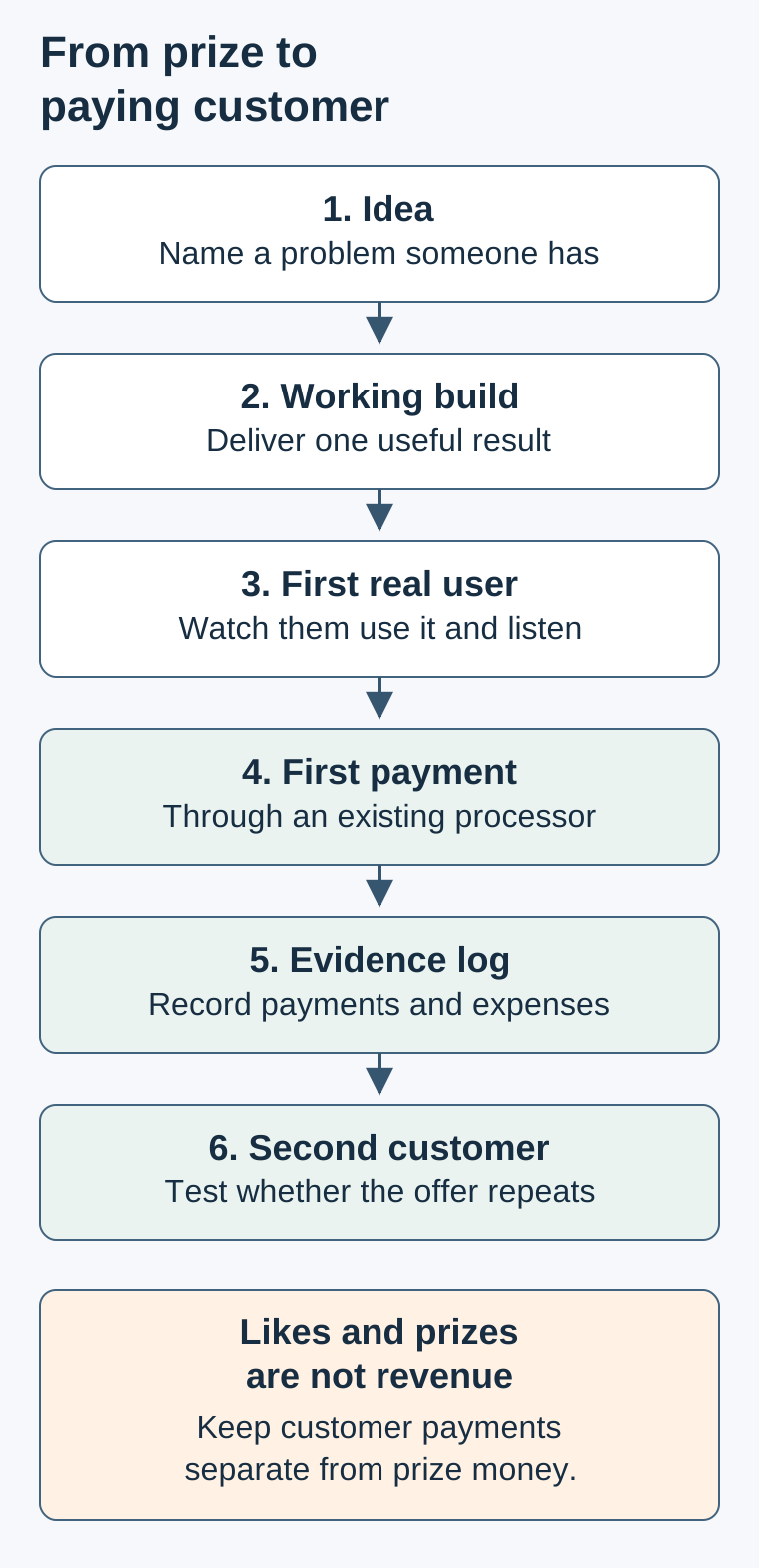
1. Idea: name a problem someone has
   ▼
2. Working build: deliver one useful result
   ▼
3. First real user: watch them use it and listen
   ▼
4. First payment → through an existing processor
   ▼
5. Evidence log: record payments and expenses
   ▼
6. Second customer: test whether the offer repeats

┌──────────────────────────────────────┐
│ Likes and prizes are not revenue.    │
│ Keep customer payments separate from │
│ prize money.                         │
└──────────────────────────────────────┘
Use Devpost this week, with a finish line for each step
1. Owner: choose a customer and a recurring problem. Start with a task you already understand: a report someone prepares repeatedly, a document staff must reconcile, or a service people struggle to buy. Write down who benefits, who uses it and who controls the budget. Done when a prospective payer can explain the value in their own words.
2. Owner and web person: scout by sponsor and theme. Browse Devpost's project gallery, then follow winners in the relevant sponsor's competition. Read the problem, commercial evidence and stated limitations before admiring the demo. The gallery's Staff picks, Popular and event-specific sections are different ways to discover projects. They do not rank financial performance. Gallery observation. Done when you have a shortlist with a named payer and an evidence tier for each project.
3. Developer, if needed: narrow the challenge list. On the hackathons page, use open or upcoming status and the Machine Learning/AI theme. The hackathons API, the structured data behind a software-readable listing, supported these filtered views in our browser review. That snapshot showed 43 open and 42 upcoming AI-themed events at 18:50:39 UTC on November 7. Counts and deadlines change; reopen each event's rules before planning work. Done when your shortlist records the official deadline, eligibility, required platform and prize conditions.
4. Owner: distinguish an existing entity from an existing business activity. XPRIZE allowed small organizations with fewer than 25 employees, including nonprofits. Its rules and FAQ nevertheless required a newly created AI-run business during the submission period. An existing entity could supply its audience and staff, with employee costs disclosed, but a new feature in an old product did not qualify. Existing-customer revenue had to be separated and was excluded from consideration. This competition has ended, so use it as a rules-reading example. Done when your proposed entry meets both eligibility and new-work requirements. Rules and FAQ.
5. Owner and developer: review rights before building. IP means intellectual property, including rights in code, images and writing. Check ownership, the license granted to the organizer, publicity permission, required source-code access, permitted existing work and any open-source obligation. A public repository is a visible code collection; visibility alone grants no reuse permission. Done when each material requirement has a cited rule and an owner. Devpost's rules guidance.
6. Owner: offer a bounded paid pilot. State the deliverable, test price, delivery date, support limits and refund conditions. A pilot is a small initial engagement to test the service. Set the amount for your own experiment. The customer approves the purchase; the assistant may prepare documents and proposed messages. Done when an independent customer has agreed to the scope and the approved payment route records the transaction.
7. Developer and owner: prove the handoff. Give the agent a narrow task and fixed limits. Keep commitments, payments, filings and sensitive publications behind the agreed human approval. Record errors and how you recover. Done when you can show an ordinary successful delivery and a failure that stopped or returned the customer's credit.
8. Owner: review the business weekly. Track independent paying customers, refunds, collected revenue, expenses and your own labor. Record marketing spending even when zero and keep related-party receipts separate. Ask whether a second customer wants the same outcome without a complete rebuild. For a nonprofit, measure mission benefit separately from income: a donor, service buyer and beneficiary are different roles. Done when the owner has reconciled the week's receipts and selected the next customer test.
Borrow ideas with a license check
Our companion Claude Code and Codex project guide covers reusable patterns and the checks before borrowing implementation. Here we studied business designs. We make no general reuse claim for the featured projects' code, assets or text. Ask your developer to read the actual license and record its permissions before reuse. If permission is absent, keep the inspiration at the problem-and-workflow level and ask the author before copying.
For distribution after you have a useful service, the connector listing guide covers documentation and review. A connector is a connection that lets an assistant use a service. Listing one does not establish paid demand. Decide how a qualified inquiry becomes an owner-approved purchase before treating a directory as a revenue channel.
Download the working kit
- Hackathon to first revenue kit (.md): a one-page launch plan, revenue evidence log, weekly metrics, rules checklist, project scouting worksheet and the featured evidence table.
For the owner working through the offer itself, The $97 Launch is related reading. Start the kit with the customer problem and the first paid deliverable you can stand behind.
Related reading
- MCP directories and the listing sequence
- Claude Code and Codex projects: what to borrow
- Connectors for nonprofits, events and WordPress
- Big brands, MCP and agentic commerce
- What getting an MCP connector listed takes
- A small business website launch plan
Fact-check notes and sources
The financial statements above are attributed to their teams. We have not audited them. Public product pages establish only the content and availability observed at the stated time. We made no purchases, submitted no forms, accessed no customer records and ran no third-party software. Recommendations and the worksheet are our own.
- Build with Gemini XPRIZE, rules and winner gallery: browser review November 7, 2026, 18:55:53 to 18:56:33 UTC. Supports competition requirements, criteria, prizes and the attributed project accounts. Private financial evidence was unavailable to us.
- Devpost gallery, all-time popular projects and hackathons API: gallery read November 7, 2026, 18:45:35 to 18:51:57 UTC; API read 18:50:39 UTC. This is a dated snapshot; it cannot establish a census of businesses or their income.
- ActinGym, Ability Bazaar, Spoken Letter and Enamel: browser recheck November 7 at 19:01:04 UTC. ActinGym's rendered page controls over a differing search extract. Ability Bazaar's service and training revenue is separated. Spoken Letter's campaign amount has no reconciled spend or attributable-return breakdown in the reviewed page.
- Browser recheck of project accounts, November 7 at 19:17:03 UTC: Ten Minutes Wiser, Spoken Letter, C2x, MergeGate, Polyfork, MyFixam, Class Diagrams for Bitbucket, MixPose and Smart Voicenotes. Supports their stated human approval boundaries and historical descriptions. We did not independently test those controls.
- Public product checks, November 7 at 18:59:52 UTC: ActinGym App Store, Spoken Letter, NoBanks documentation, Pantry Insight, TRAMA, LaunchBridge and Ability Bazaar. Repository availability establishes documentation, rather than an operating checkout.
- Further product checks: Polyfork and MyFixam app page, November 7 at 18:59:53 UTC; C2x and MergeGate at 19:00:26 UTC; Ten Minutes Wiser rendered at 19:01:01 UTC; Enamel demo rendered at 19:01:05 UTC; MyFixam terms on its homepage at 19:17:05 UTC. Thirteen featured competition projects checked: eleven substantive direct pages and two browser-rendered pages; all had a public page measured. This does not establish that all thirteen currently sell a product.
- Earlier business examples: MixPose and STEPN read November 7 at 19:00:07 UTC; Genopets game, its App Store listing and Decrypt's STEPN report at 19:01:22 UTC. Historical MixPose and Smart Voicenotes project accounts were read in the browser at 18:55:25 UTC. Lucidchart's integration address redirected to its general marketplace in the browser recheck at 19:03:50 UTC; EveryWord's disconnected-site placeholder was confirmed at 19:03:56 UTC. Neither establishes current operation of the historical product.
- SalesShortcut interview, November 7 at 19:16:41 UTC; current paid plans at 19:01:02 UTC. The interview's revenue claim is self-reported outside XPRIZE.
- Devpost's rules guidance, November 7 at 19:04:54 UTC. The XPRIZE FAQ was rechecked in the browser at 19:04:00 UTC, confirming the distinction between an existing entity and a new project, and the separate treatment of existing-customer revenue. Check the current official rules for any competition you enter.
This post is informational, not legal advice. Mentions of third parties are nominative fair use. No affiliation or endorsement is implied.
