
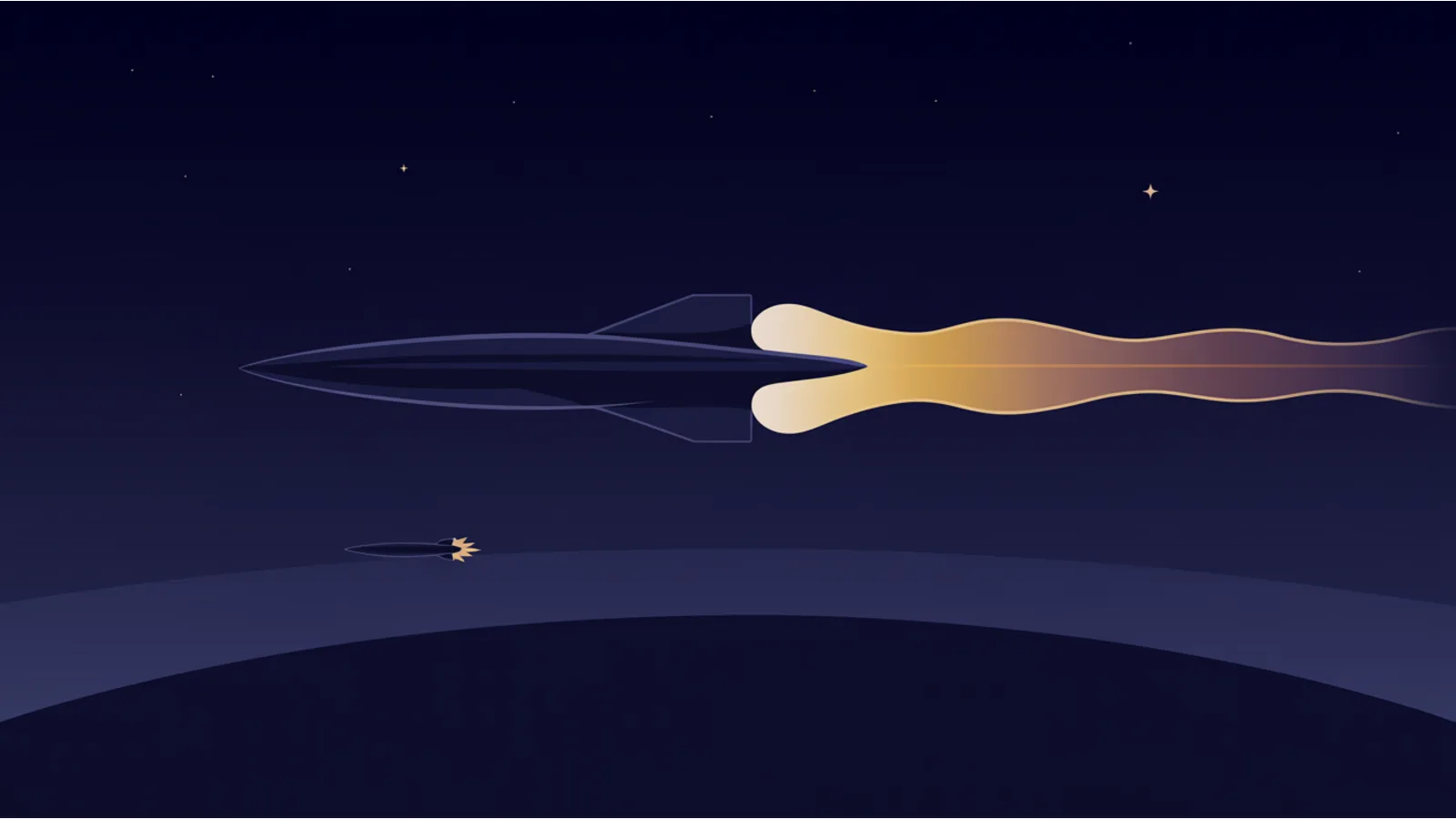
Twice, engineers strapped a wedge-shaped, unmanned glider to the top of a rocket, launched it from the California coast, and waited for it to arc across the Pacific at roughly twenty times the speed of sound. Twice, about nine minutes into a planned thirty-minute flight, the signal went dead. There was no third attempt. By DARPA's own accounting, the Falcon Hypersonic Technology Vehicle 2 program is complete, and neither of its two flights finished the run.
That record makes HTV-2 an easy target for a boondoggle headline. It is also the wrong headline. HTV-2 was a deliberate research bet on one of the hardest unsolved problems in aerospace: sustained, maneuvering, controlled flight through the atmosphere at Mach 20. The vehicle failed at that. It did not fail at producing knowledge. This is the honest way to read HTV-2, an informative failure whose data fed a research area that later became a top US defense priority, with the legitimate critiques being cost, the unsolved control problem, and the strategic-arms debate that surrounds hypersonic weapons in general.
What HTV-2 actually was
DARPA describes the Hypersonic Technology Vehicle 2 as "an unmanned, rocket-launched, maneuverable aircraft that glides through the Earth's atmosphere at incredibly fast speeds," at a design speed of "Mach 20 (approximately 13,000 miles per hour)." At that speed, DARPA notes, "flight time between New York City and Los Angeles would be less than 12 minutes."
Two points matter for reading this correctly.
First, Mach 20 was the target, the design speed the vehicle was built to reach and hold, not a demonstrated cruise that either flight completed.
Second, HTV-2 was a boost-glide vehicle, not a jet. A Minotaur IV Lite rocket lifted it, the glider separated, and from there it was unpowered, flying on its shape and its control surfaces alone. This is the single most important distinction to keep straight. HTV-2 is not the X-51 Waverider, which is a separate air-breathing scramjet program flying near Mach 5. The X-51 had a successful powered flight in May 2013. HTV-2 is the unpowered, rocket-boosted glider that flew twice and lost contact both times. Because HTV-2 had no engine in its glide phase, its failures were problems of aerodynamics and heat, not "engine failure" or "propulsion loss."
HTV-2 was part of DARPA's Falcon program, short for Force Application and Launch from Continental US, a joint DARPA and Air Force effort. The vehicle itself was a pathfinder, not a fielded weapon. DARPA states that "data from the program informs policy, acquisition, and operations decisions for future Department of Defense Conventional Prompt Global Strike programs." In other words, HTV-2 was research meant to feed a future capability, not a system anyone was going to deploy.
DARPA framed the goal as advancing "long-duration hypersonic flight" and identified three critical technical challenges the program had to attack:
- Aerodynamics
- Aerothermal effects, meaning the heating a body experiences at these speeds
- Guidance, navigation, and control
Each of those is hard on its own. Doing all three at once, on a maneuvering vehicle, at Mach 20, inside the atmosphere, is close to the frontier of what aerospace engineering can attempt.
Flight 1: April 22, 2010
The first HTV-2 launched on April 22, 2010, from Vandenberg Air Force Base atop a Minotaur IV Lite. The plan was a roughly 4,800-mile Pacific run toward the Kwajalein Atoll at Mach 20. That run was never completed. Controllers lost contact about nine minutes into a planned thirty-minute mission, and the vehicle's autopilot commanded flight termination after the glider began rolling uncontrollably.
By any normal standard, that is a failed flight. But the vehicle was not silent before it was lost, and this is where the informative-failure framing starts to earn its keep. DARPA credits the first flight with returning "nine minutes of unique flight data, including 139 seconds of Mach 22 to Mach 17 aerodynamic data," while the vehicle "maintained GPS signals while traveling 3.6 miles per second." Holding a GPS lock and two-way communication with a body moving at 3.6 miles per second is itself a demonstrated capability. So is capturing more than two minutes of aerodynamic measurements across the Mach 22-to-17 band, a regime where real flight data barely exists.
The vehicle failed. The instruments worked, and they recorded something no wind tunnel can fully reproduce.
Flight 2: August 11, 2011
The second HTV-2 launched on August 11, 2011. This time the flight got further into the hard part. The glider separated cleanly, entered its glide, and held stable, aerodynamically controlled flight at Mach 20 for roughly three minutes before an anomaly took over. Then, as with the first flight, contact was lost about nine minutes into a planned flight of roughly thirty minutes, and the vehicle was ditched into the Pacific by its onboard safety system.
That three minutes of stable Mach 20 glide is a genuine result, and it should be read as exactly what it is: partial controlled flight before the failure, not a completed or successful mission. The flight ended the same way the first one did, without finishing the run.
DARPA convened an Engineering Review Board and spent about seven months analyzing what went wrong. As reported by Air Force Technology, the board found that "the most probable cause" of the flight-2 termination "was unexpected aeroshell degradation, creating multiple upsets of increasing severity that ultimately activated the Flight Safety System." In plain terms, larger portions of the vehicle's skin than expected peeled away at roughly 13,000 miles per hour, and the resulting abrupt rolling motions eventually crossed the threshold that told the safety system to end the flight.
Two officials' comments from that review are worth quoting directly, because they capture both the severity of the environment and the actual engineering payoff.
Acting DARPA Director Kaigham Gabriel said the disturbances the vehicle survived before the final upset "exceeded by more than 100 times what the vehicle was designed to withstand." Program manager Chris Schulz described the top result differently: "The greatest achievement from Flight Two, independent of any technical data collected, was that we successfully incorporated aerodynamic knowledge gained from the first flight into the second flight." A vehicle that recovers from disturbances a hundred times past its design tolerance, and a program that visibly folded flight-1 lessons into flight-2 hardware, is a program that was learning fast, even as it kept losing the vehicle.
The board did more than assign a cause. Air Force Technology reported that the findings "validated the vehicle's aerodynamic design and uncovered new information regarding the thermal material properties" specific to Mach 20 flight inside the atmosphere. That new material data reduces the guesswork in the computational models used to design future hypersonic vehicles. For a sense of the environment those materials had to survive, press coverage of DARPA's statements put the glider's surface temperature near 1,930 degrees Celsius, roughly 3,500 degrees Fahrenheit, a figure that is widely cited but best treated as approximate.
No third flight
There was no third HTV-2 flight. DARPA's program page simply states, "This program is now complete." Only two vehicles ever flew, and both failed to finish their glides. Reporting on DARPA's reasoning indicates the agency judged that substantial data had already been collected from the first two flights and that a third was not likely to add enough value to justify its cost. That is a defensible way to close a research program, but it also means the honest ledger has to record what HTV-2 did not do: it never demonstrated a complete, controlled Mach 20 glide.
The ROI case and the honest caveats
Because this is a "where the public money goes" series, the point is to hold both sides of the ledger up at once rather than pick a verdict.
The return-on-a-research-bet case:
- HTV-2 attacked a genuine frontier problem. Sustained maneuvering flight at Mach 20 inside the atmosphere, with roughly 3,500-degree-Fahrenheit surface heating, is one of the hardest problems in aerospace, and it was largely unsolved when the program began.
- Both flights returned real, rare data. The first produced 139 seconds of Mach 22-to-17 aerodynamic measurements and proved GPS and communications at 3.6 miles per second. The second held roughly three minutes of stable Mach 20 glide and, through the Engineering Review Board, validated the aerodynamic design and produced new thermal-material property data.
- The knowledge fed forward. DARPA states the program's data informs Department of Defense Conventional Prompt Global Strike work, and hypersonics later became a top US national-defense priority, an area for which HTV-2 was an early pathfinder.
The honest caveats:
- The vehicle failed at its central task. It never completed the Mach 20 glide, losing contact about nine minutes into each planned thirty-minute flight, and both vehicles were destroyed or ditched into the Pacific.
- The core control-and-materials problem was not solved on HTV-2's watch. The aeroshell degradation that ended flight 2 was, in DARPA's own words, unexpected, and the program ended without a fix demonstrated in flight.
- The cost is not established here. No confirmed total program-cost dollar figure appears in the primary sources gathered for this piece, so this post asserts none. Falcon-program aggregate numbers that circulate online are not HTV-2-specific and are not primary-sourced.
- The mission carries a policy debate. Conventional Prompt Global Strike, the family of programs HTV-2 fed, is the subject of an ongoing strategic-arms discussion about whether fast, long-range conventional strike weapons are stabilizing or destabilizing. That debate is separate from HTV-2's engineering results but is part of the honest context.
And one credit-sharing caveat that matters for the whole series: HTV-2 should not be described as the sole author of US hypersonic weapons. It was one early pathfinder feeding a broad, multi-service effort across the Army, Navy, and Air Force, with contributions from many labs, contractors, and researchers. The right claim is narrow and defensible. HTV-2 helped chart the territory. It did not conquer it alone, and it did not conquer it at all in flight.
Fact-check notes and sources
- HTV-2 was an unmanned, rocket-launched, maneuverable glider designed to cruise at Mach 20, about 13,000 mph, with a New-York-to-Los-Angeles flight time under 12 minutes. Mach 20 was the design target, not a completed cruise: DARPA, Falcon HTV-2 program page.
- HTV-2 was part of DARPA's Falcon program (a DARPA and Air Force joint effort), and its data "informs policy, acquisition, and operations decisions for future Department of Defense Conventional Prompt Global Strike programs." It was a pathfinder, not a fielded weapon: DARPA, Falcon HTV-2 program page.
- The program identified three critical technical challenges: aerodynamics, aerothermal effects, and guidance, navigation, and control: DARPA, Falcon HTV-2 program page.
- First flight launched April 22, 2010, from Vandenberg AFB on a Minotaur IV Lite; contact was lost about nine minutes into a planned 30-minute mission after uncontrolled rolling; the target was a roughly 4,800-mile run toward Kwajalein: Wikipedia, Hypersonic Technology Vehicle 2 (corroborating DARPA).
- First flight returned nine minutes of data including 139 seconds of Mach 22-to-17 aerodynamic data, with GPS maintained at 3.6 miles per second: DARPA, Falcon HTV-2 program page.
- Second flight launched August 11, 2011; the glider separated, entered glide, held roughly three minutes of stable Mach 20 flight, then lost contact about nine minutes in and was ditched into the Pacific: Wikipedia, Hypersonic Technology Vehicle 2; SpaceNews, DARPA Engineering Review Board coverage (SpaceNews URL returned a rate-limit error on direct fetch but is a valid corroborating source for the DARPA ERB findings).
- The DARPA Engineering Review Board's roughly seven-month analysis found the most probable cause of the flight-2 termination was "unexpected aeroshell degradation, creating multiple upsets of increasing severity that ultimately activated the Flight Safety System": Air Force Technology, reporting the DARPA ERB.
- The vehicle survived disturbances "more than 100 times what the vehicle was designed to withstand" (Acting Director Kaigham Gabriel), and the program's top cited achievement was incorporating flight-1 aerodynamic knowledge into flight 2 (program manager Chris Schulz): Air Force Technology, reporting the DARPA ERB.
- The ERB findings validated the vehicle's aerodynamic design and produced new thermal-material property data for Mach 20 flight, feeding modeling and later hypersonics work: Air Force Technology, reporting the DARPA ERB.
- No third HTV-2 flight was conducted; DARPA lists the program as complete: DARPA, Falcon HTV-2 program page.
- Second-flight surface temperatures reached roughly 1,930 degrees Celsius (3,500 degrees Fahrenheit); treat as approximate: Wikipedia, Hypersonic Technology Vehicle 2.
- Plain-language account of the second-flight loss and the aeroshell peeling at hypersonic speed: Space.com, DARPA hypersonic glider demise explained.
- No confirmed total program-cost dollar figure appears in these primary sources, so this post asserts none.
Related reading
- X-51 Waverider: the scramjet that worked: the air-breathing hypersonic program that is HTV-2's frequent point of confusion, and a success where HTV-2 was not.
- The Airborne Laser (YAL-1): another high-risk defense research bet, and how to read its ledger honestly.
- DARPA and AFRL: the portfolio of hits and misses: where HTV-2 sits among the wins and failures of government research.
- The public-money programs index: the full series on where public research and program money goes.
This post is informational and journalistic, not legal or financial advice. It describes public programs and documented events; mentions of third parties are nominative fair use and no affiliation is implied.
