
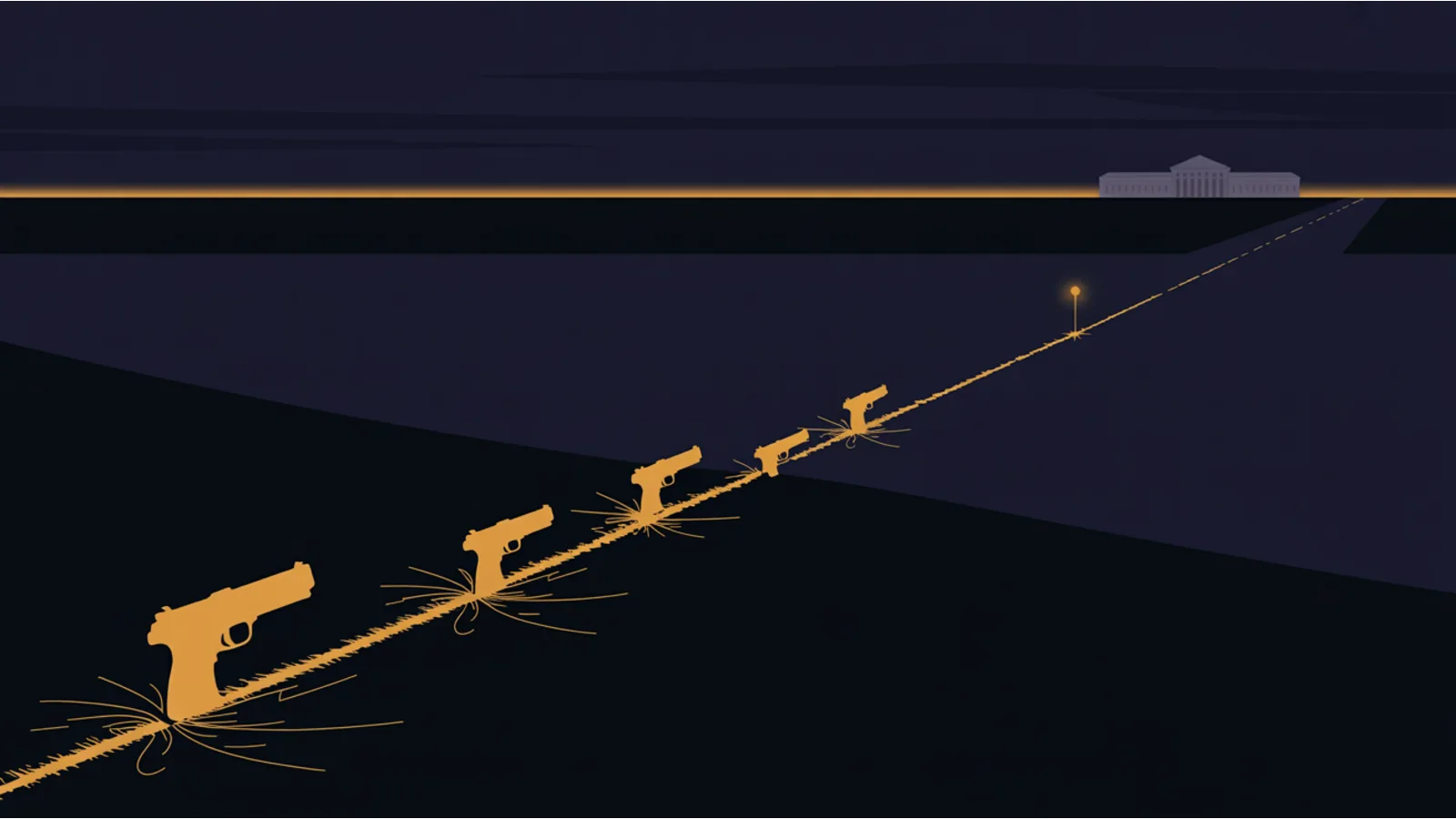
A federal law-enforcement agency decided to let guns go on purpose. Between 2009 and 2011, agents in Phoenix watched licensed dealers sell firearms to buyers they suspected were fronts for Mexican cartels, and instead of arresting the buyers on the spot, they let the weapons leave the store. The theory was that the guns would lead investigators up the chain to the trafficking organizers who mattered. Roughly 2,000 firearms moved this way. The agency recovered only a fraction. Hundreds later surfaced at crime scenes in the United States and Mexico, and two of them were found in the desert where a U.S. Border Patrol agent had just been killed.
This is Operation Fast and Furious told as a public-money and oversight question: what the operation was, what its own agency's Inspector General found, what the record does and does not establish about the harm, and how to weigh a serious mission against a serious failure in carrying it out. The strongest source here is not a partisan account. It is the Justice Department's own internal watchdog.
What it was, and which agency ran it
Operation Fast and Furious was run by the Bureau of Alcohol, Tobacco, Firearms and Explosives, known as ATF. ATF is an agency inside the Department of Justice. This precision matters, because the operation is frequently and wrongly attributed to the FBI or the DEA. It was ATF, and specifically ATF's Phoenix Field Division, operating under a broader anti-trafficking program called Project Gunrunner.
The tactic at the center of the case is "gun walking." The phrase is easy to misread. It does not mean that ATF sold guns to criminals. It means that when agents identified suspected straw purchasers, people buying guns on behalf of someone legally barred from buying them, the agents chose not to interdict the weapons immediately. They let the guns "walk" out into the illegal market, hoping to follow them to the cartel figures who directed and financed the trafficking. The aspiration was to build a large conspiracy case against organizers rather than settle for arresting interchangeable low-level buyers.
Fast and Furious was also not a wholly unprecedented one-off invention. It sat under the existing Project Gunrunner umbrella and was preceded by an earlier, similar operation, Wide Receiver, run under the prior administration. The gun-walking idea had a lineage. What made Fast and Furious notorious was its scale and the fact that it lost control of the weapons.
The numbers, kept distinct
Three figures get thrown around here and they are not the same figure. The Justice Department Inspector General's later review, together with congressional findings, separates them, and keeping them apart is the difference between an accurate account and a sloppy one.
- The ATF subjects under investigation purchased about 1,961 firearms over roughly late 2009 into 2010.
- Of the guns tied to the operation, ATF Phoenix interdicted only about 105, while at least about 1,856 were allowed to walk.
- "Approximately 2,000" is the accepted rounded shorthand for the overall scale, and it should be treated as approximate rather than as a fourth, separate count.
So the honest phrasing is that agents let something on the order of 2,000 firearms flow into the illegal market and recovered only a small share of them at the time.
Recovery figures rose over time and are point-in-time snapshots, so they carry dates. As of October 20, 2011, according to congressional and press records, 389 Fast and Furious firearms had been recovered in the United States and 276 in Mexico, with the rest unaccounted for. By February 2012, total recoveries had reached roughly 710. Those are dated tallies, not final totals, and a later, higher number would not contradict them.
The harm, stated carefully
On December 14, 2010, U.S. Border Patrol Agent Brian Terry was killed in Peck Canyon, near Nogales, Arizona, during a confrontation with an armed group. Two AK-pattern rifles found at the scene were traced back to a Fast and Furious straw purchaser. Terry's death is what brought the operation into the open, because it prompted ATF agents inside the operation to come forward.
Here the record has to be stated with discipline, because it is easy to overstate. That two Fast and Furious guns were recovered at the scene is established. Whether one of those specific rifles fired the fatal shot is not established. The bullet recovered from the scene was too badly damaged to be conclusively matched to either weapon. Manuel Osorio-Arellanes, who was part of the group and later pleaded to charges in the case, stipulated that the fatal shot was fired by a member of his group, but that plea did not identify which weapon fired it. Taken together, the record supports a precise statement and no more than that statement: two operation-linked firearms were present where a federal agent was murdered, and no gun was ever conclusively tied to the shot that killed him. Agent Terry's death is the human center of this story, and it deserves that care.
The oversight: what the Inspector General found
The authoritative account of what went wrong is not a campaign document or a cable-news segment. It is Report 12-09, "A Review of ATF's Operation Fast and Furious and Related Matters," released by the Justice Department Office of the Inspector General on September 19, 2012. Secondary sources describe it as running roughly 471 pages. The report is exhaustive, and its conclusions are blunt.
The OIG found a series of misguided strategies, tactics, errors in judgment, and management failures that it described as permeating multiple layers of the government: ATF Headquarters, the ATF Phoenix Field Division, the U.S. Attorney's Office for the District of Arizona, and Justice Department Headquarters. In the OIG's own framing, the operation was a risky strategy that failed to adequately weigh the danger to public safety it created. That is the core institutional finding, and it comes from inside the Justice Department itself.
The report also had consequences for individuals. The OIG referred 14 Justice Department and ATF employees and officials for potential disciplinary and administrative action. The referrals ranged from ATF agents up to federal prosecutors and reached senior levels, including officials in the Justice Department's Criminal Division.
One finding in the report matters specifically for keeping the account fair. The OIG found no evidence that Attorney General Eric Holder knew of the gun-walking tactics before early 2011, and no evidence that he attempted to cover up the operation once he learned of it. That is the Inspector General's own conclusion, and it belongs in any honest summary alongside the failures.
The timeline
- 2009 to 2011. ATF Phoenix runs Operation Fast and Furious under Project Gunrunner, allowing roughly 2,000 firearms to walk.
- December 14, 2010. Border Patrol Agent Brian Terry is killed near Nogales, Arizona; two Fast and Furious rifles are recovered at the scene.
- Early 2011. ATF whistleblowers, notably Special Agent John Dodson, come forward after Terry's death, prompting congressional inquiries.
- February 28, 2011. Attorney General Holder requests that the Inspector General review the operation.
- June 28, 2012. The House of Representatives votes to hold Holder in contempt of Congress over withheld documents.
- September 19, 2012. The OIG releases Report 12-09 documenting the failures and referring 14 employees for possible discipline.
The contempt fight, and why it is a separate matter
On June 28, 2012, the House voted to hold Attorney General Holder in criminal contempt of Congress, 255 to 67, with 17 Democrats joining. A civil-contempt measure passed the same day, 258 to 95. It was the first time a sitting U.S. Attorney General had been held in contempt of Congress. The vote is historically significant, and it is also frequently misunderstood.
The contempt citation was not a finding about the operation. It grew out of a document-production dispute. Congressional investigators had subpoenaed Justice Department records, the administration asserted executive privilege over a set of them, and the department declined to produce those documents. That fight largely concerned internal deliberations that occurred after the operation had already become public. In other words, the contempt vote was about what the department turned over to Congress, not a judgment that any particular official was guilty of directing the gun-walking. Conflating the two, treating the contempt citation as proof of operational guilt, misreads the record. The two are separate, and the OIG's finding that Holder did not know the tactics before early 2011 sits alongside the contempt vote rather than being erased by it.
The failure and the mission, side by side
Both of the following are true, and the honest way to close is to let them stand together.
The failure critique. A law-enforcement operation that deliberately let roughly 2,000 firearms flow to suspected straw buyers, and then lost track of most of them, is a case study in public-safety and oversight failure. This is not a partisan characterization; it is close to the Inspector General's own language. The OIG documented misguided tactics, errors in judgment, and management failures across four layers of the government, from the Phoenix Field Division up to Justice Department Headquarters, and it referred 14 employees for possible discipline. The tactic put weapons into the illegal market with no reliable means of recovering or tracking them. Hundreds turned up at crime scenes, and two were found where Agent Brian Terry was killed. The operation, in the OIG's framing, did not adequately weigh the danger to public safety it created. And the subsequent fight over withheld documents added a transparency and accountability failure on top of the operational one, whatever one concludes about the executive-privilege claim itself.
The mission defense. The underlying objective was legitimate and serious. Mexican drug cartels are armed in significant part by firearms purchased in the United States and trafficked south, and disrupting that flow is a real public good. ATF's Project Gunrunner was aimed at exactly that documented problem. The specific ambition of Fast and Furious, to move up the chain from replaceable street-level straw buyers to the cartel organizers who fund and direct the trafficking, reflects a recognized instinct in complex organized-crime investigations: a conspiracy case against the people at the top is harder to build and more valuable than another interchangeable low-level arrest. The failure was in execution, surveillance, and interagency control, not in the aspiration to cut off cartel gun supply. And the debacle produced something lasting. It drove reforms to ATF's practices and oversight, and "gun walking" became a cautionary standard, a tactic that later investigations are measured against and warned away from.
Neither verdict cancels the other. The goal was defensible and the execution was not, and a federal agent is dead, and the government's own watchdog said so in 471 pages. That is the record.
Fact-check notes and sources
- Operation Fast and Furious was a 2009 to 2011 ATF (a Justice Department agency) gun-walking operation run out of the Phoenix Field Division under Project Gunrunner; agents let suspected straw purchasers buy firearms intending to trace them to cartel leaders: DOJ Office of the Inspector General, Report 12-09.
- Scale of firearms: subjects purchased about 1,961 firearms; ATF Phoenix interdicted only about 105 while at least about 1,856 were allowed to walk; "approximately 2,000" is the accepted round figure: DOJ OIG Report 12-09 and ATF gunwalking scandal overview citing the OIG report.
- Recoveries as dated snapshots: 389 in the United States and 276 in Mexico as of October 20, 2011, rising to roughly 710 total by February 2012: ATF gunwalking scandal, congressional and press records.
- Border Patrol Agent Brian Terry was killed December 14, 2010 near Nogales, Arizona; two Fast and Furious rifles were found at the scene; no gun was conclusively tied to the fatal shot because the recovered bullet was too damaged to match: CBS News on the Terry killing and its link to Fast and Furious.
- DOJ OIG Report 12-09, "A Review of ATF's Operation Fast and Furious and Related Matters," released September 19, 2012 (about 471 pages), documented management and judgment failures across ATF HQ, the Phoenix Field Division, the U.S. Attorney's Office for Arizona, and DOJ HQ, and called the operation a risky strategy that failed to adequately weigh danger to public safety: DOJ OIG Report 12-09.
- The OIG referred 14 Justice Department and ATF employees and officials for potential discipline, reaching senior levels including the Criminal Division: DOJ OIG Report 12-09 and ATF gunwalking scandal overview.
- The OIG found no evidence that Attorney General Eric Holder knew of the gun-walking tactics before early 2011 or attempted a cover-up: DOJ OIG Report 12-09.
- The House voted June 28, 2012 to hold Holder in criminal contempt 255 to 67 (17 Democrats voting yes) and in civil contempt 258 to 95, the first sitting Attorney General held in contempt; the dispute was over subpoenaed documents withheld under a claim of executive privilege, separate from the operation itself: ABC News on the House contempt vote and The Washington Post on the executive-privilege assertion.
- The operation was exposed by whistleblowers, notably Special Agent John Dodson, after Terry's death, and Attorney General Holder requested the OIG review on February 28, 2011: DOJ OIG follow-up page and ATF gunwalking scandal overview.
- Congressional investigation record and ATF agent accounts of gun walking: U.S. House Committee on Oversight.
Note on sources: the Justice Department Inspector General's Report 12-09 is the primary anchor for this account. Secondary outlets are used as aggregators of figures that trace back to that report and to congressional findings, and dated recovery counts are labeled with their as-of dates so a later figure does not read as a contradiction.
Related reading
- DEA cash seizures and civil forfeiture, another Justice Department enforcement practice tested against its own oversight record.
- The FBI's Virtual Case File and Sentinel, a Justice Department systems failure documented by the same watchdog machinery.
- The GAO high-risk list and improper payments, the oversight lens that runs through this series.
- The full public-money programs index.
This post is informational and journalistic, not legal, financial, or investment advice. It describes public programs, documented events, and public records; mentions of third parties are nominative fair use and no affiliation is implied.
