
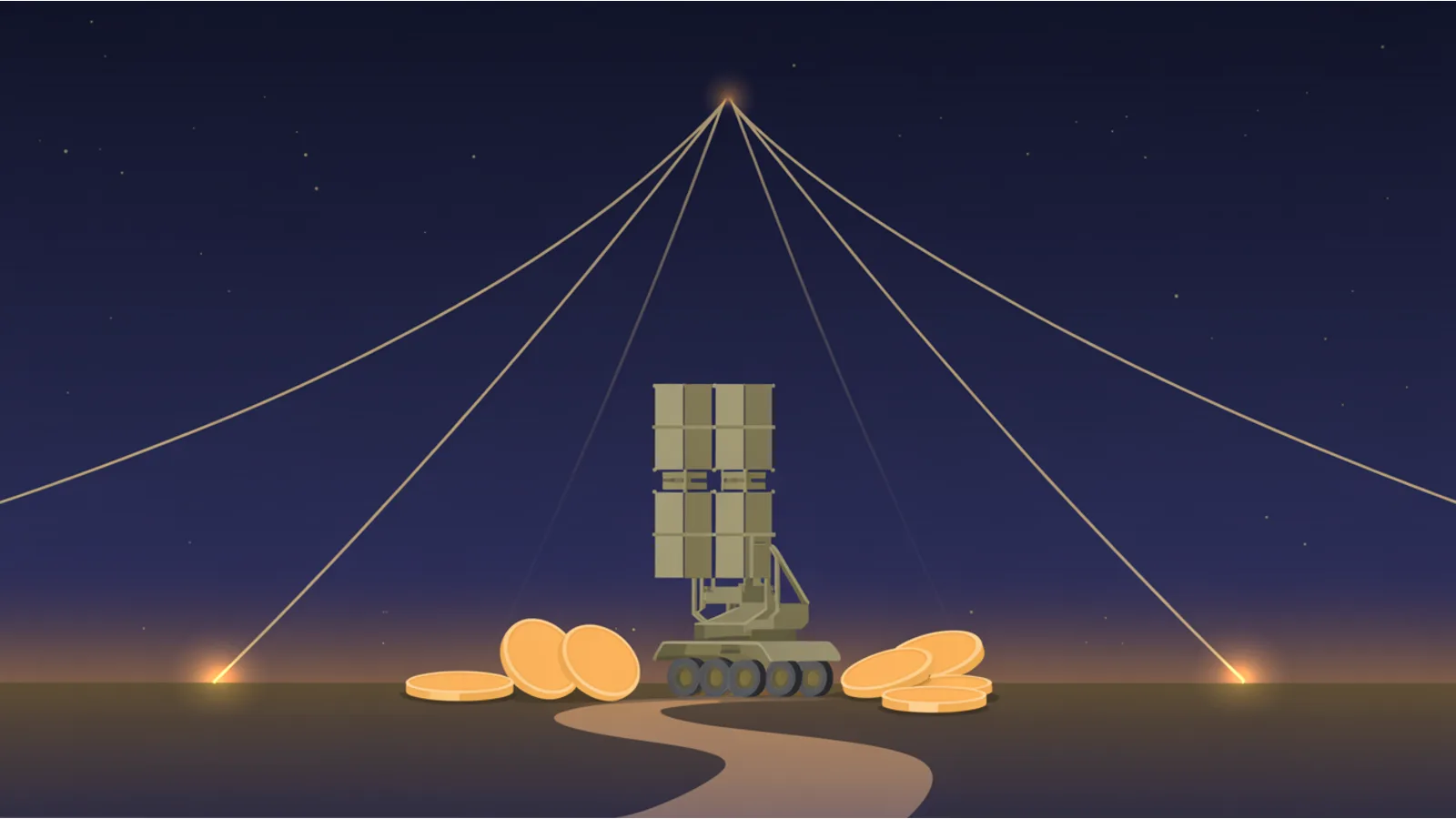
In February 2011 the Pentagon looked at a Patriot-replacement air-defense system it had spent years co-developing with two NATO allies, concluded it would cost too much and arrive too late, and formally decided the United States would not buy it. Then it kept paying. Over the next two years the Department of Defense spent roughly 804 million dollars more to finish developing a system it had already decided never to field, a decision a bipartisan group of senators would attack as spending on "a weapons system such as MEADS that our warfighters will never use."
That is the whole story in miniature, and it is worth being precise about what kind of story it is. MEADS is not a tale of a weapon that did not work. The system passed its intercept tests. It is instead a procurement story about a much narrower question: once you have decided not to field something, do you exit, or do you pay to complete it? The US chose to complete it. This post walks through what MEADS was, what it cost, and how the record reads when you set the honest critique and the honest defense side by side.
What MEADS was
MEADS stands for the Medium Extended Air Defense System. It was a tri-national development program shared by the United States, Germany, and Italy, intended to build a mobile, 360-degree, networked air-and-missile-defense system to replace the Patriot. The industry team was MEADS International, a joint venture of Lockheed Martin and MBDA (through MBDA Deutschland and MBDA Italia). It is worth stating plainly, because the confusion is common: this was not a Raytheon program. Raytheon built the Patriot that MEADS was meant to replace.
The program descended from an earlier US Corps SAM effort, was renamed MEADS, and was made multinational in the mid-1990s, according to the CSIS Missile Threat project. Its selling points targeted real gaps in Patriot:
- 360-degree coverage. Patriot defends a limited sector; MEADS was designed to see and shoot in a full circle.
- Mobility and air-transportability. MEADS was built to move and to deploy by air.
- An open, netted "plug-and-fight" architecture. Sensors and shooters could be mixed and networked rather than locked into a single closed system.
Those are not frivolous goals. They describe, fairly closely, what modern integrated air-and-missile defense is expected to do. That matters for the defense side of the ledger later.
The money, kept distinct
The single most important discipline in reading MEADS is keeping three different dollar figures apart, because press shorthand routinely blends them.
The development contract. In September 2004, MEADS International received a nine-year design and development contract valued at about 3.4 billion dollars, according to CSIS. That figure covers all three nations, not the US alone. It is the hardest, best-sourced number in the program and the one to anchor to.
The cost-share. The design and development program was split 58 percent United States, 25 percent Germany, 17 percent Italy. That split appears verbatim across CSIS and trade press and is repeated in the DAU case study and elsewhere. The US was the majority partner.
The "US spent about 4 billion dollars" headline. This figure floats through press coverage and is order-of-magnitude sound as a total-program magnitude in 2004 dollars, but it should be handled carefully. The specific "4 billion dollar 2005 memorandum of understanding" framing traces most strongly to the Lexington Institute, a pro-program advocacy source. The 4 billion number conflates total-program spending with the US-only share; it is a reasonable order-of-magnitude for the whole tri-national commitment, of which the US funded roughly 58 percent, not a precise US-only obligation. Where a hard number is needed, the 3.4 billion dollar development contract is the defensible anchor.
Keep those three apart and the rest of the story stays honest.
The timeline
- Mid-1990s: The earlier US Corps SAM concept is renamed MEADS and reorganized as a tri-national US, Germany, Italy program.
- September 2004: MEADS International signs the nine-year, roughly 3.4 billion dollar design and development contract (definitized in 2005).
- February 14, 2011: The Department of Defense announces it will complete design and development but will not procure MEADS, citing cost and schedule. Funding is set to end after fiscal 2013.
- March 2011: The Congressional Budget Office recommends terminating MEADS in favor of continued Patriot production. GAO's annual weapons assessment that spring also flags MEADS technical-performance risk.
- 2011 to 2013: MEADS conducts intercept and characterization tests, including successful engagements against multiple simultaneous targets and an "over-the-shoulder" rear-attack intercept.
- March 21, 2012: Eight senators, four Democrats and four Republicans, sign a letter opposing the roughly 400 million dollar fiscal 2013 request. The House Defense Appropriations Subcommittee strips MEADS funding from its version of the bill.
- March 2013: Congress provides about 381 million dollars through a continuing resolution to complete development.
- Roughly 2014: The development contract is completed. The US never procures or fields an operational MEADS.
- June 9, 2015: Germany selects a MEADS-derived system, TLVS, as a separate national program.
- December 2020: Germany freezes TLVS, leaving only a token budget line, and moves to upgrade its Patriots instead.
The decision that made it an oversight story
The February 14, 2011 announcement is the pivot. In DoD's own framing, the department "intended to fulfill its commitment to complete the design and development effort, but that it would not procure the MEADS system for budgetary reasons." In plain terms: too expensive, too late, will not buy it, but will finish paying to develop it.
The finishing cost is where the numbers must stay sharp. SpaceNews reports the continued development ran through 2013 "at a cost of 804 million dollars." That is the two-year proof-of-concept phase. The fiscal 2013 budget request within it was about 400.9 million dollars. Congress ultimately provided about 381 million dollars in March 2013, via continuing resolution, to complete development, according to CSIS. "Requested" (roughly 400.9 million) and "appropriated to finish" (roughly 381 million) are different figures, and conflating them is easy to do.
The critique wrote itself, and it came from both parties. In their March 2012 letter, the eight senators wrote that "we cannot afford to spend a single additional dollar on a weapons system such as MEADS that our warfighters will never use." Senator John McCain led the opposition and returned to the subject repeatedly in floor speeches across 2012 and 2013; the letter tied to the fiscal 2013 request is the specific March 2012 document, and it is worth not collapsing his floor speeches and that letter into a single dated event. Army Secretary John McHugh is reported to have questioned whether the proof-of-concept phase was convincingly viable, though that particular characterization is less firmly sourced than the rest and is best attributed loosely. And the CBO, in March 2011, had already recommended simply terminating MEADS and continuing to build Patriots.
The result, stated without adjectives: billions committed across the tri-national program, hardware that demonstrably worked in tests, and zero fielded US capability.
The afterlife, and why it is not vindication
MEADS did not vanish entirely. On June 9, 2015, Germany selected TLVS (Taktisches Luftverteidigungssystem), a system built on MEADS technology, as its future air-defense program. For a few years this looked like a second life for the design.
It did not last. By December 2020, reporting from Defense News describes the German purchase frozen, with only a token line of about 2 million euros left in the budget, as Germany moved instead to sustain and upgrade its Patriots. Reported TLVS procurement estimates had run around 4.5 billion dollars, with industry reportedly seeking far more.
Two cautions matter here. First, TLVS was a separate German program, not a US fielding, so it cannot be read as evidence that MEADS was eventually deployed by anyone in operational form. Second, the more accurate description of TLVS's end is not a single clean 2020 cancellation but a freeze and defunding, superseded by a Patriot upgrade. The irony is real either way: the system's most concrete afterlife was itself set aside in favor of the very Patriot it was designed to replace.
The broader claim, that MEADS technology and its open plug-and-fight architecture carried forward into successor systems, is also real but should be attributed rather than stated flat. It is asserted most strongly by Lockheed Martin and MBDA, the industry team, which has a clear interest in salvaging the investment. Treat it as an industry and allied claim, not an independent oversight finding.
The honest critique and the honest defense
The critique. This is the "design and walk away" problem in its clearest form. The US committed as majority partner to a roughly 3.4 billion dollar tri-national development contract to build a Patriot replacement, then in February 2011 concluded the system would cost too much and arrive too late and decided not to procure it. Rather than exit, DoD spent several hundred million dollars more, an 804 million dollar two-year proof-of-concept phase, roughly 381 million of it appropriated in March 2013, to finish a system it had already decided never to buy. A bipartisan bloc of senators, Senator McCain, and the CBO all urged against it. What the money bought was demonstrated hardware and no fielded American capability. The oversight lens, the kind of scrutiny GAO applies to major weapons programs, asks exactly this: when a program's own sponsor concludes it will not use the product, what justifies finishing it?
The defense. The mission and the method were legitimate. MEADS aimed at capability gaps Patriot genuinely struggled with: 360-degree coverage, mobility, and an open networked architecture. Those are precisely the attributes modern integrated air-and-missile defense demands, not speculative features. It was also a real cooperative-development model with two close NATO allies sharing cost and risk, Germany at 25 percent and Italy at 17 percent, and Germany publicly opposed the US shutdown, which the Nuclear Threat Initiative documented. Completing the proof-of-concept phase honored a treaty-level commitment to those partners, preserved allied access to the technology, and produced demonstrated intercept results, including the multiple-target and rear-attack tests. Walking away mid-development would have carried its own diplomatic and sunk-cost consequences.
Both of those can be true at once, and the record supports leaving them side by side. The strongest fact in MEADS's favor is that it was not a failure of engineering: the system did what it was built to demonstrate. The strongest fact against it is that the country building it decided, before the tests were even finished, that it would never put the result in the field, and paid to the end regardless.
Fact-check notes and sources
- MEADS was a tri-national US, Germany, Italy program to build a mobile, 360-degree, netted Patriot replacement; the industry team was MEADS International (Lockheed Martin plus MBDA Deutschland and MBDA Italia), not Raytheon. CSIS Missile Threat.
- The design and development cost-share was 58 percent US, 25 percent Germany, 17 percent Italy. CSIS Missile Threat; Wikipedia, Medium Extended Air Defense System.
- A nine-year development contract valued at about 3.4 billion dollars (all three nations) was signed in September 2004. This is the hard anchor figure; keep it distinct from the looser roughly 4 billion dollar total-program magnitude. CSIS Missile Threat.
- The roughly 4 billion dollar "total program" figure is order-of-magnitude sound but is asserted most firmly by a pro-program advocacy source and conflates total-program with US-only spending; treat it as approximate. Lexington Institute.
- On February 14, 2011, DoD announced it would complete design and development but not procure MEADS for budgetary reasons, with funding ending after fiscal 2013. SpaceNews; Wikipedia.
- The continued development ("proof of concept") ran through 2013 at a cost of 804 million dollars. SpaceNews.
- The fiscal 2013 request was about 400.9 million dollars; Congress provided about 381 million dollars in March 2013 through a continuing resolution to complete development. "Requested" and "appropriated to finish" are different figures. CSIS Missile Threat.
- Eight senators (four Democrats, four Republicans) signed a March 21, 2012 letter opposing the roughly 400 million dollar fiscal 2013 request; Senator John McCain led the opposition; Army Secretary John McHugh is reported to have questioned the proof-of-concept's viability (attribute the McHugh characterization loosely). SpaceNews.
- The CBO recommended terminating MEADS in favor of continued Patriot production in March 2011. SpaceNews.
- MEADS conducted successful intercept tests in 2011 to 2013, including engagements against multiple simultaneous targets and an over-the-shoulder rear-attack intercept; the US never fielded an operational system, and the development contract completed around 2014. CSIS Missile Threat.
- Germany selected the MEADS-derived TLVS in June 2015, then froze and defunded it by December 2020 (leaving a token budget line) and moved to a Patriot upgrade; TLVS was a separate German program, not a US fielding. Defense News.
- Germany publicly opposed the US shutdown of MEADS, reflecting the cooperative-program dimension. Nuclear Threat Initiative.
- The claim that MEADS technology carried forward into successor systems is asserted most strongly by the industry team and should be read as an industry claim, not an independent finding. Lockheed Martin press release.
- The taxpayer-waste framing of the pay-to-finish decision. Citizens Against Government Waste.
Related reading
- Army Future Combat Systems: another ambitious networked system-of-systems that was cancelled after heavy investment.
- The Airborne Laser (YAL-1): a missile-defense demonstrator that worked in tests but was never fielded.
- Coast Guard Deepwater cutters: a large acquisition program measured against what the money actually delivered.
- The GAO High-Risk List and improper payments: the oversight lens this series applies to federal spending.
- The public-money programs index: the full set of "where the public money goes" write-ups.
This post is informational and journalistic, not legal or financial advice. It describes public programs and documented events; mentions of third parties are nominative fair use and no affiliation is implied.
