
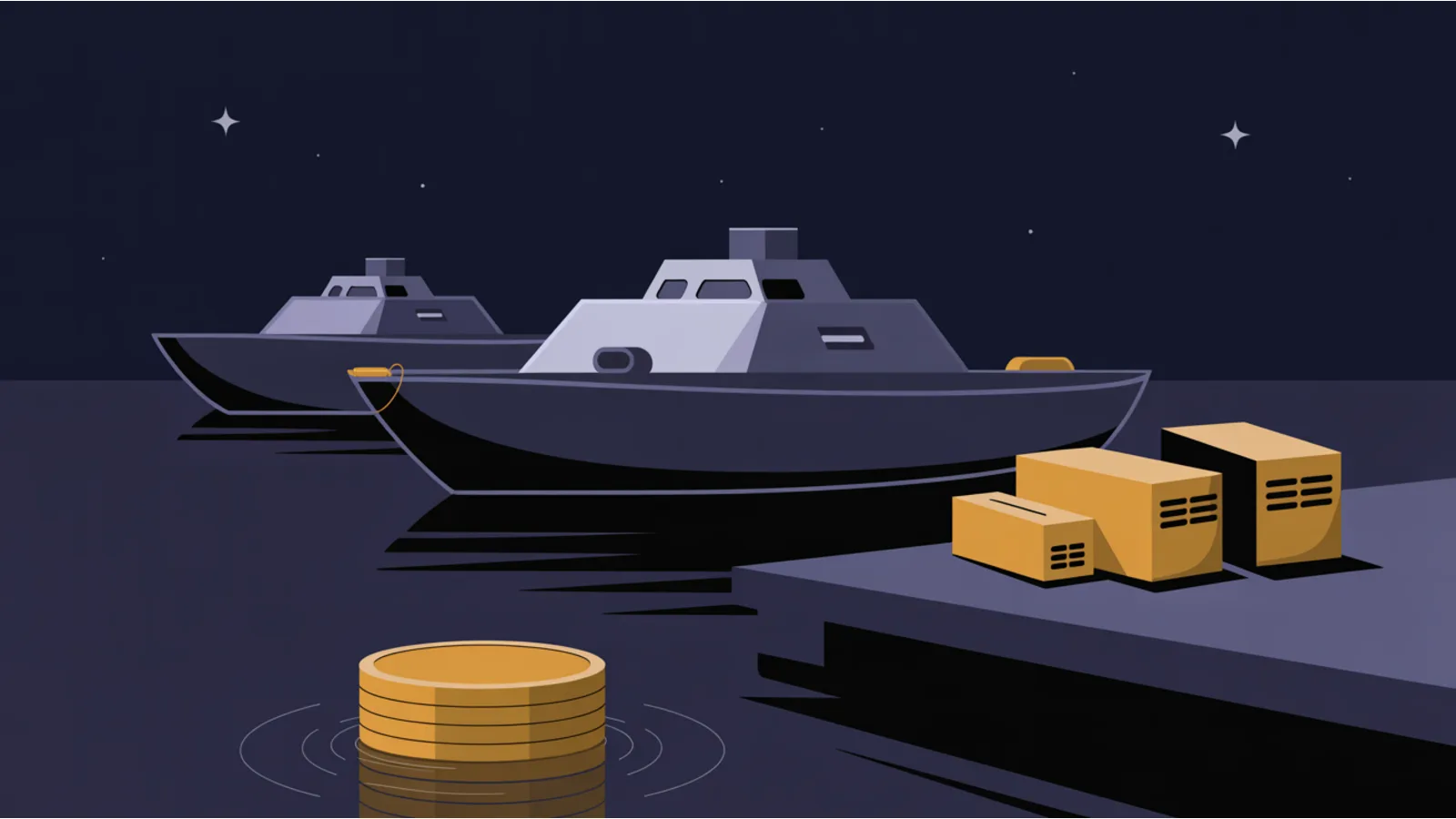
The United States Navy commissioned USS Freedom in November 2008 as the lead ship of a new kind of warship: small, fast, cheap, and built to change jobs by swapping out modular equipment the way a workshop swaps tool heads. It was decommissioned on September 29, 2021, roughly 13 years old, about half its intended service life. Its Independence-class counterpart, USS Independence, went out of service in July 2021 at about 11 years. USS Sioux City, commissioned in November 2018, was decommissioned on August 14, 2023, after less than five years at sea.
Those retirement dates are the compressed version of a much longer story: a program whose defining feature never delivered as promised, whose per-ship cost more than doubled, and which the Navy tried to walk away from years before its ships were worn out. This post traces what the Littoral Combat Ship actually cost from primary records, and it holds the honest failure critique next to the honest defense, because both belong in the record.
What the LCS was supposed to be
The Littoral Combat Ship program answered a real post-Cold War gap. The Navy had built itself for blue-water fights against the Soviet fleet, and after 1991 it lacked an affordable, shallow-draft ship for close-to-shore, or littoral, missions: mine warfare, small-boat and submarine threats in coastal waters, presence patrols, and partner engagement. The Congressional Research Service, in its long-running LCS report (RL33741, by naval analyst Ronald O'Rourke), describes the core idea as a modular seaframe that would swap interchangeable mission packages for three roles: surface warfare (SUW), mine countermeasures (MCM), and anti-submarine warfare (ASW).
The pitch was elegant. Decouple the ship from its payload. Buy many cheap hulls instead of a few expensive ones. When a mission or a technology changed, change the module, not the ship. In plug-and-fight theory, one seaframe could hunt mines this month and chase submarines the next.
Two things complicated that theory from the start. First, the Navy did not pick one design. It built two very different ones and ran them side by side:
- The Freedom-class, a steel monohull designed by Lockheed Martin and built at Fincantieri Marinette Marine in Wisconsin.
- The Independence-class, an aluminum trimaran from the Austal USA and General Dynamics team, built in Mobile, Alabama.
Running two dissimilar classes concurrently, rather than choosing a single winner, multiplied the maintenance, training, and logistics burden for the rest of the program's life. Second, the modules that were supposed to make the whole concept worthwhile turned out to be the hardest part.
The money, kept in separate boxes
Cost is where LCS is most often misdescribed, because several very different numbers get blurred together. They need to stay in separate boxes.
The target. The Navy set an aspirational goal of roughly $220 million per seaframe, a figure meant for later serial production, not for the first-of-class ships. Congress, watching costs climb, later imposed a legislated ceiling of $480 million per seaframe beginning in fiscal year 2011. Both figures come from the Government Accountability Office's 2010 review, GAO-10-523. The $220 million was an ambition; the $480 million was a legal cap. Neither was an actual price.
The lead ships. GAO-10-523 documented that the two first-of-class hulls ran far above their initial budgets. As reported in that review, LCS 1 grew from a $215.5 million initial budget to $537.0 million, and LCS 2 from $256.5 million to $607.0 million, in FY2011 budget terms. These carry heavy first-of-class overhead, so they are not the fleet average; later hulls came down but never reached the target.
The fleet average. Over the program, the average seaframe settled at roughly $500 million each, about double the original target. GAO's own summary framed it plainly: the ships would cost about $500 million each against a $220 million goal. (A widely cited figure of about $478 million traces to a separate GAO citation reported by ProPublica.) These are seaframe-only numbers. They exclude the mission packages, research and development, and long-run operating costs.
The acquisition total. GAO estimated in 2010 that the Navy planned to invest more than $25 billion through FY2035 to buy LCS seaframes and mission packages. That figure excludes long-run operating and support (O&S) costs.
The lifetime projection. Analysts, including GAO's John Pendleton as cited by ProPublica, projected that the class could run on the order of $60 billion in O&S alone and roughly $100 billion in total across its life. This is the number most often misused. It is a lifetime projection for the class, an order-of-magnitude estimate, not money already obligated or spent. It belongs in a separate box from everything above, and it should never be presented as cash out the door.
One more cost worth isolating, discussed below, is the roughly $8 million to $10 million per ship it took to repair the Freedom-class propulsion defect. That is a repair bill, not a purchase price.
A total of 35 LCS were procured through FY2019, three more than the 32 the Navy said it required. Per CRS RL33741 and ProPublica's reporting, Congress added ships the Navy did not request, forcing purchase of roughly three additional hulls at a cost of more than $1.5 billion beyond what the service wanted.
The modules that did not arrive
If the seaframes were merely expensive, LCS would be an ordinary cost-growth story. What makes it distinct is that the mission modules, the entire reason to accept a lightly armed hull, largely failed or were heavily restructured.
Mine countermeasures. The centerpiece of the MCM package was the Remote Minehunting System (RMS). After more than 15 years of development and over $700 million invested, the Navy effectively cancelled RMS in March 2016 over unreliability and false alarms, as USNI News and ProPublica reported. The MCM mission was restructured around newer unmanned systems, including the Unmanned Influence Sweep System (UISS) and the Knifefish. But the restructured package still struggled in testing. The Pentagon's Director, Operational Test and Evaluation (DOT&E) reported an operational availability of 0.29 when employing UISS from an LCS in an August 2022 test, well below the Navy's defined minimum threshold, even though UISS had been declared to have reached initial operational capability that same July. As late as its FY2025 annual report, DOT&E still could not determine the MCM package's operational effectiveness or suitability because of insufficient data.
Anti-submarine warfare. The ASW package was cancelled around 2022, leaving the LCS without the submarine-hunting capability it had been promised. This was not a quiet shelving. The cancellation triggered a formal Nunn-McCurdy cost breach in May 2022, and the Chief of Naval Operations said the effort simply did not work out technically. The Raytheon AN/SQS-62 variable-depth sonar at the heart of the package had towing and stability problems.
Of the three planned mission areas, then, only surface warfare fielded cleanly. Mine countermeasures arrived late and still troubled; anti-submarine warfare was cancelled outright. The plug-and-fight promise, the thing that justified the whole design, largely did not materialize.
The propulsion defect and the survivability question
The Freedom-class carried a second, separate problem in its machinery. Its combining gear, the transmission that couples the Rolls-Royce MT30 gas turbines with the Fairbanks Morse Colt-Pielstick diesels, contained an under-engineered high-speed clutch bearing that wore out prematurely. The gear's manufacturer was Germany's RENK AG. In January 2021, after failures first surfaced on USS Detroit (LCS-7) and USS Little Rock (LCS-9), the Navy declared it a class-wide engineering defect and announced it would not accept new Freedom-class ships until the defect was fixed, as USNI News reported.
This is a Freedom-class problem specifically; it should never be attributed to the Independence-class trimarans. Repairing the gears was estimated at roughly $8 million to $10 million per ship. The first fix was completed on USS Minneapolis-Saint Paul (LCS-21) by November 2021 and applied to LCS-19 and follow-on ships. Roughly 13 hulls needed the repair, and for several the Navy decided it was cheaper to retire the ship than to fix and keep operating it.
Survivability was criticized on a separate axis. DOT&E concluded the LCS was "not expected to be survivable" in high-intensity combat, meaning it was not expected to keep fighting after a significant hit. Critics also called it under-armed, a judgment sharpened when the Non-Line-of-Sight (NLOS) missile was cancelled in 2010. The Navy's rebuttal, reported by USNI News, is worth stating fairly: the LCS was built to a "Level 1+" survivability standard, above patrol and mine-warfare craft but below the Oliver Hazard Perry-class frigates it partly replaced, and the service argued that survivability should be judged against the ship's intended low-threat missions, not a peer naval battle it was never meant to fight.
Retiring ships barely used
The clearest symptom of a program that did not deliver is a Navy paying to get rid of nearly new ships. Against a design service life of about 25 years:
- USS Freedom (LCS-1) was decommissioned in September 2021 at about 13 years.
- USS Independence (LCS-2) was decommissioned in July 2021 at about 11 years.
- USS Little Rock (LCS-9), one of the combining-gear failure ships, was retired at about six years old.
- USS Sioux City (LCS-11), commissioned in November 2018, was decommissioned in August 2023 after less than five years, having completed four deployments before being placed in foreign-military-sale status.
Retiring the combining-gear hulls let the Navy skip the per-ship repair plus years of operating costs. But the retirement story is not a simple tale of the Navy scrapping its own fleet at will, and this is where the record demands care. In the FY2023 budget, the Navy proposed retiring nine Freedom-class hulls early. Congress pushed back, arguing against discarding recently built warships, and limited how many the Navy could retire; the exact count allowed varied by budget year. The retirements were contested, not wholesale.
The reversal went further than that. As of about January 2026, the Navy backed off plans to retire seven more LCS hulls and now intends to keep a fleet of roughly 28 ships. The "Navy is scrapping the entire class" framing that circulated a few years ago is outdated. What actually happened is a service that tried to exit early, a Congress that repeatedly blocked or slowed the exit, and a later partial reversal that kept most of the fleet in the water.
The successor, with its own caveat
The Navy's stated lessons-learned answer is the Constellation-class (FFG-62) guided-missile frigate: larger, more heavily armed, more survivable, and, crucially, based on a proven in-service design, Italy's FREMM, rather than a clean-sheet concept. Procurement began in FY2020, per CRS report R44972.
The honest footnote is that the "buy a proven design" lesson has not fully held. Per GAO reporting, the FFG-62 program was running roughly 36 months late to first delivery as of 2024, and design commonality with the parent FREMM had fallen from about 85 percent to under 15 percent, the product of hundreds of functional design changes, added length, and added weight. The successor is meant to fix the LCS failures, but it is already demonstrating how easily a "proven design" becomes a new development program.
The honest critique and the honest defence, side by side
The critique. By GAO's and DOT&E's own records, LCS spent enormous sums on a fleet whose defining feature largely did not work. Per-ship seaframe cost more than doubled, from a roughly $220 million target to about $500 million. Planned acquisition exceeded $25 billion, with lifetime class cost projected on the order of $100 billion. The minehunting centerpiece was cancelled after more than $700 million and 15 years; the anti-submarine package was cancelled outright and triggered a Nunn-McCurdy breach; the restructured mine package still tested at 0.29 availability years after fielding. The Freedom-class shipped with a class-wide propulsion defect. DOT&E judged the ships not expected to be survivable in serious combat. The result was warships built for a 25-year life that the Navy tried to retire at 13, 11, six, and under five years, in some cases paying to dispose of them rather than operate capability that never arrived.
The defence. The need was genuine. The post-Cold War Navy really did lack an affordable, shallow-draft ship for littoral presence and mine warfare, and betting on many cheaper hulls rather than a few costly ones was a defensible choice at the time. Some LCS do useful work today: forward presence, drug-interdiction and partner patrols, and, belatedly, mine countermeasures, where LCS with MCM packages are replacing the aging Avenger-class minehunters in the Persian Gulf. The modular idea, decoupling a ship from its payload so capability can be upgraded without rebuilding the hull, remains sound in principle and echoes in current unmanned-systems thinking. And the Navy is explicitly carrying LCS lessons into the Constellation-class: keep the affordability goal, but fix the survivability, armament, and dual-design failures that sank the LCS. That the frigate is itself late and heavily modified is a caution, not a refutation, of the attempt.
Both verdicts are true at once. LCS is neither a clean success the critics ignore nor a pure boondoggle the defenders excuse. It is a program that met a real need with the wrong ship, learned expensive lessons, and left behind a fleet the Navy is still deciding how long to keep.
Fact-check notes and sources
- Modular seaframe concept swapping SUW, MCM, and ASW mission packages; two variants; 35 ships procured against a stated requirement of 32: Congressional Research Service, RL33741 (O'Rourke), everycrsreport.com/reports/RL33741.html.
- Roughly $220 million per-ship target, $480 million congressional cost cap from FY2011, more than $25 billion planned acquisition through FY2035, and documented lead-ship cost growth: U.S. Government Accountability Office, GAO-10-523 (2010), gao.gov/products/gao-10-523; accessible text at gao.gov/assets/a308964.html (LCS 1 $215.5M to $537.0M; LCS 2 $256.5M to $607.0M, FY2011 budget figures).
- About $478 million to $500 million average seaframe cost, the roughly $60 billion O&S and roughly $100 billion lifetime class projections (an estimate, not obligated money), the RMS cancellation after more than $700 million over about 15 years, and the congressionally added hulls: ProPublica, propublica.org/article/how-navy-spent-billions-littoral-combat-ship.
- RMS officially cancelled March 2016: USNI News, news.usni.org/2016/03/24/navys-remote-minehunting-system-officially-canceld-sonar-may-live-on.
- Restructured MCM shortfalls, including UISS operational availability of 0.29 (August 2022 test) and MCM effectiveness undetermined: DoD Director, Operational Test and Evaluation (DOT&E), FY2025 LCS report, dote.osd.mil/Portals/97/pub/reports/FY2025/navy/2025lcs.pdf.
- ASW mission package cancellation and the resulting Nunn-McCurdy breach (May 2022): USNI News, news.usni.org/2022/05/13/navys-cancellation-of-asw-mission-package-for-littoral-combat-ship-triggers-nunn-mccurdy-breach.
- Freedom-class class-wide combining-gear (CODAG) defect, RENK AG gear coupling Rolls-Royce MT30 turbines and Colt-Pielstick diesels, and the January 2021 delivery halt: USNI News, news.usni.org/2021/01/19/navy-calls-freedom-lcs-propulsion-problem-class-wide-defect-wont-take-new-ships-until-fixed.
- Roughly $8 million to $10 million per-ship combining-gear repair and the first fix completed on LCS-21 by November 2021: USNI News, news.usni.org/2021/11/17/cno-first-combining-gear-fix-completed-on-freedom-class-lcs-minneapolis-saint-paul.
- DOT&E "not expected to be survivable" finding, the 2010 NLOS missile cancellation, and the Navy's Level 1+ rebuttal: USNI News reporting DOT&E findings, news.usni.org/2013/01/17/navy-responds-pentagon-lcs-survivability-claims.
- USS Freedom (LCS-1) commissioned November 2008, decommissioned September 29, 2021 (about 13 years): USNI News, news.usni.org/2021/10/04/navy-decommissions-first-littoral-combat-ship-uss-freedom-strikes-tug-usns-sioux; The War Zone, twz.com/42582/the-first-littoral-combat-ship-has-been-decommissioned-after-just-13-years-of-service.
- USS Independence (LCS-2) decommissioned July 2021 (about 11 years; ceremony July 29, 2021): USNI News, news.usni.org/2021/07/31/navy-quietly-decommissions-littoral-combat-ship-independence-after-11-years.
- USS Sioux City (LCS-11) commissioned November 2018, decommissioned August 14, 2023 after less than five years: U.S. Navy, navy.mil/Press-Office/News-Stories/Article/3493606/uss-sioux-city-lcs-11-decommissions.
- USS Detroit (LCS-7) and USS Little Rock (LCS-9) early retirements, Little Rock about six years old: The Maritime Executive, maritime-executive.com/article/u-s-navy-quietly-decommissions-two-littoral-combat-ships-in-one-day.
- Navy's FY2023 proposal to retire nine Freedom-class hulls and congressional pushback: USNI News, news.usni.org/2022/03/29/all-freedom-littoral-combat-ships-in-commission-tapped-for-early-disposal; The Maritime Executive, maritime-executive.com/article/u-s-navy-plans-to-retire-the-rest-of-its-freedom-class-lcs-hulls.
- Constellation-class (FFG-62) follow-on based on the Italian FREMM, procured from FY2020, with a roughly 36-month delay and FREMM design commonality falling from about 85 percent to under 15 percent: CRS report R44972, congress.gov/crs-product/R44972; GAO-24-106546, gao.gov/products/gao-24-106546.
Related reading
- The DDG-1000 Zumwalt and the LRLAP shell: another Navy program where a signature capability priced itself out of existence.
- The Coast Guard's Deepwater cutter program: a parallel case of shipbuilding ambition outrunning delivery.
- The GAO High-Risk List and improper payments: the oversight lens this series uses to read cost growth.
- The public-money programs index: the full set of program-by-program cost reviews.
This post is informational and journalistic, not legal or financial advice. It describes public programs and documented events; mentions of third parties are nominative fair use and no affiliation is implied.
