
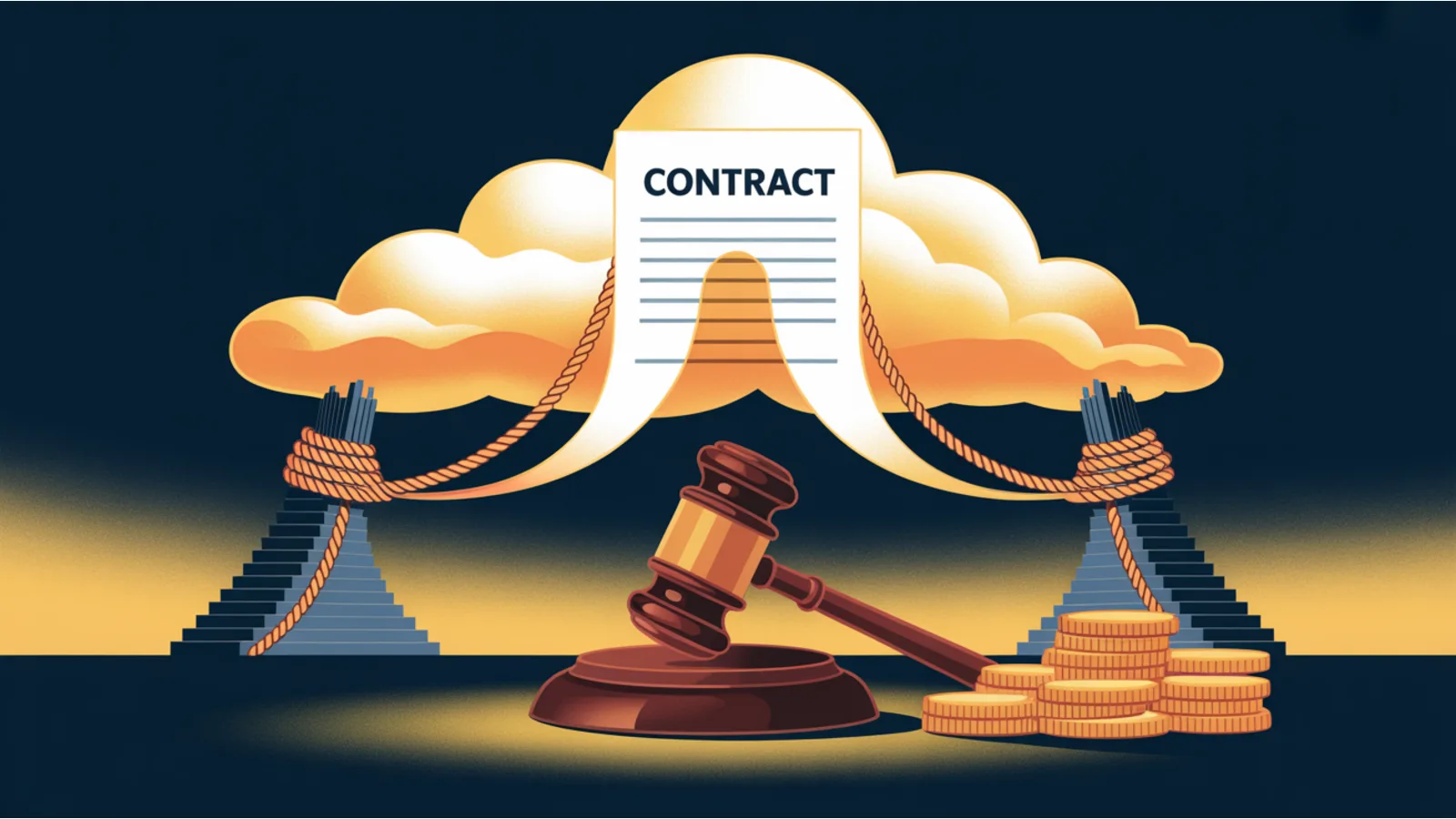
In October 2019 the U.S. Department of Defense picked a single company to build one cloud for the entire American military, a contract the press consistently sized at up to $10 billion over ten years. Twenty months later, in July 2021, the department cancelled it. Not a single production workload had ever run on it. The winner never got to build anything, the loser sued, and the years in between were spent in court rather than in a data center.
That is the headline most people half-remember: a $10 billion Pentagon cloud contract that blew up. The number is real, but the easy conclusion is wrong. The $10 billion was a ceiling on a contract that was cancelled before it was ever implemented. The vast majority of that money was never obligated, because there was nothing to obligate it against. What the Joint Enterprise Defense Infrastructure actually cost the government was three years of delay, a stack of litigation, duplicated procurement effort, and a genuine warfighting capability that arrived years late. This post walks the record: what JEDI was, what happened, what the money figures do and do not mean, and the honest case on both sides.
What JEDI was
The Joint Enterprise Defense Infrastructure, universally shortened to JEDI, was a single-award commercial-cloud contract. The idea was ambitious and, on its face, reasonable: give the Department of Defense one modern commercial cloud that spanned unclassified through classified networks, reached from headquarters all the way to the tactical edge, and could support data-driven and AI-enabled operations. The department was tired of running hundreds of fragmented, aging systems and wanted an enterprise backbone that looked more like what a large private company would buy.
The structural choice that defined JEDI, and eventually doomed it, was that it was a single-award indefinite-delivery, indefinite-quantity (IDIQ) contract. One vendor would win the whole thing. According to the fact base and the GAO docket (RFP HQ0034-18-R-0077), the vehicle was sized at up to $10 billion over ten years. That figure is a ceiling, the maximum the department could spend across a decade of task orders, not a committed or guaranteed amount. This distinction is the single most important thing to understand about JEDI, and it is the one the "$10 billion wasted" framing gets wrong.
What happened, in order
The story is best told as a timeline, because the sequence is what turned a normal procurement into a case study.
- November 14, 2018: Before any award, Oracle challenged the entire premise of a single-winner contract. The Government Accountability Office denied Oracle's protest (B-416657 et al.), finding that DoD's single-award IDIQ determination was reasonable under FAR 16.504. Oracle later lost at the Court of Federal Claims and the Federal Circuit, and the Supreme Court declined to take the case. Oracle's fight was about the structure itself, not about who won.
- 2018: Google withdrew from the competition. Per the fact base, this was a voluntary withdrawal tied to internal employee protests over military AI work, not a disqualification. Google would return years later for the successor contract.
- October 25, 2019: DoD announced Microsoft (Azure) as the JEDI winner, selecting it over Amazon Web Services, which had been the presumed front-runner. Microsoft won. AWS lost. That order matters, because everything that followed flowed from the loser's protest.
- November 22, 2019: Amazon filed a bid protest at the U.S. Court of Federal Claims. AWS argued two things: that DoD made technical errors in evaluating the bids, and that the award was tainted by improper political interference. Specifically, Amazon alleged that President Trump's animus toward Amazon and its founder Jeff Bezos, who owned The Washington Post, improperly shaped the process. The most quoted piece of this, an alleged instruction to "screw Amazon" out of the deal, traces to former speechwriter Guy Snodgrass's account of Trump speaking to then-Defense Secretary Jim Mattis, and was surfaced in Amazon's litigation. It is an alleged and reported statement, not a court finding.
- February 13, 2020: Judge Patricia Campbell-Smith granted Amazon a preliminary injunction halting work, finding AWS likely to succeed on the merits regarding how DoD evaluated one specific Microsoft price scenario. Importantly, the injunction turned on that narrow technical evaluation issue, not on the political-interference allegation. From this point forward the program sat under a stop-work order. The order landed roughly a day before the system was scheduled to go live, but no production workload was ever fielded.
- April 2020: The DoD Inspector General reported its findings, and they cut both ways. The IG found no evidence that the source-selection team had been pressured and concluded the award decision was consistent with law and acquisition standards. At the same time, the IG expressly stated it could not fully investigate potential White House influence, because the White House asserted "presidential communications privilege," which the IG disagreed with but could not override. The same report also found that DoD had improperly disclosed some procurement information to AWS. It was not a clean exoneration of anyone.
- April 2021: A court denied the government's and Microsoft's motion to dismiss Amazon's interference claim, allowing that claim to proceed. It was never resolved on the merits.
- July 6, 2021: DoD cancelled JEDI outright, without it ever being implemented. The department's stated reasons were that evolving requirements, the government's own increased cloud fluency, and advances across the commercial cloud industry meant the JEDI contract no longer met its needs. Years of litigation had also stalled it indefinitely.
The money, kept honest
Here is where discipline matters most, because JEDI is the kind of story that invites a wrong number.
The $10 billion figure attached to JEDI was a contract ceiling over ten years, the maximum spend authorized across a single-award IDIQ. It was not a check that was written. Because the contract was frozen under a stop-work order from February 2020 and then cancelled in July 2021 before any production workload ran, the overwhelming majority of that ceiling was never obligated. There was no decade of task orders, because there was barely any contract at all.
So what did JEDI actually cost the public? The real losses were:
- Time. Roughly three years, from the 2018 solicitation to the July 2021 cancellation, spent standing up a contract that delivered nothing.
- Litigation. Multiple protests and lawsuits across the GAO, the Court of Federal Claims, the Federal Circuit, and the Supreme Court's cert stage, absorbing government and contractor legal effort. When Amazon obtained its injunction, it posted a $42 million bond, a marker of the scale of the legal machinery involved.
- Duplicated procurement effort. DoD had to design, solicit, defend, and then abandon one contract, and then design and run a second one.
- Delayed capability. The enterprise cloud the department said it needed for data-driven and AI-enabled operations arrived years later than planned.
None of these are $10 billion, and conflating the ceiling with a cash loss misrepresents the record. The honest sentence is: a contract worth up to $10 billion was cancelled before the money behind it was spent.
The successor: JWCC
When DoD cancelled JEDI in July 2021, it simultaneously announced a replacement built on the opposite structural principle. The Joint Warfighting Cloud Capability (JWCC) would be multi-vendor and multi-cloud, reversing JEDI's single-award, winner-take-all design. (Some early 2021 press miswrote the name as "Joint Warfighter"; the official name is Joint Warfighting Cloud Capability.)
One nuance is worth stating precisely, because it is easy to paint JWCC as an instant open competition that fixed everything. It was not, at first. At the July 2021 cancellation, DoD initially named only Microsoft and AWS as the "only cloud service providers capable of meeting requirements" and planned to solicit those two directly. Google and Oracle were added later.
The four-way award landed on December 7, 2022, when DoD awarded JWCC to Amazon Web Services, Microsoft, Google, and Oracle as a multiple-award IDIQ with a shared ceiling of up to $9 billion, running through roughly June 2028. That $9 billion is another ceiling number that has to be handled carefully: it is a shared, task-order-based maximum across all four vendors combined, not $9 billion each and not a guaranteed spend. The whole point of the multi-vendor design is that the department buys services task order by task order, choosing among competing providers, rather than betting the entire enterprise on one winner.
The honest critique and the honest defense
This series exists to let both verdicts sit side by side, and JEDI genuinely earns both.
The honest critique. JEDI is a textbook case of a mega-procurement litigated into paralysis, and the root cause was a design choice the government made with its eyes open. A single-award, winner-take-all contract for a decade-long, department-wide capability created the maximum possible incentive for every losing bidder to fight. Oracle attacked the structure before the award. Amazon attacked the evaluation and alleged interference after it. The GAO warned about neither being frivolous by taking them seriously; the injunction froze everything; the IG could not fully close the interference question because of a privilege assertion; and the department ultimately walked away with nothing to show for three years. The lesson is structural, not partisan: concentrating a strategic capability into one award concentrated legal risk into one predictable failure mode.
The honest defense. The mission behind JEDI was legitimate, and it did not go away when the contract did. DoD really did need a modern, enterprise-wide commercial cloud spanning unclassified through classified levels and reaching to the tactical edge, and it still needs it. The failure was the contracting structure, not the underlying requirement. And the department demonstrably learned: it replaced the single-award design with the multi-vendor JWCC, which spreads work across competing providers, reduces the single-point protest risk that sank JEDI, and lets the department buy best-of-breed services incrementally. That is what a correction looks like. The honest read is a needed capability, a badly chosen contracting structure, and a redesigned successor that fixed the specific flaw, not proof that the investment was pointless.
Both of those are true at once. JEDI was a real failure of procurement design and a real success of institutional learning, and it cost the public time and delay rather than the ten-figure cash loss its nickname implies.
Fact-check notes and sources
- JEDI was a single-award DoD commercial-cloud contract sized at up to $10 billion over ten years, spanning classified and unclassified networks to the tactical edge; the $10B was a ceiling, not committed spend. Consolidated timeline and terms per Wikipedia's JEDI overview; the ceiling-versus-obligated distinction is load-bearing and confirmed against the GAO docket (RFP HQ0034-18-R-0077).
- GAO denied Oracle's pre-award protest of the single-award structure on November 14, 2018 (B-416657 et al.), finding the single-award IDIQ reasonable under FAR 16.504. U.S. Government Accountability Office, B-416657 et al.. Oracle later lost at the Court of Federal Claims and Federal Circuit, and the Supreme Court declined the case.
- On October 25, 2019, DoD announced Microsoft (Azure) as the JEDI winner over AWS. Microsoft won and AWS lost; Google had withdrawn voluntarily in 2018. See CNBC's report on Amazon's protest.
- Amazon filed a bid protest on November 22, 2019, alleging technical evaluation errors and improper political interference by President Trump, including an alleged "screw Amazon" instruction. Attributed as Amazon's allegation, never adjudicated on the merits before cancellation; the "screw Amazon" phrasing traces to Guy Snodgrass's account of Trump speaking to SecDef Mattis. See DataCenterDynamics on the court allowing the interference claim to proceed.
- On February 13, 2020, Judge Patricia Campbell-Smith granted AWS a preliminary injunction on a narrow price-scenario evaluation issue, and AWS posted a $42M bond; work sat under a stop-work order thereafter. The injunction turned on the technical issue, not the interference claim. See TechCrunch's contemporaneous report.
- The DoD Inspector General's April 2020 report found no evidence evaluators were pressured but could not fully investigate White House influence due to a "presidential communications privilege" assertion, and also found DoD improperly disclosed some procurement information to AWS. Present both halves; it was not a clean exoneration. See FedScoop's coverage of the IG report.
- On July 6, 2021, DoD cancelled JEDI without it ever being implemented, citing evolving requirements, increased cloud fluency, and industry advances. The $10B ceiling was overwhelmingly never obligated. See FedScoop on the cancellation and analysis from the Center for Strategic and International Studies.
- Concurrent with cancellation, DoD announced the multi-vendor Joint Warfighting Cloud Capability (JWCC), initially targeting only Microsoft and AWS before broadening to four vendors. See Federal News Network on the cancellation and JWCC announcement.
- On December 7, 2022, DoD awarded JWCC to AWS, Microsoft, Google, and Oracle as a multiple-award IDIQ with a shared ceiling of up to $9 billion through roughly June 2028. The $9B is a shared, task-order-based ceiling across all four vendors, not $9B each. See DefenseScoop and Breaking Defense.
Related reading
- The Navy Marine Corps Intranet (NMCI): another single-vendor enterprise IT bet, and what outsourcing an entire network to one contractor taught the Navy.
- The Air Force ECSS ERP failure: a large DoD modernization program that spent real money and delivered little, a useful contrast to JEDI's cancelled-before-spend outcome.
- Coalition networks: CENTRIXS and Mission Partner Environment: how the department actually stitches together classified and unclassified sharing, the problem JEDI aimed to modernise.
- The GAO High-Risk List and improper payments: the oversight lens for reading federal acquisition failures.
- The public-money programs index: the full series tracking where federal dollars go.
This post is informational and journalistic, not legal or financial advice. It describes public programs and documented events; mentions of third parties are nominative fair use and no affiliation is implied.
