
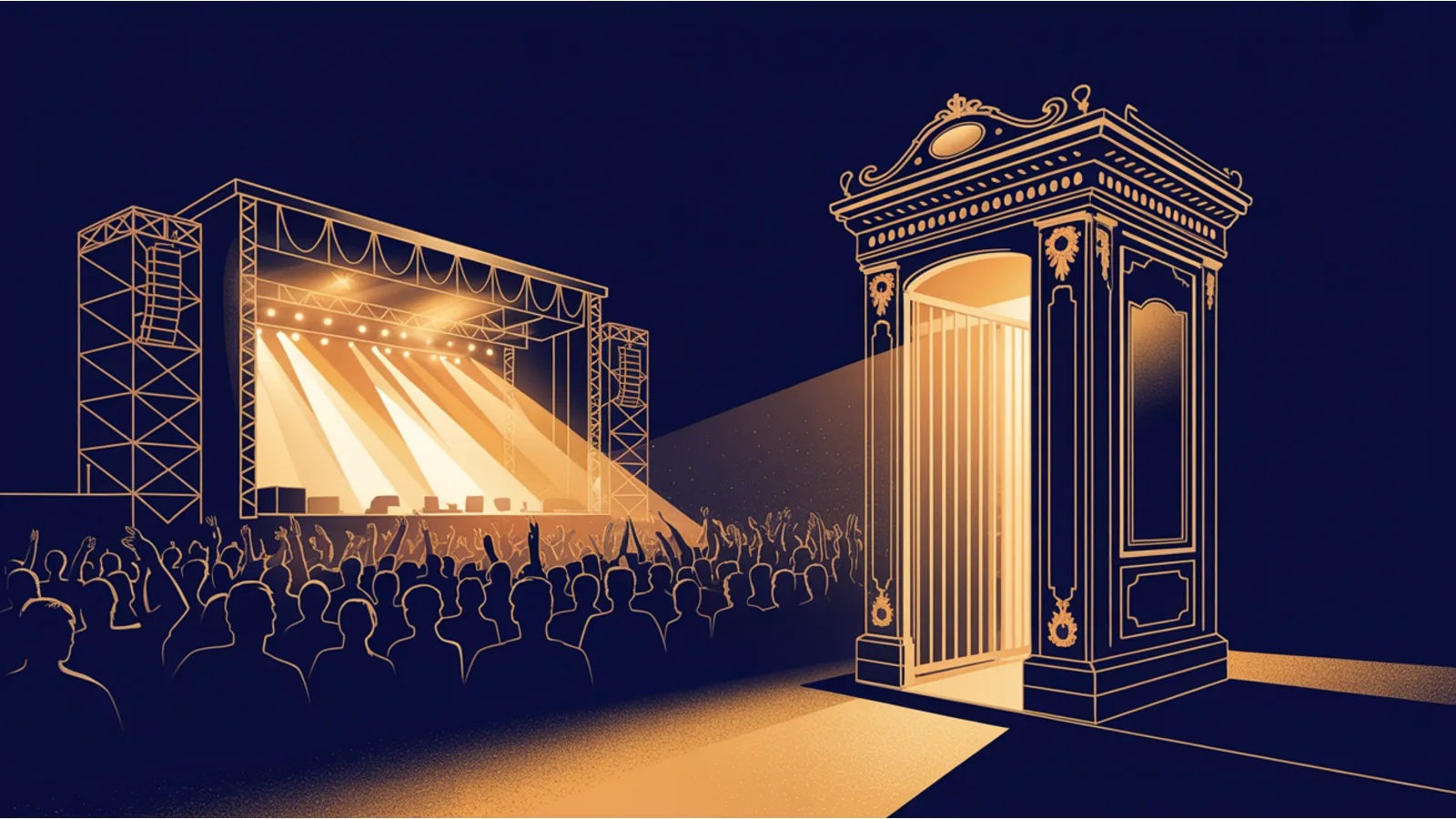
Thirty-eighth in a series on jobs whose pay system is stranger than the salary. Earlier entries covered the card networks, who peel a slice off every swipe and appear on no receipt, and the certificate-of-need holder, who is paid because the state forbids a competitor from building. The ticketing company belongs right beside them, because the fee you see stacked under the word "convenience" is not a charge for convenience at all. It is a toll on a flow of concerts that the same company frequently owns, collected by an entity that keeps a slice and then hands the rest to the venue and the promoter, which are often itself. Every figure below is cited to the Justice Department's antitrust complaint, a company's SEC filing, or the statute itself, and where a number could not be verified at a primary source I say so rather than estimating.
Look at the last concert ticket you bought. There is a face value, the number the artist and the venue set. Then there is a second number, larger than you expected, assembled out of a service fee, an order fee, a processing fee, and a facility fee, none of which you agreed to and none of which you can decline.
That second number is the business. The concert is not.
This is the entry in the series where the toll is easiest to see and hardest to believe, because the company collecting it barely profits from the events themselves. In Live Nation Entertainment's own SEC filings, its enormous Concerts segment does more than four-fifths of the revenue and earns a margin near a rounding error. Its small Ticketing segment does about an eighth of the revenue and throws off a margin that would make a software company jealous. The fees are where the money lives. And per the Justice Department, the company that collects those fees keeps a portion and remits the rest to the venue and the promoter, entities that are frequently Live Nation itself, "amounting to paying several of these fees (or portions thereof) to itself."
The toll is the fees, not the ticket
Start with the anatomy of what gets stacked on the price, because the words on the checkout screen are engineered to sound like services and are really a set of tollgates.
The Justice Department's complaint describes it plainly. "Ticketmaster, as primary ticketer, collects both the face value of the ticket as well as a host of fees tacked on top of the face value." Ticketmaster keeps some of those fees. "The remaining fees are remitted to other intermediaries like the venue and promoter, which are often Live Nation-owned entities, amounting to paying several of these fees (or portions thereof) to itself."
Read that twice. The party charging the fee, the party collecting the fee, and one of the parties the fee is paid to are, in a large share of cases, the same company wearing three hats.
The complaint then itemizes the stack. There is a "Service" or "Convenience" fee, negotiated between the venue and the ticketer, which can be a flat amount, a percentage of the service fee, or a percentage of the face value. There is a "Platinum" or "Pricemaster" dynamic-pricing fee, which the complaint says carries an "inside fee" that Ticketmaster collects from the promoter, calling it "a double dip." There is a "Per Order" or "Handling" fee. There is a "Payment Processing" fee. And there is a "Facility" fee, typically remitted in full to the venue. Five kinds of add-on, most of them flowing at least partly back inside the same corporate family.
I want to be careful about one figure people expect me to give, because I could not pin it to a primary source in this pass. The widely repeated claim that add-on fees run roughly 20 to 40 percent, or more, of a ticket's face value is directional and event-dependent, and I am not asserting it as a verified average. The Justice Department quantifies the outcome for the company, not the per-ticket percentage a fan pays. What it says is that the stacked fees "contribute to Live Nation's nearly 40% adjusted operating margin in 2023 for its global ticketing business." That margin is the confirmable magnitude here. The per-ticket fee percentage is not.
The profit hides in the smallest segment
The strangest fact about this company sits in its own annual report, and it is the reason the fees matter so much. The part of the business that makes the concerts happen barely makes money. The part that runs the checkout page makes almost all of it.
In its Form 10-K for the fiscal year ended December 31, 2025, Live Nation reported total revenue of about $25.2 billion. Here is how the three segments split that revenue, and what each one actually earned. Live Nation reports segment profit using a non-GAAP measure it defines and calls Adjusted Operating Income, or AOI, which it reconciles to GAAP operating income in the filing. The margin percentages below are the AOI margins Live Nation reports for each segment, which also equal segment AOI divided by segment revenue.
| Segment (Live Nation, FY2025) | Revenue | Share of revenue | Segment AOI | AOI margin |
|---|---|---|---|---|
| Concerts | $20,860,726K | 82.8% | $687,083K | ~3.3% |
| Ticketing | $3,081,166K | 12.2% | $1,134,432K | ~36.8% |
| Sponsorship and Advertising | $1,329,233K | 5.3% | $845,225K | ~63.6% |
Sit with the top two rows. Concerts is more than four-fifths of the company and earns a margin of about 3 percent. Ticketing is about an eighth of the company and earns a margin near 37 percent. Put another way, Ticketing generated $1,134,432K of segment profit on $3,081,166K of revenue, which is more segment AOI than the entire Concerts business produced on nearly seven times the revenue.
Add up the three segments before corporate overhead and you get roughly $2.67 billion of gross segment AOI. Ticketing alone is more than 40 percent of it, from an eighth of the revenue. The prior year has the same shape: FY2024 Concerts AOI of about $530 million on roughly $19 billion of revenue, a margin near 3 percent, against Ticketing AOI of about $1,124 million, a margin near 38 percent. Consolidated GAAP operating income in 2025 was about $1.25 billion after the reconciling items.
These are Live Nation's own figures for Live Nation, not an industry universal, and I present them as that company's numbers. But the structural point is not company-specific at all. The concert is the loss leader. The tollbooth on the way into the concert is the profit engine. And the third row of the table, sponsorship and advertising at a margin above 60 percent, is a reminder that the ticket is only one of the surfaces this machine tolls.
The flywheel that protects the toll
A margin like that does not survive on its own. Somebody has to be prevented from undercutting it. The Justice Department's whole case is a description of how that prevention works, and Live Nation has a name for the machine. It calls it the "flywheel."
The complaint describes the flywheel in the company's own words. It quotes a Live Nation executive saying, "At the core is our flywheel," and then lays out how the wheel turns. The concert business, which the company itself calls the lower-margin part, is the hub. Live Nation uses its concert promotion to lock artists into exclusive deals, uses that roster of live content to pull venues into long-term exclusive ticketing contracts, and uses the fees and sponsorship those contracts throw off to fund the next turn of the wheel. The concerts are the low-margin bait. The ticketing and sponsorship tolls are the high-margin catch, and each turn is meant to make the next one easier.
Trace the loop, because each turn is a different tollgate feeding the next. The fees fund advances to artists. The artists sign exclusive promotion deals. The catalog of exclusive live content becomes leverage to sign venues into exclusive ticketing contracts. The ticketing contracts generate more fees. Around it goes.
The scale behind the flywheel is what makes it hard to escape. The Justice Department describes Live Nation as "the largest live entertainment company in the world," "the largest producer of live music concerts in the world," and "the world's leading live entertainment ticketing sales and marketing company." It "owns or controls more than 265 concert venues in North America, including more than 60 of the top 100 amphitheaters in the United States." Ticketmaster, the complaint says, is "by far the largest concert ticketing company in the United States," and by the Department's account at least eight times the size of its closest competitor.
The scarcity choke point is the amphitheater. Per the complaint, "Live Nation controls more than 60% of large amphitheaters in the United States," its portfolio "includes at least 40 of the top 50, and more than 60 of the top 100 amphitheaters," and that footprint "has allowed Live Nation to attain a greater than 70% market share in large amphitheater promotions." The complaint adds the sentence that explains why no rival ticketer can simply compete on price: "No other entity owns more than a handful of amphitheaters."
There is a fourth hat here that is easy to miss. Live Nation is also in artist management. The complaint notes that ticket face values are set "in consultation with their manager and the promoter (either or both of which might be Live Nation employees)." Manager, promoter, venue owner, and ticketer can all be the same company, sitting on every side of the table at once.
And the promoter leg is itself a toll. Promoters, the complaint says, "generate revenue primarily through a pre-agreed split of the gross ticket sales of a show or tour with the artist as well as through payments made by venues to incentivize the promoter to route its artists to perform at a particular venue." Live Nation "typically pays an artist the higher of either (1) a percentage of the gross ticket sales less expenses or (2) the artist's guaranteed payment," then, the complaint alleges, extracts "recompense in other parts of the ecosystem" by routing artists through venues it owns or controls or that Ticketmaster serves exclusively.
The lock runs backwards: the venue is paid to keep the booth
Here is the part that inverts what fans assume. You would think the venue is the victim of the ticketing fees, forced to accept them. In the Justice Department's telling, the venue is paid to keep the booth in place.
The mechanism is the rebate. "Although venues retain some proportion of ticketing fees," the complaint says, "a significant proportion of the venue's share is often passed onto promoters, like Live Nation, to incentivize them to steer content to their venue." These payments take the form of "rebate deals," "co-promotion deals," or "drawbacks," including "facility rental fee rebates" through which, the complaint alleges, "Live Nation can essentially claw back a show's expenditures."
So the fee revenue does not simply flow from fan to venue. A slice of it loops back to the promoter to buy the promoter's content, and the content is the leverage that keeps the venue signed to the exclusive ticketing deal in the first place. The venue is not resisting the toll. It is being compensated to maintain it.
The complaint is blunt about who really sets the fee. Live Nation says "the venue decides on the service fees." But "in reality, these decisions are predicated upon the portion of those fees that Live Nation (via Ticketmaster) will retain in the first instance, an amount Live Nation negotiates with each venue in advance of the venue setting the amount of the fee." There is even a worked example. A venue forced to pay Live Nation a "$5 promotions rebate," plus a portion of any increased fees to Ticketmaster, "would need to raise fees on fans by significantly more than $5 to break even." The fan pays for the rebate, several times over.
Then the contract nails the arrangement down. The Justice Department's press release lists the exclusionary conduct directly. "Locking Out Competition with Exclusionary Contracts: Live Nation-Ticketmaster locks concert venues into long-term exclusive contracts so that venues cannot consider or choose rival ticketers or switch to better or more cost-effective ticketing technology." It also cites "Blocking Venues from Using Multiple Ticketers" and "Restricting Artists' Access to Venues" unless those artists also agree to use Live Nation's promotion services. The complaint adds that since 2020 Ticketmaster has entered into long-term exclusive ticketing agreements with venues and works to extend them before they expire.
The reason a venue cannot just switch ticketers to save its fans money is now visible. Switching risks losing the concerts, because the company that ticks the box also controls the amphitheaters and the exclusive artist deals. The tollbooth is bolted to the road, and the road is the only one to the show.
The law that was supposed to restrain it
A toll this large usually draws a rule. This one drew several, and the record of how well they held is instructive.
The merger that created today's company was itself challenged. Live Nation and Ticketmaster agreed to merge in February 2009. The United States and nineteen states sued under Section 7 of the Clayton Act to stop it. The parties settled, and a consent decree was entered as a final judgment on July 30, 2010, allowing the merger to proceed "subject to certain conditions." I want to flag the limit of what I verified. The specific 2010 remedies that are widely reported, such as a required divestiture of Ticketmaster's Paciolan self-ticketing business and a licensing of Ticketmaster's Host platform to a rival, plus anti-retaliation and anti-conditioning terms, were not confirmed at a primary source in this pass. The complaint confirms only that the merger was allowed subject to conditions. Treat the specific 2010 remedy terms as reported, not verified here.
The decree did not hold well enough. In January 2020 the United States moved to modify it. Per the complaint, "Ticketmaster and Live Nation denied the allegations but ultimately agreed to the United States' and some state co-plaintiffs' proposed amendments," and the court entered an amended final judgment that, "among other things, partially extended the decree's effective date through December 31, 2025." The complaint's own summary of why is unsparing: the Section 7 decree "has failed to restrain Live Nation and Ticketmaster from violating other antitrust laws in increasingly serious ways." The Justice Department's January 2020 public characterization, that Live Nation had repeatedly violated the 2010 decree by retaliating against venues and that the amendment added an independent monitor, is treated here as secondary, because that press release would not open for me and the complaint corroborates only that violations were alleged and amendments agreed.
That is the backdrop to the current case. On May 23, 2024, the Justice Department, joined by 30 state and district attorneys general, filed a civil antitrust lawsuit against Live Nation Entertainment Inc. and its wholly owned subsidiary Ticketmaster LLC in the U.S. District Court for the Southern District of New York, Case No. 1:24-cv-03973, alleging unlawful monopolization under Section 2 of the Sherman Act. The count of co-plaintiffs is time-sensitive. As of the filing on May 23, 2024, it was 30 state and district attorneys general. Additional states reportedly joined later in 2024, so any figure above 30, and any specific per-state roster, should be re-verified against the latest amended complaint and the docket before it is restated. The procedural status of the case as of mid-2026, and whether the old decree's 2025 expiration has since lapsed or been modified, I did not research and do not assert.
There is one more law worth naming, because it aims at a different set of tolls on the same market. The Better Online Ticket Sales Act of 2016, the BOTS Act, is Public Law 114-274, approved December 14, 2016, and codified at 15 U.S.C. 45c. It makes it unlawful to circumvent "a security measure, access control system, or other technological control or measure" a ticket issuer uses to enforce purchase limits or order rules, and to resell tickets obtained that way. A violation is treated as an unfair or deceptive practice under the Federal Trade Commission Act and is enforced by the FTC, with state attorneys general able to sue as well. The statute applies to events at venues with capacity exceeding 200 persons. It targets the bots that scoop up inventory. It does not touch the fees.
What a salaried reader should take from this
The loss leader is the product; the tollbooth is the business. Live Nation's Concerts segment is more than 80 percent of revenue and earns a margin near 3 percent. Its Ticketing segment is about 12 percent of revenue and earns a margin near 37 percent. When you see a company that seems to be in the business of putting on shows, and then discover almost all of its segment profit comes from the checkout page, you have found the real machine. The event is the excuse to run the tollbooth. The same inversion runs through the card networks, where the fattest margin is not in lending money but in charging to route the swipe, and through the pharmacy benefit managers, where the money is in the spread, not the pill.
Follow the fee all the way around the circle, and check whether it ends where it started. The Justice Department's most damning line is not about size. It is that the fees are remitted to the venue and promoter "which are often Live Nation-owned entities, amounting to paying several of these fees (or portions thereof) to itself." When one company sits on every side of a transaction, as manager, promoter, venue owner, and ticketer, the "fee paid to the venue" is not an arms-length cost. It is an internal transfer dressed as a market price. Whenever a charge is justified as a payment to a third party, ask whether the third party is actually independent.
The lock-in usually runs the opposite way from where the anger points. Fans blame the venue for the fees and assume the venue is trapped by the ticketer. In the government's account, the venue is paid, through rebates and drawbacks, to keep the exclusive ticketing deal in place, and a slice of the fee loops back to the promoter to buy the content that makes the venue unable to leave. The party you think is the victim of the toll can be the party being compensated to defend it. This is the same shape as the alcohol distributor, where the law that looks like a burden on the brand is what guarantees the middleman's cut.
A margin that fat is not a verdict on the company; it is a question about who cannot compete. Near-37-percent segment margins do not survive real competition. They survive because, in the Justice Department's telling, one company controls more than 60 percent of large amphitheaters, holds a greater-than-70-percent share of large amphitheater promotions, and signs venues to long-term exclusive ticketing contracts they cannot leave without losing the shows. When you meet a margin like that, stop asking how good the company is and start asking who is structurally prevented from undercutting it. That is the same question that explains the certificate-of-need holder and the taxi medallion owner, and the answer is always a rule, a contract, or a license that someone else is forced to honor.
Related reading
- The Toll Booth: the full index: where this piece sits in the series on who collects rent on the things you cannot avoid, and every other toll alongside it.
- How card networks are paid: the fattest margin is not in the obvious business but in charging to route the transaction, and it appears on no receipt.
- How certificate-of-need holders are paid: a state law that pays an incumbent by forbidding a competitor from being built.
- How alcohol distributors are paid: a state-enforced franchise where the law that looks like a burden is the moat.
- How taxi medallion owners are paid: scarcity manufactured and then destroyed by the same authority that sold it.
- How pharmacy benefit managers are paid: an intermediary whose money is the invisible spread, not the service.
Fact-check notes and sources
The monopolization allegations, the fee anatomy, the vertical-integration figures, the flywheel, the rebate mechanism, and the consent-decree history come from the Justice Department's press release and its filed complaint. The revenue, segment, and margin figures come from Live Nation's own SEC filing and are that company's figures, not industry universals. The BOTS Act text comes from the enacted public law. Where a figure is secondary, time-sensitive, or could not be verified at a primary source, it is flagged in the text and here.
- The lawsuit's basics (filed May 23, 2024 by the Justice Department and 30 state and district attorneys general against Live Nation Entertainment Inc. and Ticketmaster LLC, No. 1:24-cv-03973, S.D.N.Y., alleging monopolization under Section 2 of the Sherman Act, Press Release Number 24-653), the flywheel description, the scale and venue footprint ("largest live entertainment company in the world"; "owns or controls more than 265 concert venues in North America, including more than 60 of the top 100 amphitheaters"; over $22 billion in annual global revenue across three segments; Ticketmaster "by far the largest concert ticketing company in the United States"), and the exclusionary-conduct list (long-term exclusive venue contracts, blocking multiple ticketers, restricting artists' venue access) are from the U.S. Department of Justice, Office of Public Affairs press release, "Justice Department Sues Live Nation-Ticketmaster for Monopolizing Markets Across the Live Concert Industry" (May 23, 2024), a primary source. The count of co-plaintiffs is as of the May 23, 2024 filing (30); additional states reportedly joined later and any higher number or specific roster should be re-verified against the latest amended complaint and docket.
- The amphitheater market-share figures ("controls more than 60% of large amphitheaters"; "at least 40 of the top 50, and more than 60 of the top 100"; "greater than 70% market share in large amphitheater promotions"; "No other entity owns more than a handful of amphitheaters"), the fee anatomy (Ticketmaster "collects both the face value... as well as a host of fees tacked on top"; retains a portion; remits the rest to venue and promoter "which are often Live Nation-owned entities, amounting to paying several of these fees (or portions thereof) to itself"; the enumerated Service/Convenience, Platinum/Pricemaster with an "inside fee" and "double dip," Per Order/Handling, Payment Processing, and Facility fees), the rebate and lock-in mechanism (venue's share "often passed onto promoters... to incentivize them to steer content"; "rebate deals," "co-promotion deals," "drawbacks," "facility rental fee rebates" through which "Live Nation can essentially claw back a show's expenditures"; Live Nation negotiates its retained fee slice "with each venue in advance of the venue setting the amount of the fee"; the "$5 promotions rebate" break-even example), the "nearly 40% adjusted operating margin in 2023 for its global ticketing business," the promoter revenue model and artist split (pre-agreed split of gross ticket sales plus venue incentive payments; "the higher of" a percentage-less-expenses or the guaranteed payment; recompense extracted elsewhere in the ecosystem), the artist-management leg (face values set in consultation with a manager and promoter "either or both of which might be Live Nation employees"), and the consent-decree history (Clayton Act Section 7 challenge, No. 1:10-cv-00139, D.D.C.; Final Judgment entered July 30, 2010 allowing the merger subject to conditions; January 2020 modification; amended final judgment partially extending the decree through December 31, 2025; the decree "has failed to restrain Live Nation and Ticketmaster from violating other antitrust laws") are from the DOJ complaint, United States et al. v. Live Nation Entertainment, Inc. and Ticketmaster LLC, No. 1:24-cv-03973 (S.D.N.Y., filed May 23, 2024), paras. 30, 40-48, 50, 65-67, 108, 110-113, a primary source. The specific 2010 remedy terms (e.g., a Paciolan divestiture or Host licensing) were not confirmed at a primary source in this pass and are not asserted; the complaint confirms only that the merger proceeded "subject to certain conditions."
- The DOJ's January 2020 characterization (repeated decree violations via retaliation against venues, and the addition of an independent monitor) is treated as secondary, because that press release would not open for me; the complaint (para. 66) corroborates only that the United States alleged violations and the parties "denied the allegations but ultimately agreed" to amendments extending the decree through December 31, 2025. Source of record for the corroborated portion is the DOJ complaint.
- The FY2025 revenue and segment figures (total revenue about $25,201,406K; Concerts $20,860,726K, 82.8% of revenue; Ticketing $3,081,166K, 12.2%; Sponsorship and Advertising $1,329,233K, 5.3%), the segment AOI (Concerts $687,083K; Ticketing $1,134,432K; Sponsorship and Advertising $845,225K; Corporate $(275,607)K; consolidated AOI about $2,366,400K), the prior-year comparison (FY2024 Concerts AOI about $529,748K and Ticketing about $1,123,588K), the GAAP operating income of about $1,251,217K, and the Sponsorship and Advertising 11% revenue growth to $1,329,233K with AOI of $845,225K are from the Live Nation Entertainment, Inc. Form 10-K for the fiscal year ended December 31, 2025 (filed February 19, 2026), Segment Data note and MD&A, via SEC EDGAR. These are Live Nation's own figures; AOI is a non-GAAP measure the company defines and reconciles to GAAP operating income in the filing, the 10-K reports AOI margin by segment (about 3.3% Concerts, 36.8% Ticketing, 63.6% Sponsorship), consistent with dividing each segment's AOI by its revenue, and the ~43% Ticketing share of gross segment AOI is my arithmetic on those reported figures. The "nearly 40% adjusted operating margin" phrasing is quoted directly from the DOJ complaint, not the 10-K. The flywheel material, the fee anatomy, and the "paying several of these fees (or portions thereof) to itself" language are from the DOJ complaint (No. 1:24-cv-03973, S.D.N.Y.).
- The BOTS Act (Better Online Ticket Sales Act of 2016, Public Law 114-274, approved December 14, 2016, codified at 15 U.S.C. 45c; the Section 2(a) prohibitions on circumventing security/access-control measures and on reselling tickets so obtained; treatment as an unfair or deceptive act under Section 18(a)(1)(B) of the FTC Act; FTC enforcement and state parens patriae authority; "event" defined as a venue with capacity exceeding 200 persons) is from Public Law 114-274, via the U.S. Government Publishing Office (govinfo), a primary source.
- Not asserted, and why: the commonly cited claim that add-on fees run roughly 20 to 40 percent (or more) of a ticket's face value could not be pinned to a single primary source in this pass; the DOJ quantifies the company's ticketing operating margin (near 40 percent), not a fan-facing per-ticket fee percentage, and a frequently cited GAO report (GAO-18-347, April 2018) on average fees near 27 percent was not confirmed here, so the 20-to-40-percent range is treated as directional and event-dependent. The specific 2010 consent-decree remedy terms, the DOJ's January 2020 press-release characterization, the current count and roster of state co-plaintiffs, and the procedural status of the 2024 case and the 2025 decree expiration as of mid-2026 are flagged above as unverified or time-sensitive and should be checked against the live docket before restatement.
This post is informational and journalistic, not legal or financial advice, and nothing here is a recommendation to buy or sell any security. It describes a Justice Department press release and filed complaint, the enacted text of the BOTS Act, and the SEC filing of Live Nation Entertainment, Inc.; the antitrust allegations are allegations that have not been proven, and Live Nation and Ticketmaster have denied wrongdoing. Company figures, litigation status, and market shares change, and several items here are as of the fiscal year, filing, or flagged as unverified, so verify current data before relying on any of them. Mentions of specific companies, agencies, and litigation are drawn from the public record and are nominative fair use, and no affiliation is implied.
