
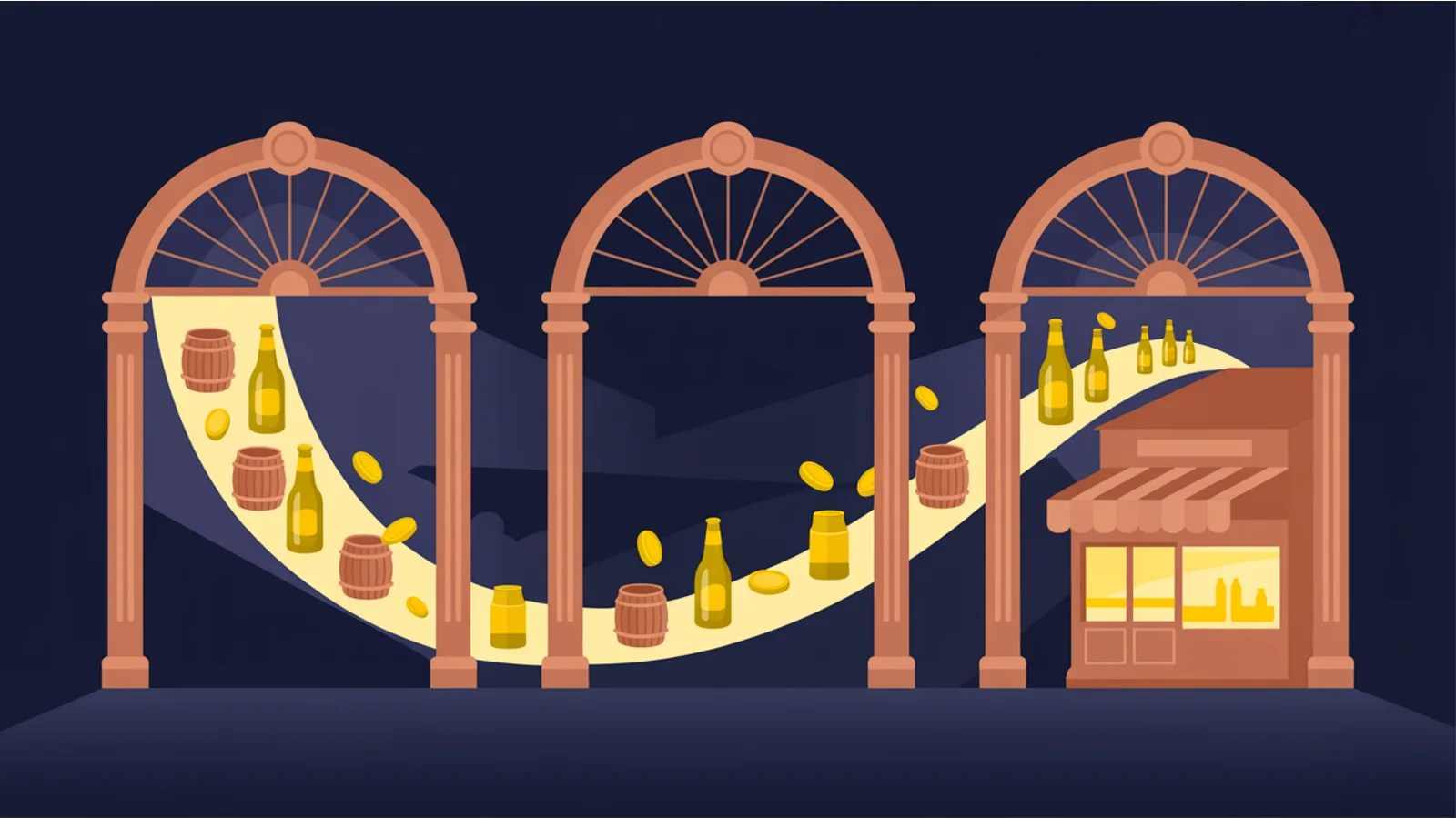
Nineteenth in a series on jobs whose pay system is stranger than the salary. Earlier entries covered harbor pilots, whose roster is capped by a state board, and taxi medallion owners, who hold a paper license a city refuses to print more of. Beer distributors belong right beside them, because a distributor's real asset is not the trucks or the warehouse. It is a state-enforced right to be the only company a brewer is allowed to sell through in a given territory, plus a second state law that makes that right nearly impossible to take back. Every figure below is cited to a statute, a state legislative research office, an industry economic study, or a court opinion, and where a number could not be verified at a primary source I say so rather than estimating.
Most jobs in this series are jobs. This one is closer to a toll booth that happens to own some trucks.
When Prohibition ended, the states did not simply let brewers sell beer to whoever would buy it. Nearly every state built a wall down the middle of the industry and required that alcohol pass through three separate, legally distinct hands: the producer who makes it, the wholesaler who warehouses and delivers it, and the retailer who sells it to you. No company is allowed to own businesses across those tiers. Then a majority of states bolted a second lock on top, the beer franchise law, which turns the wholesaler's slice of that wall into something a brewer can almost never dismantle.
The combined effect is the strangest pay structure in this whole series, because the distributor is not really being paid for labor at all. The distributor is collecting a fee on every case that flows through a piece of geography that the state has promised no one else may serve. That is why a family that bought one small Schlitz distributorship in the mid-1970s for $740,000 is now worth $31 billion.
The first lock: everything must pass through a wholesaler
The legal foundation is the 21st Amendment, the one that repealed Prohibition. It did more than legalize drinking. It handed the states sweeping power to regulate alcohol inside their borders, and almost all of them used that power to build the same basic machine, the three-tier system.
The three tiers are the producers, the brewers, distillers, and wineries who make the product; the wholesalers or distributors who buy from producers and sell to retailers; and the retailers, the stores, bars, and restaurants who sell to the public. The defining rule is that these tiers cannot be merged. The system prohibits what the trade calls tied-house arrangements, meaning no single entity may own businesses across the tiers. A brewer generally cannot own the trucks that deliver its beer to the bar, and cannot sell straight to the bar over the distributor's head. Minnesota, to take one state that spells the structure out cleanly, codified the whole apparatus in chapter 340A of its statutes.
Read what that does to the middle tier. In a normal industry, a manufacturer that dislikes its distributor can sell around it, deliver its own product, or set up a rival channel. Under the three-tier system, the producer is forbidden from doing any of those things. The wholesaler is not one option among several. The wholesaler is the only legal road from the brewery to the shelf. That is the first lock, and by itself it would make a distribution license valuable. The second lock is what makes it close to permanent.
The second lock: and the wholesaler can almost never be fired
A majority of states have enacted full beer franchise laws, and their features are remarkably consistent from state to state. They read less like commercial contracts and more like tenure.
Start with how the relationship begins. Under a typical franchise statute, the mere act of a brewer shipping beer to a wholesaler, even under an informal or oral arrangement, can create a franchise relationship. There is often no signature required. The shipment itself is the wedding.
Now look at how hard it is to end. Once that relationship exists, the brewer cannot simply walk away and pick a better distributor. Termination generally requires good cause, and the burden of proving that cause sits on the brewer. The wholesaler is entitled to advance written notice, commonly 60 or 90 days, and to an opportunity to cure whatever the brewer complained about. The specific clocks vary by state and they are not short. Florida's law (Fla. Stat. 563.021 to 563.022) runs on 90 days' notice. Texas (Tex. Alco. Bev. Code 102.51 and 102.71 to 102.82) pairs 90 days' notice with 90 days to cure. Maryland (Md. Code art. 2B, 17-101 to 17-107) is the most generous of the group I reviewed, 180 days' notice plus another 180 days to cure. Massachusetts runs its version through Mass. Gen. Laws ch. 138, sec. 25E, New York through Alcoholic Beverage Control Law sec. 55-c, and Minnesota through Minn. Stat. 325B.01 to 325B.17.
Then comes the feature that makes this an inheritance rather than a contract. When a distributor wants to sell the business or hand it down, the brewer usually cannot unreasonably withhold consent to the transfer, and in most states has little or no power to block a transfer to a designated family successor. The brewer's product can pass from a distributor to the distributor's child, and the brewer largely has to accept the heir.
And the whole structure is bolted shut against private bargaining, because a clause in which a wholesaler agrees to waive these protections is, by statute, void and unenforceable. A brewer cannot buy its way out at the negotiating table, because the state has declared the escape hatch illegal in advance.
Put the two locks together. The producer must sell through a wholesaler. The wholesaler, once shipped to, holds a good-cause-protected, notice-and-cure-protected, inheritable, non-waivable right to keep distributing that brand across a territory. That is not a job. That is a franchise on a scarcity the state itself enforces, which is the exact pattern under every high-paying entry in this series.
What the lock is worth
Here is the number that makes the abstraction concrete.
The Reyes family, whose fortune Forbes attributes plainly to food and beer distribution, is worth $31 billion. Their holding company, Reyes Holdings, reports roughly $45 billion in sales and more than 41,000 employees, and its Reyes Beverage Group is the largest beer distributor in the United States. I want to flag the revenue figure honestly, because Forbes and trade coverage have reported it variously as $44 billion, $45 billion, and higher across different years, so treat $45 billion as an approximate recent figure rather than an audited constant.
Now the origin. The business began in the mid-1970s, when the family bought a single small Schlitz beer distributorship in South Carolina for $740,000. From that one protected territory it grew by buying more of them. Reyes Holdings kept acquiring beer distribution operations across the country over the decades that followed and now ranks among the largest privately held companies in the country, co-chaired by brothers Chris and Jude Reyes with Duke Reyes as chief executive. That acquisition history is drawn from secondary business coverage rather than a company filing, so I label it as such, but the shape is unmistakable. A fortune measured in the tens of billions was assembled by collecting toll booths, one franchise-protected territory at a time.
This is the taxi medallion logic run at industrial scale and with far better legal armor. A medallion is a transferable license the city has stopped printing. A beer distributorship is a transferable license the state has stopped printing, and layered a franchise law on top so the brand you carry cannot fire you and mostly cannot stop you from handing the whole thing to your kids.
The margin, and how the money reaches a person
So what does the distributor actually charge for standing in the middle? A markup, applied to every case.
The distributor buys from the producer and resells to the retailer at a higher price, and the spread is the business. U.S. merchant wholesalers of beer, wine, and distilled spirits ran a gross margin of about 29.9 percent of sales in 2021. Craft-beer trade sources put the typical distributor gross margin somewhat lower, roughly 25 to 28 percent. Either way, the distributor adds on the order of 25 to 30 percent to the producer's price on the way to the shelf. Both of those margin figures come from secondary industry sources rather than a government audit, so read them as the industry's own accounting rather than a neutral measurement, but the order of magnitude is the point. Roughly a quarter to a third of the pre-retail price of your beer is the toll for crossing the middle tier.
And that toll is collected on an enormous flow. The wholesale tier of the U.S. beer industry directly employs 134,540 people, a figure up more than 2.5 percent over the prior decade. There are an estimated 6,134 firms in wholesale distribution of alcoholic beverages, of which 2,770, about 45.2 percent, supply malt beverages, a count that excludes the wholesale operations the major brewers run themselves. Across all three tiers, the beer industry generated $471.0 billion in economic output in the most recent study, about 1.58 percent of GDP, supported 2.42 million total jobs, and produced roughly $58.0 billion in taxes, which works out to 41.3 percent of the retail price a consumer pays. Anheuser-Busch, Molson Coors Beverage Company, and Yuengling are among the named major brewers whose product moves through that middle tier.
One caveat on those economic-impact numbers, and it matters. They come from Beer Serves America, a study by John Dunham and Associates commissioned by the Beer Institute and the National Beer Wholesalers Association, which are the industry's own trade bodies. The employment counts, the output figure, and especially the multipliers are industry-funded estimates, not disinterested government statistics. I am reporting them because they are the most complete figures available and because the direct-employment counts are the least speculative part, but the reader should file the whole set under industry framing rather than neutral data.
The tell: the people inside the warehouse are paid ordinary wages
Here is the part that proves the franchise, not the work, is what generates the money. The people who physically do the distributing are paid like anyone else who drives a truck or supervises a sales team.
I could only obtain a dated snapshot for this, and I want to be upfront about it. The most recent occupational wage figures I could retrieve for beer, wine, and liquor merchant wholesalers, the industry classification NAICS 4248, are from an archived May 2017 Bureau of Labor Statistics table, because the live bls.gov page would not load for me and no newer snapshot of that industry page was available. So treat the following as illustrative and roughly a decade stale, not current pay:
| Role inside beer/wine/liquor wholesalers (NAICS 4248, May 2017, dated) | Approx. annual |
|---|---|
| General and operations managers | $139,890 |
| First-line non-retail sales supervisors | $79,860 |
| Heavy tractor-trailer truck drivers | $44,500 |
| Driver/sales workers | $39,350 |
Those are normal industrial wages. A truck driver moving the beer earns in the mid-forties. A sales supervisor earns in the high seventies. Even the general manager, running the whole operation, is at about $140,000, a good salary and nothing like a fortune. Nobody inside the building is being paid $31 billion worth of anything.
That is the entire lesson of the series in one table. The workers are paid for their labor, at market rates for driving and supervising and selling. The staggering value sits somewhere else entirely, in the ownership of the franchise, the license to be the only lawful road for a brand across a territory. The wage compensates the work. The franchise captures the toll. They are two completely different economic objects, and only one of them makes a billionaire.
Please do not lean on the specific dollar figures in that table without refreshing them against current BLS data, and I want to note two other things I could not confirm at a primary source. A claim that surfaced in search results, that many states award treble damages to a distributor on wrongful termination, is not supported by the primary franchise-law survey I read, which describes reasonable compensation, fair-market-value payments, injunctions, and attorneys' fees rather than trebled damages, so I am not asserting treble damages. And no audited, primary per-territory valuation of what an individual protected distributorship is worth on resale was available. The franchise clearly carries large goodwill value, but any specific sale multiple you see quoted is a reporting estimate, not an audited figure.
The system the Supreme Court blessed, and its limit
You might expect a state-created chain of local monopolies to be constitutionally shaky. It is not. The Supreme Court has repeatedly upheld the basic architecture.
In Granholm v. Heald in 2005, the Court described the three-tier system as, in its words, unquestionably legitimate, quoting an earlier opinion. I want to be precise about that quotation's provenance, because I am relying on secondary legal summaries for the exact wording and internal attribution rather than the U.S. Reports text itself, so confirm it against the opinion before quoting it in anything load-bearing. The thrust, though, is well established. The states' power to force alcohol through three separated tiers is settled law.
There is a limit, and it arrived in 2019. In Tennessee Wine and Spirits Retailers Association v. Thomas, the Court clarified that blessing the basic three-tier model does not sanction every discriminatory feature a state chooses to bolt onto it. A state may build the three tiers. It may not use them as cover for rules that simply protect in-state incumbents against out-of-state competition for no legitimate reason. So the wall itself stands, but not every brick a state adds to it is automatically safe. That distinction, and the summaries of both opinions, come from secondary legal analysis rather than the primary opinion text, and I flag it as such.
The register is shrinking, which only concentrates the toll
One more structural fact, and it cuts the way you would expect for anyone who already owns a franchise. The number of these protected middlemen is falling.
The count of traditional beer distributors dropped from 4,595 in 1980 to around 3,000 by 2020, a long consolidation as larger operators bought up smaller territories, exactly the pattern the Reyes acquisition history illustrates. The broader category of licensed alcohol beverage wholesalers now numbers more than 20,000, but the specifically-beer distributor tier has been shrinking for four decades. Fewer owners, each holding more franchise-protected territory. When the asset is a state-enforced monopoly on a flow of goods, consolidation does not compete the margin away. It gathers more toll booths under fewer owners.
What a salaried reader should take from this
The valuable thing is the franchise, not the job. Everyone inside the warehouse, the drivers, the supervisors, the general manager, is paid an ordinary market wage for ordinary work. The billion-dollar value lives entirely in owning the license to be the only lawful channel for a brand across a territory. When you look at any lucrative business, separate the two questions cleanly: what is the labor worth, and what is the position worth. They are almost never the same number, and in the most extreme cases, like this one, they are not even close.
A law that makes you hard to fire is a form of pay. The beer franchise laws are worth studying precisely because they are pure structural protection with no wage attached. Good cause to terminate, 60 to 180 days of notice, a right to cure, protection for a family successor, and a ban on waiving any of it, all of that is value the distributor never negotiated for and the brewer cannot buy back. This is the same mechanism as the harbor pilots' capped roster and the longshoremen's closed register: the durable money comes from a rule someone else is forced to honor, not from your own skill or bargaining.
Ask who is legally forbidden from competing with you. A distributor's margin survives because the producer is barred from selling around it and no rival may serve the same protected territory. Whenever a business earns an unusually fat, stable margin, the first thing to look for is not how good it is but who has been legally prevented from undercutting it. A margin that anyone may attack gets competed to the floor. A margin the law fences off does not.
Watch the direction of consolidation. The distributor count fell from 4,595 to about 3,000 while the value climbed into the tens of billions. When an asset is a protected monopoly rather than a competitive service, a shrinking number of owners is not a warning sign of a dying industry. It is the sign of a toll being gathered into fewer hands. The same shrinking-register pattern that raises a longshoreman's wage raises a distributor's franchise value, for the same reason.
Related reading
- The Toll Booth: the full index: where this piece sits in the series on who collects rent on the things you cannot avoid, and every other toll alongside it.
- How taxi medallion owners are paid: the other transferable license a government stopped printing, and what happened when the scarcity broke.
- How harbor pilots are paid: a state board that votes on how many people may hold the job, and a pension funded by a levy on ships.
- How longshoremen are paid: a closed register and a cargo royalty that do what the wage does not.
- How union tradesmen are paid: the total package, and a third of the money that never touches the paycheck.
- COLA versus the merit raise: why a number set by rule pulls away from one set by discretion.
Fact-check notes and sources
The structural rules come from state statutes and a legislative research office. The economic figures come from an industry-commissioned study and trade bodies. The wealth figures come from Forbes and business press. The wage figures come from an archived federal survey. Where a figure is secondary, dated, or could not be verified at a primary source, it is flagged in the text and here.
- The three-tier structure and Minnesota's codification of it in chapter 340A, described there as created after Prohibition, are from the Minnesota House Research Department, "Minnesota's Three-Tier System of Liquor Regulation", a nonpartisan state legislative research office. That paper confirms the three-tier system and its statutory codification but does not itself spell out the tied-house and cross-tier-ownership prohibition or name the 21st Amendment; those are part of the general post-Prohibition legal framework, with the 21st Amendment's grant of state authority discussed in the Granholm and Tennessee Wine materials cited below.
- The typical features of beer franchise laws (a shipment creating a franchise relationship, good-cause termination with the burden on the brewer, 60 or 90 day notice, opportunity to cure, protection of family-successor transfers, and the non-waivability of these protections), and the specific state statutes and their notice/cure periods (Florida Fla. Stat. 563.021 to 563.022, 90 days; Texas Tex. Alco. Bev. Code 102.51 and 102.71 to 102.82, 90 days' notice and 90 to cure; Maryland Md. Code art. 2B 17-101 to 17-107, 180 days plus 180 to cure; Massachusetts Mass. Gen. Laws ch. 138 sec. 25E; New York N.Y. Alco. Bev. Cont. Law sec. 55-c; Minnesota Minn. Stat. 325B.01 to 325B.17) are from Marc E. Sorini (McDermott Will & Emery), "Beer Franchise Law Summary," prepared for the Brewers Association. A search-surfaced claim that many states award treble damages on wrongful termination is not supported by this survey, which describes reasonable compensation, fair-market-value payments, injunctions, and attorneys' fees, so treble damages are not asserted here; verify against individual state statutes before relying on them.
- The wholesale-tier employment figure of 134,540, the estimate of 6,134 alcoholic-beverage wholesale firms with 2,770 (45.2 percent) supplying malt beverages, the $471.0 billion in total industry output (about 1.58 percent of GDP), 2.42 million total jobs, roughly $58.0 billion in taxes equal to 41.3 percent of retail price, and the named brewers are from Beer Serves America 2024 (John Dunham and Associates, for the Beer Institute and the National Beer Wholesalers Association), May 2025. This is an industry-commissioned econometric study; its economic-impact and multiplier figures are industry estimates, not neutral government data, and are labeled as such above.
- The decline in the number of traditional beer distributors from 4,595 in 1980 to around 3,000 in 2020, the figure of more than 20,000 licensed alcohol beverage wholesalers, and the statement that the three-tier system requires beer distributors to sell to beer retailers are from the National Beer Wholesalers Association, Industry Fast Facts. NBWA is a trade body; its employee-count figures derive from the same John Dunham and Associates study cited above.
- The Reyes family net worth of $31 billion, attributed to food and beer distribution, along with Reyes Holdings' roughly $45 billion in sales, 41,000-plus employees, and the mid-1970s purchase of a Schlitz distributorship in South Carolina for $740,000, are from the Forbes Reyes family profile. Reyes Holdings revenue has been reported variously as $44 billion, $45 billion, and higher across different years, so the exact figure should be pinned to a single dated Forbes figure before being restated. The founding year is not clean across sources (Forbes narrative text says 1974, Crain's says the mid-1970s, and only a Forbes data field says 1976), so it is given here as "the mid-1970s" rather than a single year; the $740,000 Schlitz-in-South-Carolina purchase itself is well corroborated.
- The acquisition history (an aggressive, multi-decade record of buying up beer distribution operations), the company's status as the biggest U.S. beer distributor, its ranking among the largest privately held U.S. firms, and the roles of Chris, Jude, and Duke Reyes are from Crain's Chicago Business, "How Reyes Holdings became the biggest beer distributor in the U.S." and are treated as secondary. The specific count of "more than 130" acquisitions that circulates is not stated in the cited article and is not asserted here.
- The Supreme Court's "unquestionably legitimate" description of the three-tier system in Granholm v. Heald, 544 U.S. 460 (2005), and the limiting holding of Tennessee Wine and Spirits Retailers Association v. Thomas (2019), are summarized from GrayRobinson, "The Supreme Court Speaks: Tennessee Wine & Spirits Retailers Assn. v. Thomas" and are treated as secondary. The exact page, wording, and internal attribution of the "unquestionably legitimate" quotation (Granholm quoting North Dakota v. United States) were taken from secondary legal summaries, not the opinion text; confirm against the U.S. Reports before quoting.
- The wholesale gross margin of about 29.9 percent of sales in 2021, and the roughly 25 to 28 percent typical craft-distributor margin, are from Statista, "Share of gross margin of U.S. beer sales" and ProBrewer's "Distribution 101," and are treated as secondary industry accounting rather than a government measurement.
- The occupational wages inside NAICS 4248 (general and operations managers about $139,890; first-line non-retail sales supervisors about $79,860; heavy tractor-trailer drivers about $44,500; driver/sales workers about $39,350) are from the BLS Occupational Employment Statistics for NAICS 4248, archived October 2017 snapshot via the Wayback Machine. These are a dated May 2017 snapshot, retrieved only because the live bls.gov page would not load for me and no newer snapshot of the industry page was available. Treat them as illustrative and roughly a decade stale, and refresh against current bls.gov/oes data before relying on any figure. No audited primary valuation of an individual protected distributorship's resale value was located; any specific sale multiple is a reporting estimate.
This post is informational and journalistic, not career, legal, or financial advice. It describes state statutes, a state legislative research office, an industry-commissioned economic study, business-press reporting, and an archived federal wage survey. Statutes, margins, rosters, and wealth figures change, and several figures are dated as noted, so verify current status before relying on any of them. Mentions of specific companies, families, states, and trade bodies are nominative fair use, and no affiliation is implied.
