
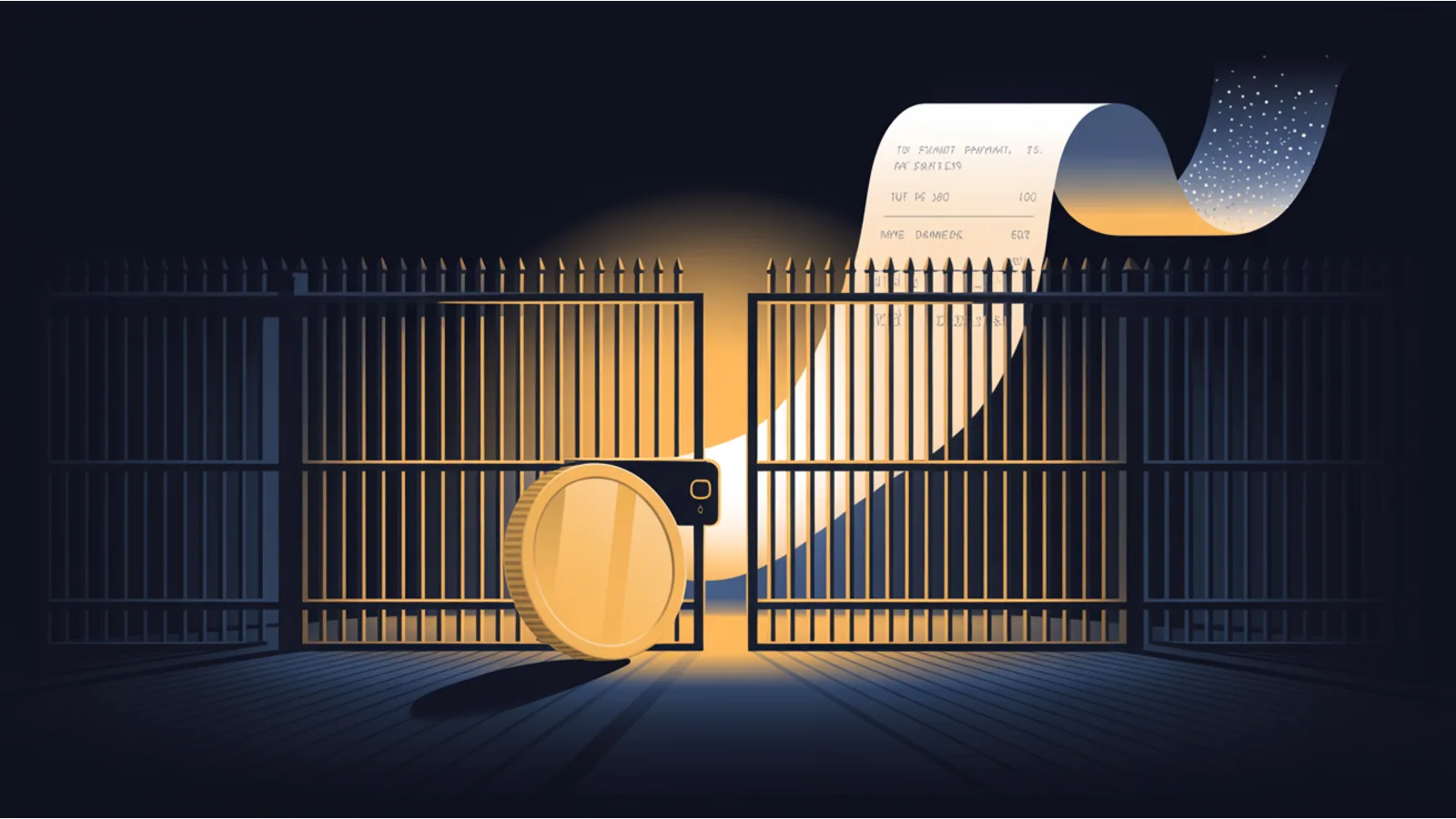
Twenty-third in a series on jobs whose pay system is stranger than the salary. It runs right beside its own collections arm, the bounty hunter, and it belongs in the same cluster as the taxi medallion owner, the alcohol distributor, and the police officers whose arrests supply its customers. The bondsman does not sell labor. He sells a key to a door the state locked, and he charges a toll to open it. Every figure below is cited to a statute, a state insurance regulator, a Supreme Court opinion, or a named secondary compilation, and where a number could not be verified at a primary source I say so rather than estimating.
Most jobs in this series collect a toll on a scarcity that somebody else enforces. The bail bondsman collects a toll on the scarcest thing a government controls, which is your ability to sleep in your own bed while the case against you is still just an accusation.
Here is the deal in one sentence. The state arrests you and sets a bail figure. You almost certainly cannot post the whole thing in cash. So a state-licensed private insurance agent posts it for you, in exchange for a fee that is typically 10 percent of the bail amount, and that fee is his to keep. He keeps it if you are acquitted the next morning. He keeps it if the prosecutor drops the charges at noon. He keeps it if you attend every single court date for two years and are found innocent at the end. The premium buys your release, and nothing you do afterward earns any of it back.
That is the whole business. Everything else is machinery built to protect it.
The fee is earned the moment the door opens
Start with the price, because the price is fixed by the state and it does not move.
In California the regulator that governs this trade is not a court. It is the Department of Insurance, and it is explicit about the number. Its consumer guidance states that the cost "is most commonly ten percent of the total amount of the bond, plus actual, necessary, and reasonable expenses." Surety companies must file their rates with the department, and a bail agent representing a surety "must charge the same filed rates." So the 10 percent is not a haggle. It is a filed price, the same way a utility files a tariff.
Then comes the part that makes this pay structure genuinely strange. The same California regulator states, in plain words, that "premiums are nonrefundable even if charges are dropped." The only path to any refund is narrow: the money comes back, minus administrative costs, only if the bailee is surrendered before the surety's liability attaches. Attend court, behave, win your case, and the outcome for the bondsman's wallet is identical to the outcome if you had done nothing at all. The fee was fully earned the instant the cell door opened.
Florida draws the line even harder. Under Chapter 648 of the Florida Statutes and the insurance rules beneath it, the premium "may not exceed or be less than the premium rate as filed with and approved by the office." The standard rate there is the same 10 percent, with a $100 minimum, and the premium is generally fully earned once the defendant is released. A refund exists in theory only where the surety had no liability under the bond in the first place, for instance where the court lacked jurisdiction or the defendant was never actually released. The filed-rate rule itself is confirmed at section 648.33 of the Florida Statutes. The specific 10 percent rate and the $100 minimum are not written into Chapter 648; they live in the rate filings and the insurance rules, so treat those two figures as reported rather than confirmed at the statute. The shape is not in doubt. You cannot be charged more than the filed rate, you cannot be charged less, and once you walk out the money is gone.
Notice what the fixed price does. It removes the one thing that normally disciplines a price, which is a customer shopping around. Every agent charges the state-filed rate, so there is nothing to shop. And the buyer is a person sitting in a jail cell, which is not a setting that produces careful comparison of vendors.
The insurer that almost never has to pay
A bail bond is nominally an insurance product. The agent posts a surety bond backed by an insurance company, and the theory is that the surety is taking a risk: if you skip court, the surety owes the full face amount of the bond to the state. For carrying that risk, the story goes, the surety earns its premium.
The trouble with the story is the loss data.
According to a Columbia Law Review study of the industry, the surety business is both concentrated and nearly riskless. Just nine companies control the roughly thirty surety corporations that underwrite the vast majority of the $14 billion in bail bonds written each year, and the industry earns about $2 billion in revenue annually. And the losses? In 2012, the study reports, the entire industry cumulatively paid out less than 1 percent in forfeiture losses.
Sit with that ratio. An industry that collects around $2 billion in premiums to insure against defendants fleeing paid, in the year measured, under 1 percent of that in actual forfeitures. That is not what carrying risk looks like. That is what selling a product that almost never triggers looks like. These figures are a reputable secondary compilation rather than a government audit, and the 2012 loss number predates 2023, so I flag its vintage. But even generously, an insurer paying pennies on the premium dollar is not being paid for bearing risk. It is being paid a toll.
And when a forfeiture does happen, the surety has usually pushed the risk downhill anyway, which is the next piece.
Where the premium actually goes
The person who signs your bond and the company whose paper backs it are not the same party, and they split your fee in a way that quietly loads the real risk onto the agent, not the insurer.
The mechanism has a name: the build-up fund, or BUF. The Columbia Law Review study describes how surety companies require the bondsman to set aside an additional portion of the premium the arrestee paid, usually another 10 percent, into a build-up fund held by the surety as a reserve against forfeitures. So the agent does not simply pocket the fee and pass a cut upward. He is required to pre-fund the very losses the surety is supposedly insuring, out of his own share. The insurer collects its cut and holds the agent's money as a cushion, which is a large part of why the insurer's own losses stay under 1 percent.
How much does the agent actually keep? A common secondary explainer puts the typical split at roughly 40 to 50 percent of the premium landing with the bondsman, with the rest, including the build-up fund, going to the surety. I want to be honest about that number: it comes from a legal explainer, not from a statute or a regulator, and real splits vary widely by contract, by volume, and by state. I could not confirm it at a primary source, so treat 40 to 50 percent as illustrative rather than established. The BUF figure, the roughly 10 percent diverted into the reserve, is the more authoritative one, and it comes from the law review study.
The point that survives the uncertainty is the direction of the risk. The insurer's name is on the bond, but the agent's money is in the reserve. The toll is collected at the top and the risk is parked at the bottom.
The recovery power the Supreme Court handed the collector
If the agent keeps the fee and pre-funds the losses, he has every incentive to make sure a forfeiture never happens. That is where the second job in this pair begins, and where the law hands the bail industry a power that exists almost nowhere else in American life.
The source is a Supreme Court opinion from 1872, Taylor v. Taintor. In it the Court described the released defendant as delivered into the custody of the people who bonded him, and the language is worth reading in full because it is still cited today:
When bail is given, the principal is regarded as delivered to the custody of his sureties. Their dominion is a continuance of the original imprisonment. Whenever they choose to do so, they may seize him and deliver him up in their discharge... They may pursue him into another State; may arrest him on the Sabbath; and if necessary, may break and enter his house for that purpose.
Read what that grants. A private party may cross state lines, act on a Sunday, and break into a home, to recover a person, without the warrant a police officer would need for any of it. The defendant is treated as still imprisoned, merely with his jailer changed from the state to the surety who paid for his release. That is the legal engine behind the bounty hunter, the collections arm of this same toll. The bondsman owns the tollbooth on pretrial liberty. The recovery agent is what he sends when a customer tries to leave without the state getting its bond back.
This is the structural link between the two entries in this pair. One sells the key. The other retrieves the person if the key gets misused. Both are paid because the state's power to jail you before trial is the scarcity, and private parties have been licensed to stand in the doorway and charge for passage through it.
The two-country business, and the states walking out of it
Here is the fact that tells you this is not a law of nature but a policy choice: almost no other country does it.
Commercial money bail, the for-profit posting of bonds by private agents for a fee, is essentially legal in only two countries on earth, the United States and the Philippines. The Columbia Law Review study makes the claim, and PolitiFact rated a nearly identical statement Mostly True, citing scholarship by F.E. Devine and Shima Baradaran Baughman's book on bail. Everywhere else, the function the bondsman performs is either handled by the courts directly or does not exist, because pretrial release is not treated as something a private party should profit from.
Inside the United States, the walkout has already started. Four states, Illinois, Kentucky, Oregon, and Wisconsin, had long since banned commercial bail bonding outright, replacing it with court-run deposit systems where you post a percentage directly to the court and get it back, and Massachusetts effectively ended the practice by 2014. I could not confirm the individual enactment years for the Kentucky, Oregon, and Wisconsin bans at primary statute level, and whether a handful of other jurisdictions belong on the list depends on how you define a ban, so the count of states without commercial bail is sometimes given as four, sometimes higher. The four-state core is well corroborated. The exact edges are not, and I am not asserting them.
The sharpest recent move is Illinois. Under the Pretrial Fairness Act provisions of the SAFE-T Act, Illinois eliminated cash bail statewide, effective September 18, 2023, after the Illinois Supreme Court upheld the law on July 18, 2023, and it is widely described as the first state to do so. In Illinois there is now no premium to charge, because there is no cash bail to post. The tollbooth was not reformed. It was removed.
That is the thing to watch about this whole trade. Its revenue depends entirely on a policy, the use of money as the price of pretrial freedom, and that policy is under active political withdrawal in a way that a wage never is. A longshoreman's register or a harbor pilot's cap has to be pried loose by the incumbents. This tollbooth can be closed by a legislature deciding that liberty should not have a filed rate.
The job the federal statistics cannot price
One more oddity, and it is the same one that recurs across this series: the federal government barely counts these people, so honest nationwide pay data almost does not exist.
There is no dedicated Bureau of Labor Statistics occupation code for bail bond agents. They are not separately surveyed. They fall, to the extent they are counted at all, under the generic category of Insurance Sales Agents, Standard Occupational Classification 41-3021, which on the most recent Bureau of Labor Statistics release reported roughly 457,510 employees at a mean annual wage around $79,700. I have to be blunt about that figure: it is the mean for all insurance sales agents, the people selling auto and life and homeowners policies, not for bail agents specifically. It must not be read as bondsman income. It is simply the bucket the government drops them into for lack of a better one.
Meanwhile the one hard headcount I could confirm comes not from a labor agency but from an insurance regulator. California licenses approximately 2,300 bail agents and bail organizations through its Department of Insurance, because in California the licensing of this trade sits with insurance regulators, not with the courts. That is the tell about what the job legally is. The people who unlock jail cells are licensed the way people who sell annuities are licensed. And an insurer, under California Insurance Code section 1800, "shall not execute an undertaking of bail except by and through a person holding a bail license issued as provided in this chapter." The license is the gate. A total nationwide count of licensed bail agents was not available at any primary source I found, so I am not publishing one.
There is one more price wrinkle worth naming. The 10 percent standard is a state-court rate. For federal charges, and in some jurisdictions, the premium runs higher: bond agents are commonly described as charging 10 percent for a state charge and 15 percent for a federal one, with the same $100 minimum. That figure comes from a secondary reference rather than a filed federal tariff, so treat the 15 percent as reported rather than confirmed at primary.
What a salaried reader should take from this
A non-refundable fee is a toll, not a payment for service. The single strangest fact about bondsman pay is that the fee is fully earned the moment you are released and is owed the same whether the case ends in acquittal, dismissal, or conviction. You are not buying an outcome or an hour of labor. You are buying passage through a door, and the price of passage does not depend on where you go afterward. Whenever a fee is unrelated to results and unrelated to hours, ask what scarcity it is really charging for. Here the scarcity is your own liberty, and the state supplies it.
Look for who bears the risk versus who collects the fee. The bond is insurance in name, but the insurer paid under 1 percent in losses while the agent is required to pre-fund forfeitures through a build-up fund out of his own share. The party whose name is on the paper is not the party with money at stake. That gap, between the entity that appears to carry the risk and the entity that actually does, is where a lot of financial products hide their real economics. Read the reserve, not the letterhead.
A toll survives only as long as the policy behind it. Unlike a licensed profession defended by incumbents, this trade depends on a single policy choice, that money should be the price of pretrial freedom, and that choice is being reversed. Illinois abolished cash bail outright, four states banned commercial bonding long ago, and the whole business exists in essentially two countries. A pay structure built on a policy toll is only as durable as the policy, and policies get repealed in a way that seniority lists and medallions do not.
When the government will not count a job, be suspicious of every quoted wage for it. There is no federal wage code for bail agents, so the numbers floating around are either regulator headcounts, like California's 2,300 licensees, or borrowed from the generic insurance-agent bucket, like that $79,700 mean that does not describe bondsmen at all. A field the statistics cannot see is a field where you should trust primary licensing and rate filings over any tidy national average, because the tidy national average is measuring somebody else.
Related reading
- The Toll Booth: the full index: where this piece sits in the series on who collects rent on the things you cannot avoid, and every other toll alongside it.
- How bounty hunters are paid: the collections arm of this same toll, and the 1872 recovery power that makes it possible.
- How taxi medallion owners are paid: another government-created scarcity you pay a private party to pass through.
- How alcohol distributors are paid: a licensed middleman standing in a doorway the state built.
- How police officers are paid: the arrests at the front of the pipeline that supply this trade its customers.
- How court reporters are paid: another courthouse role priced by rule rather than by market.
Fact-check notes and sources
The rate rules come from state insurance regulators and statutes. The industry economics come from a named law review study. The recovery power comes from a Supreme Court opinion. Where a figure is secondary or could not be verified at a primary source, it is flagged in the text and here.
- The requirement that bail be executed only through a state-licensed person is California Insurance Code section 1800: "An insurer shall not execute an undertaking of bail except by and through a person holding a bail license issued as provided in this chapter."
- The 10 percent filed premium, the rule that agents must charge the filed rate, the statement that premiums are nonrefundable even if charges are dropped, and the approximately 2,300 licensed bail agents and organizations are all from the California Department of Insurance Bail Bonds consumer page and FAQ. The refund exception applies only where the bailee is surrendered before liability attaches, minus administrative costs.
- The Florida filed-rate rule (a bail premium may not exceed or be less than the rate filed with and approved by the office) is confirmed at Florida Statutes section 648.33. The specific standard 10 percent rate, the $100 minimum, and the "earned on release, refundable only where the surety had no liability" mechanics are not written into Chapter 648 itself; they live in the rate filings and the insurance rules, so those specifics are reported rather than confirmed at the statute.
- The industry figures (nine companies controlling roughly thirty sureties, about $14 billion in bonds written each year, roughly $2 billion in revenue, and less than 1 percent paid in forfeiture losses in 2012), and the build-up fund mechanism (the agent required to set aside an additional roughly 10 percent of the premium into a BUF reserve held by the surety), are from the Columbia Law Review, "Corporate Manipulation of Commercial Bail Regulation". This is a reputable secondary compilation; the underlying loss data is from 2012 and may be dated, so its vintage is flagged.
- The 40 to 50 percent agent share of the premium is from LegalClarity, "How Bail Bondsmen Make Money" and is unverified: it comes from a secondary explainer, not a statute or regulator, and actual splits vary by contract, volume, and state. It is presented as illustrative, not established. The more authoritative figure is the roughly 10 percent BUF diversion from the law review study above.
- The recovery power over the released defendant is from Taylor v. Taintor, 83 U.S. (16 Wall.) 366 (1872), quoted directly from the opinion text.
- The four-state ban on commercial bail bonding (Illinois, Kentucky, Oregon, and Wisconsin, with Massachusetts effectively ending the practice by 2014) is from Wikipedia's "Bail bondsman" article, citing governing and Office of Justice Programs sources. The four-state core is well corroborated; the individual enactment years and whether additional jurisdictions belong on the list were not confirmed at primary statute level and are not asserted.
- Illinois abolishing cash bail under the SAFE-T Act Pretrial Fairness Act, effective September 18, 2023, after the Illinois Supreme Court upheld the law on July 18, 2023, is from Illinois Legal Aid Online and corroborating reporting, treated as secondary. The "first state" framing is widely reported general knowledge; the cited legal-aid page documents the abolition and its dates but does not itself use the word "first."
- The claim that the United States and the Philippines are essentially the only countries with a legal commercial money-bail industry is from the Columbia Law Review study above and the PolitiFact fact-check of October 9, 2018, which rated a similar claim Mostly True, citing F.E. Devine (1991) and Shima Baradaran Baughman's "The Bail Book" (2017). Treated as secondary.
- The absence of a dedicated federal occupation code, with bail agents falling under Insurance Sales Agents SOC 41-3021 at roughly 457,510 employees and a mean annual wage around $79,700 on the current release, is from the Bureau of Labor Statistics occupation structure. The $79,700 mean is for all insurance sales agents, not bail agents specifically, and must not be read as bondsman income. The "no dedicated code" point is established by the absence of a bail-specific line rather than an explicit BLS statement. A nationwide count of licensed bail agents was not located at a primary source and is not asserted.
- The higher federal premium (commonly 10 percent for a state charge and 15 percent for a federal charge, with a $100 minimum) is from Wikipedia's "Bail bondsman" article and is secondary; the 15 percent figure is reported rather than confirmed at a primary federal tariff.
This post is informational and journalistic, not legal, career, or financial advice. It describes statutes, state insurance regulator guidance, a Supreme Court opinion, and named secondary studies. Rates, licensing rules, and the laws governing cash bail change, and several figures are as of dates ranging from 1872 to 2026 as noted, so verify current status before relying on any of them. Mentions of specific agencies, states, and studies are nominative fair use, and no affiliation is implied.
