
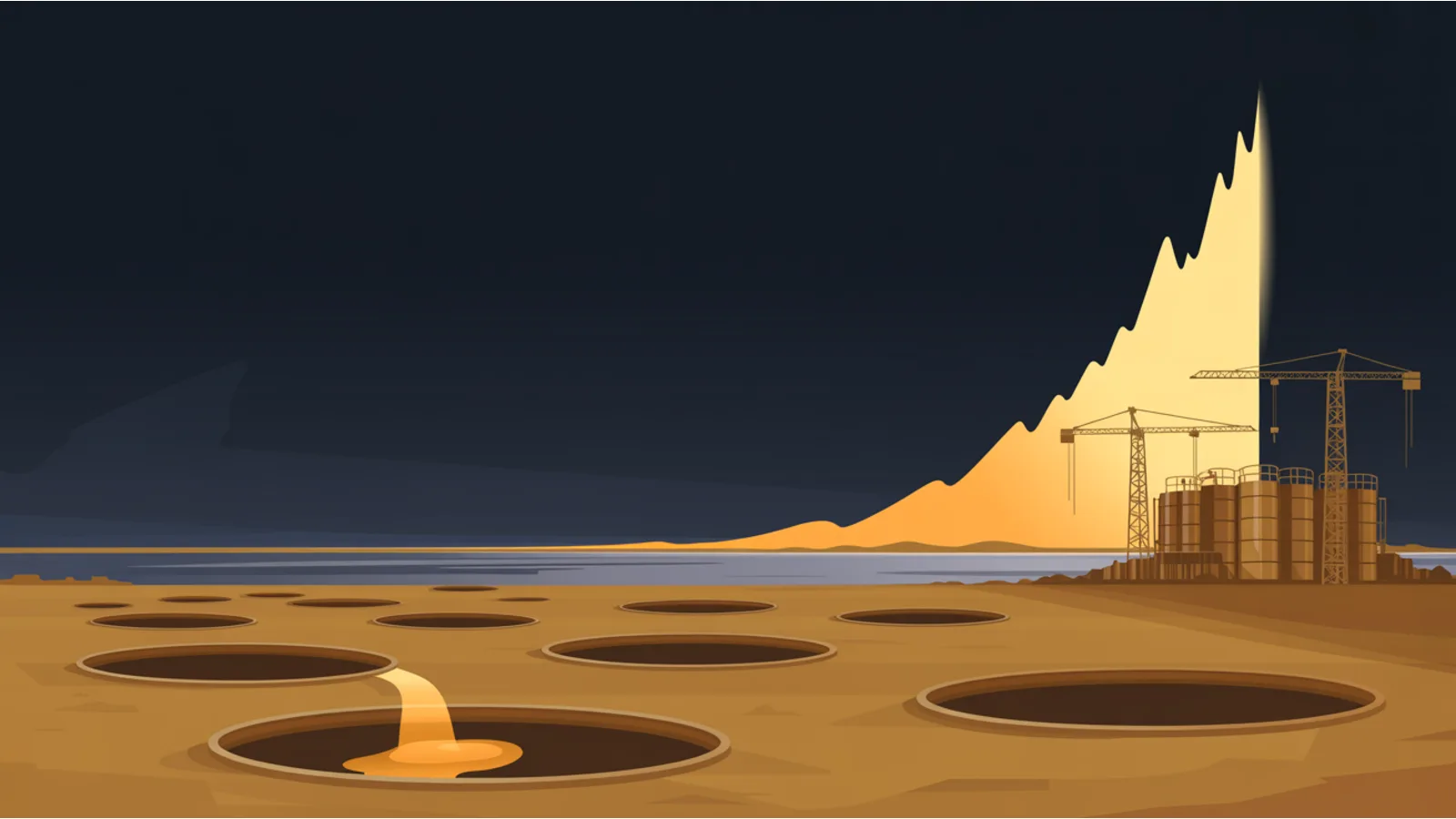
Along a bend of the Columbia River in south-central Washington sits about 56 million gallons of some of the most dangerous waste the United States has ever produced. It is stored in 177 underground tanks, most of them decades past their design life, and the government has been trying to build a plant to turn that waste into stable glass since the year 2000. On October 15, 2025, roughly 25 years after the contract was signed and 14 years after the plant was originally supposed to be finished, the first radioactive waste was finally vitrified. The most complex part of the plant, the piece meant to handle the highest-activity waste, still is not running.
Hanford is the clearest case in the federal government of a cleanup obligation that is genuinely unavoidable and a construction project that is a textbook cost-and-schedule failure at the same time. Both statements are true, both are sourced to the government's own auditors, and neither cancels the other out. This is what the record shows.
What Hanford is, and why the waste exists
From 1944 to 1989 the Hanford Site produced about 74 tons of plutonium for the U.S. nuclear weapons program, according to the Department of Energy's Office of Environmental Management. That included the plutonium for the "Fat Man" bomb dropped on Nagasaki in 1945 and the material for the Cold War arsenal that followed. Hanford's B Reactor was the world's first full-scale plutonium production reactor.
The plutonium is long gone into weapons. What remains is the chemical residue of making it: highly radioactive and chemically toxic sludge, saltcake, and liquid, stored in tanks a few miles from the Columbia River. DOE and the Washington State Department of Ecology both describe Hanford as the most contaminated nuclear site in the United States. That characterization is close to universal across DOE, the National Park Service, and independent reporting.
The waste is not a local Washington problem. It is the direct byproduct of a national decision to build the bomb and then an arsenal the country credited with deterrence. The cleanup is a debt the whole nation incurred.
The mess: 177 tanks, and the leaks
The waste sits in 177 underground tanks. Washington Ecology and DOE count 149 older single-shell tanks and 28 newer double-shell tanks, holding about 56 million gallons in total. The Government Accountability Office, in its 2023 report GAO-23-106880, rounds the figure to 54 million gallons. The small gap reflects rounding and evolving waste-volume accounting, not a factual dispute; cite the source for whichever number you use.
The tanks are the urgent part of the story. At least 67 of the older single-shell tanks are assumed to have leaked roughly 1 million gallons of waste into the surrounding soil over the decades, according to Washington Ecology, and some of that contamination has reached groundwater. Ecology and DOE distinguish that historical total from the much smaller number of tanks considered to be actively leaking now. Three tanks currently fall into that category: T-111, declared leaking in 2013; B-109, declared leaking in April 2021 at a rate of a few gallons a day; and T-101, whose suspected leak was announced in August 2024 at an estimated couple hundred gallons a year. A separate agreed order between DOE and Ecology followed in November 2024; that enforcement agreement is a different event from the leak declaration itself.
The stakes are geographic. The Columbia is the largest river in the Pacific Northwest, a drinking-water source, a salmon fishery, and a resource protected by tribal treaty rights. Contamination moving through the groundwater could reach the river within decades if the tanks are not emptied and the waste treated. The leaks are, in effect, racing the cleanup.
The plant: from $4.3 billion to something past $17 billion
The plan to deal with the tank waste is vitrification: mixing the waste with glass-forming materials, melting the mixture, and pouring it into steel containers, so the radionuclides are locked into a solid, stable glass log rather than left as mobile liquid and sludge. In 2000 DOE awarded Bechtel National an 11-year contract worth about $4.3 billion to design and build the Waste Treatment and Immobilization Plant, known locally as the Vit Plant. GAO confirmed those terms in its 2006 testimony GAO-06-602T. The plant was originally scheduled for completion around 2011. (Some press accounts cite a roughly $5.8 billion original completion estimate rather than the $4.3 billion contract value; those are two different figures for two different things and should not be blended.)
The cost did not hold. By May 2006 GAO described the estimate as "about $11 billion," an increase of more than 150 percent, in GAO-06-602T. (A frequently repeated interim figure of $10.4 billion circulates for that period; GAO's own wording is closer to $11 billion, so treat $10.4 billion as approximate.) The project was re-baselined at roughly $16.8 billion in 2017 in widely reported figures, and current estimates run from about $17 billion to $20 billion to complete the entire plant. The American Nuclear Society has characterized total design and construction investment over more than two decades as exceeding $30 billion; that is a press characterization and is worth attributing as such rather than stating flatly.
One point matters more than any of the individual numbers: the roughly $17 billion to $20 billion Vit Plant figure is the cost of one facility. It is not the same as the site-wide cleanup cost discussed below, which is far larger. The two are routinely conflated, and they are different scopes.
What "started" and what did not
The framing that the plant "still is not running" was accurate for most of its history but is no longer complete. On October 15, 2025, DOE's Office of Environmental Management and Bechtel announced the start of nuclear, or "hot," vitrification of low-activity waste at the plant's Low-Activity Waste Facility, using an approach called Direct-Feed Low-Activity Waste, or DFLAW. Washington Ecology, the American Nuclear Society, and Bechtel all confirm the date. In DFLAW, tank waste is fed to the low-activity facility, melted at roughly 2,100 degrees Fahrenheit in 300-ton melters, and poured into stainless-steel containers.
That is a genuine milestone. It is also a partial one. The High-Level Waste Facility, the piece meant to immobilize the most radioactive fraction of the waste, was paused in 2012 over unresolved technical and safety questions and still is not operating. So the honest statement in late 2025 is that low-activity vitrification has begun after 25 years, while the hardest part of the plant remains idle more than a decade after it was halted.
The DFLAW and High-Level Waste distinction is not a technicality. The low-activity stream is the larger volume but the less difficult problem; the high-level stream is the engineering challenge that drove much of the delay, and its facility is the one that is still down.
The accountability record: two civil settlements
The Vit Plant also produced a documented record of contractor billing problems and one prominent whistleblower dispute. Precision matters here, because a sibling site in this series involved actual criminal convictions and Hanford did not.
Walter Tamosaitis, a research manager for the WTP subcontractor URS, raised concerns beginning in 2010 that inadequate mixing of the waste, using pulse-jet mixers, risked plutonium settling and hydrogen-gas buildup, which in turn raised explosion and criticality concerns. Days after presenting a list of unresolved technical issues in 2010, he was removed from the project and reassigned to a basement office. He sued, and in August 2015 he received a $4.1 million settlement with AECOM, which by then had acquired URS. His technical concerns were real and hotly disputed at the time; DOE and the Defense Nuclear Facilities Safety Board stated in 2019 that the underlying technical challenges had been resolved. The accurate framing is a historical safety dispute later addressed, not a plant that is currently unsafe.
Two civil False Claims Act settlements followed, and they are separate cases with separate whistleblowers.
- On November 23, 2016, Bechtel National and URS/AECOM agreed to pay $125 million to resolve allegations that they charged DOE for deficient nuclear-quality materials, services, and testing at the plant, and that they improperly used federal contract funds to lobby Congress, including to cut DOE's own independent oversight budget. The case originated in a 2013 qui tam suit by Tamosaitis, Donna Busche, and Gary Brunson, who received a reported whistleblower share of about $31.25 million. The DOJ announcement is from the U.S. Attorney's Office for the Eastern District of Washington.
- In September 2020, Bechtel National and AECOM agreed to pay $57.75 million to resolve separate allegations that they knowingly mischarged the government for labor hours that employees did not actually spend working on the plant, covering idle time from 2009 to 2019. That case came from a different qui tam suit filed in 2017 by four other WTP whistleblowers, who received about $13.7 million.
Both matters are civil settlements. Each resolved allegations, and in each the companies did not admit liability. Neither is a criminal conviction, and neither should be described as one. They are also distinct cases and should not be merged into a single "fraud settlement."
The GAO overhang: the High-Risk List and the grout debate
Hanford does not sit inside a healthy oversight picture. GAO has placed DOE's cleanup of radioactive and hazardous waste on its High-Risk List, and it has repeatedly flagged DOE's cost and schedule estimates as unreliable. As of fiscal year 2024, GAO reports, DOE carried $544 billion in reported environmental liabilities, of which more than $417 billion was for the Office of Environmental Management. Hanford alone accounted for about $265 billion of that EM liability, over 65 percent, as of fiscal year 2021, up from roughly $73 billion in 2011. These figures escalate year over year, so the fiscal year attached to each one is load-bearing.
The site-wide lifecycle cost is the number most easily confused with the Vit Plant cost, and it is far larger. DOE's 2022 Hanford Lifecycle Scope, Schedule and Cost Report estimated remaining cleanup at $300.2 billion in the low case, with work ending around 2078, to $640.6 billion in the high case, ending around 2087. GAO cites that range. The 2025 update, now public as a primary DOE document, estimates a deterministic baseline of about $364 billion and a high-range figure of about $589.4 billion, with a schedule running to 2086 and long-term stewardship to 2100.
GAO has also questioned the treatment strategy itself. In GAO-23-106880 the office estimated that vitrifying the low-activity waste would cost about $70 billion for roughly 50 million gallons, versus about $7 billion to treat roughly 36 million gallons of comparable salt waste by grouting at the Savannah River Site in South Carolina. GAO concluded DOE could save approximately $95 billion, escalated over 50 to 60 years, by grouting a portion of the low-activity waste rather than vitrifying all of it. This is a GAO recommendation, not settled policy. Grouting is technically and politically contested: Washington State and other stakeholders have resisted it over questions about the grout's durability and regulatory acceptance, and the waste is currently managed as high-level waste by policy, so DOE would need clarified authority to change course. Present it as GAO's estimate and recommendation, not as an established fact.
The failure and the mission, side by side
The efficiency critique is straightforward and comes largely from the government's own auditors. A plant contracted in 2000 for about $4.3 billion and due in 2011 instead ran to an estimated $17 billion to $20 billion and did not vitrify any waste until October 2025. Its hardest component has been paused since 2012 and still is not operating. GAO has judged DOE's estimates unreliable, placed the cleanup on its High-Risk List, and calculated that a different treatment approach could save roughly $95 billion. Two civil False Claims Act settlements, $125 million and $57.75 million, resolved allegations of deficient nuclear-quality work, mischarged labor, and, in one case, lobbying to weaken the government's own oversight. All the while the tanks kept leaking, roughly a million gallons already assumed lost to the soil, with three tanks actively leaking as the plant crawled toward operation.
The public-good defense is equally real, and it does not depend on excusing any of the above. The waste is genuinely dangerous, and dealing with it is not optional. Fifty-six million gallons of radioactive and chemically toxic material sits a few miles from the Columbia River, a drinking-water, salmon, and treaty resource, with groundwater contamination already moving. Doing nothing is neither a lawful nor a moral option. Vitrification is a technically serious answer to a genuinely hard problem: no country had ever built a plant this large to immobilize tank waste of this complexity, and that difficulty is a real reason for delay and cost, not merely an alibi for it. The October 2025 start of low-activity vitrification is a concrete result after decades of paying to build the capability. And the debt is national, incurred by a country that made the plutonium and credited the arsenal with keeping the Cold War cold.
Both verdicts are supportable from the primary record. Hanford is at once an unavoidable national obligation and the most expensive environmental cleanup in the country's history, run through a plant whose cost and schedule performance its own government auditors have condemned. The tanks do not wait for that tension to resolve.
Fact-check notes and sources
- Hanford produced about 74 tons of plutonium from 1944 to 1989, including the plutonium for the Nagasaki bomb, and is described as the most contaminated nuclear site in the U.S.: U.S. DOE Office of Environmental Management.
- About 56 million gallons of waste in 177 tanks (149 single-shell, 28 double-shell); GAO rounds to 54 million gallons: Washington State Department of Ecology and GAO-23-106880.
- At least 67 single-shell tanks assumed to have leaked roughly 1 million gallons; three tanks (T-111 declared 2013, B-109 declared April 2021, T-101 suspected leak announced August 2024, with a DOE-Ecology agreed order in November 2024) currently considered actively leaking; Columbia River risk: Washington State Department of Ecology.
- 2000 Bechtel National contract of about $4.3 billion over 11 years, originally due around 2011, with cost rising to about $11 billion (over 150 percent increase) by 2006: GAO-06-602T. The $16.8 billion 2017 rebaseline and $17 billion to $20 billion completion figures are widely reported; the figure of more than $30 billion invested is a press characterization by the American Nuclear Society.
- Nuclear vitrification of low-activity waste began October 15, 2025, via DFLAW at the Low-Activity Waste Facility (2,100 degrees, 300-ton melters); the High-Level Waste Facility remains paused since 2012: Washington State Department of Ecology and the American Nuclear Society.
- Site-wide lifecycle cost of $300.2 billion (low, ending about 2078) to $640.6 billion (high, ending about 2087) in the 2022 DOE report, as cited by GAO: GAO-23-106880. The 2025 update of about $364 billion baseline and $589.4 billion high-range: DOE 2025 Hanford Lifecycle report, as reported by the American Nuclear Society.
- DOE reported $544 billion in environmental liabilities in FY2024, more than $417 billion for the Office of Environmental Management, with Hanford about $265 billion (over 65 percent of EM) as of FY2021; cleanup is on GAO's High-Risk List: GAO High-Risk (Environmental Liability) and GAO-19-460T.
- GAO estimate that vitrifying about 50 million gallons of low-activity waste would cost about $70 billion versus about $7 billion to grout about 36 million gallons at Savannah River, for roughly $95 billion in potential savings; a contested GAO recommendation: GAO-23-106880.
- Whistleblower Walter Tamosaitis raised mixing, hydrogen, and criticality concerns from 2010, was reassigned, and received a $4.1 million settlement in August 2015; DOE and the Defense Nuclear Facilities Safety Board stated in 2019 the technical challenges were resolved: U.S. Senate hearing record CHRG-113shrg88280.
- Civil False Claims Act settlement of $125 million (November 23, 2016) over deficient nuclear-quality work and improper lobbying, originating in a 2013 qui tam suit, with no admission of liability: U.S. DOJ, Eastern District of Washington.
- Separate civil False Claims Act settlement of $57.75 million (2020) over knowingly mischarged labor time, from a different 2017 qui tam suit, with no admission of liability: U.S. DOJ, Eastern District of Washington.
Related reading
- The Manhattan Project waste that surfaced in a St. Louis creek
- A faked radioactive cleanup and the criminal case it produced
- The deep repository the country funded but never opened
- The nuclear-waste repository that closed for three years after one drum
- The full public-money oversight index
This post is informational and journalistic, not legal, financial, or investment advice. It describes public programs, documented events, and public records; mentions of third parties are nominative fair use and no affiliation is implied.
