
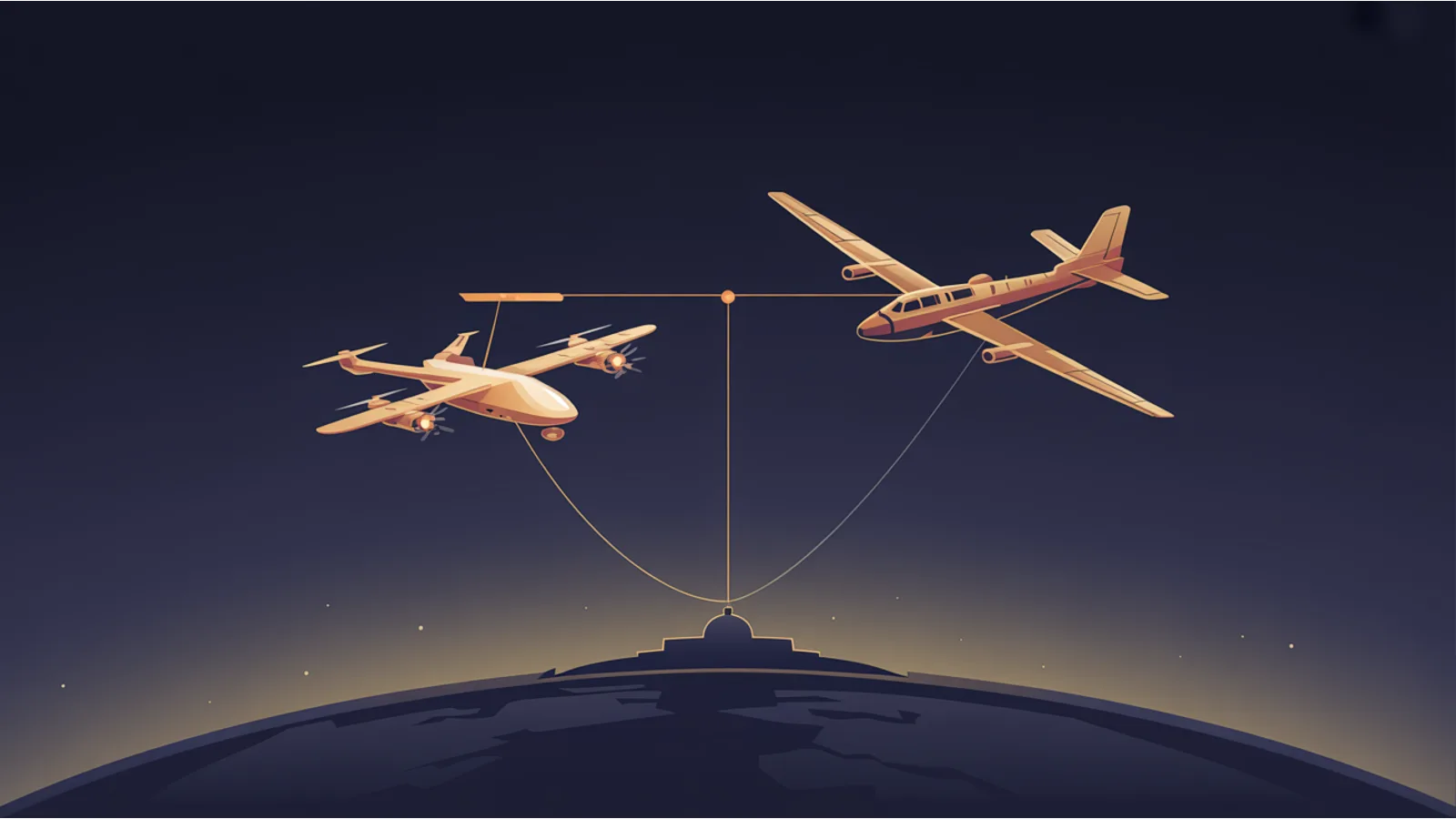
In January 2012 the U.S. Air Force did something almost no service ever does willingly: it asked to cancel one of its own drones. The target was the RQ-4 Global Hawk Block 30, a high-altitude unmanned spy aircraft built by Northrop Grumman. The stated reason inverted the usual talking point about robots being cheaper than pilots. The Air Force argued the Block 30 cost more to operate and carried less capable sensors than the manned aircraft it was designed to replace: the Lockheed U-2 "Dragon Lady," a reconnaissance plane whose basic design dates to the 1950s.
Congress said no. It ordered the Air Force to keep flying the aircraft it had just declared not worth the money. Then the numbers moved. Global Hawk operating costs fell by more than half in three years, its sensors improved, and within a few budget cycles the Air Force was trying to retire the U-2 instead. This is a case where the honest verdict depends entirely on which year you stop reading, so the point of this piece is not to freeze it at 2012.
What the Block 30 is
The RQ-4 Global Hawk is a high-altitude, long-endurance unmanned intelligence, surveillance, and reconnaissance aircraft. According to the U.S. Air Force fact sheet, it flies above 60,000 feet with more than 30 hours of endurance per sortie. That endurance is the whole mission rationale. A single aircraft can watch the same patch of ground for more than a full day, while a manned U-2 sortie is limited by the pilot to a fraction of that time, even though the U-2 flies higher, around 70,000 feet.
The Block 30 is the multi-intelligence variant. Per the Air Force and Northrop Grumman fact sheets compiled by Wikipedia, it carries electro-optical and infrared cameras, synthetic-aperture radar for imagery, and the Airborne Signals Intelligence Payload (ASIP), a wide-spectrum sensor for intercepting electronic signals. Part of its stated purpose was to take over the high-altitude reconnaissance mission from the U-2. Worth flagging up front: this story is specifically about the Block 30. The Block 40 radar variant and the earlier Block 20 have separate histories, and it distorts the record to blur them together.
The 2012 proposal to kill it
On January 26, 2012, as part of the FY2013 budget rollout, the Pentagon announced it would end Block 30 procurement and divest the existing fleet. The argument, as reported by Aviation Today and summarized in the compiled program history, was blunt: the Block 30 cost more to operate and offered less capable sensors than the U-2 it was meant to supplant.
Senior officials said so on the record. Testifying to the House Armed Services Committee on February 15, 2012, Joint Chiefs Chairman Gen. Martin Dempsey said the Block 30 "has fundamentally priced itself out of our ability to afford it when the U-2 gives, in some cases, a better capability and, in some cases, just a slightly less capable platform."
That view had support inside the Pentagon's own testing shop. In a May 2011 assessment quoted by the Center for Public Integrity, the director of Operational Test and Evaluation, J. Michael Gilmore, found the Block 30 "not operationally effective for conducting near-continuous, persistent ISR." The Center for Public Integrity reported that the aircraft delivered under half of its required 55 percent "Effective Time On Station" benchmark. That was a 2011 snapshot, taken before later reliability improvements, and it should be read as a point-in-time finding, not a permanent grade.
The cost record behind the decision was genuinely troubled. Three different cost figures matter here, and they are easy to merge by accident, so it is worth keeping them apart:
- Flyaway cost (the aircraft itself): rose from $60.9 million in 2001 to $131.4 million in 2013, per Selected Acquisition Report data compiled by Wikipedia.
- Program-acquisition unit cost (the fuller per-aircraft figure): rose from roughly $88 million in 2001 to about $223 million by 2012, more than a 150 percent increase, per the Center for Public Integrity. The "150 percent" attaches to this figure, not to flyaway cost.
- Cost per flight hour (operating cost): about $40,600 in 2010.
That cost growth was not new in 2012. Years earlier, the Government Accountability Office had flagged it. GAO-06-222R found that the program's cost increase had been understated in its Nunn-McCurdy breach reporting, and GAO-05-6 warned that the acquisition strategy needed changes to reduce program risk. Those reports predate the 2012 fight, and neither is a head-to-head Block-30-versus-U-2 comparison. No such dedicated GAO report exists. They are the cost-growth backdrop, not a scorecard for the 2012 decision.
Congress overrides the buyer
Here the direction of the story matters, because it is the opposite of the usual pattern. It was not the Air Force choosing to keep an aircraft it liked. It was Congress forcing the service to keep flying something it had formally asked to divest.
The National Defense Authorization Act for FY2013 mandated continued operations of the Block 30 fleet through the end of 2014. At the time of the dispute the Air Force had about 18 Block 30 aircraft, out of 45 RQ-4B Global Hawks planned across all variants as of 2013. Fleet counts drift slightly by source and date, so treat those as approximate.
The politics around the override were documented in detail. The Center for Public Integrity reported that Northrop Grumman and allied interests deployed 26 lobbyists, many of them former congressional staff, and that Northrop's 2012 donations to House Armed Services Committee members reached $584,000, about 46 percent more than in 2010, with committee chairman Buck McKeon receiving $113,000. Those figures come from an investigation that is advocacy-leaning in its framing, and they are presented here as reported by the Center for Public Integrity. They illustrate the lobbying environment. They do not by themselves prove that lobbying, rather than the merits, produced the outcome.
At the moment of the 2012 fight, the two aircraft were closer on cost than the headline suggested. The Center for Public Integrity reported that both the Global Hawk and the U-2 flew at roughly $32,000 per flight hour. The Air Force argued the U-2 was still cheaper overall because it deployed from bases closer to its targets, and the Pentagon projected roughly $2.5 billion in savings over five years from cancelling and mothballing the Block 30. That $2.5 billion figure is important to label correctly: it was a projected saving from a cancellation that never happened, not money actually put back in the Treasury.
The reversal, and then the reversal of that
The reason the 2012 verdict did not hold is that the drone got cheaper to fly, fast. Global Hawk cost per flight hour dropped from about $40,600 in 2010 to about $18,900 by mid-2013, a decline of more than 50 percent, as the fleet matured and sustainment stabilized. The 2012 "costlier than a U-2" judgment was a snapshot taken near the program's cost peak, and the snapshot went stale.
By the FY2015 budget the calculus had flipped so far that the Air Force proposed retiring the U-2 instead and consolidating the high-altitude mission on Global Hawk. Congress intervened again, this time in the other direction: the FY2015 NDAA blocked the U-2 retirement. As Defense News and National Defense Magazine reported, Congress spent this period protecting whichever platform was on the chopping block, first the drone, then the manned plane.
The long-run picture kept shifting after that, and the dates are moving targets rather than settled facts. Congress eventually permitted the Air Force to divest older Global Hawk Block 20 and Block 30 aircraft around FY2021, per Breaking Defense. The U-2's retirement has been an Air Force plan repeatedly deferred by Congress: divestment was blocked in FY2015 and again, for FY2027, through the FY2026 NDAA, so the frequently cited "2026" U-2 retirement is best read as a plan that keeps slipping, not an accomplished fact. Global Hawk's own end date moved too: current reporting points to a whole-fleet RQ-4 retirement around FY2027, which is distinct from that earlier Block 20/30 divestment. The two should not be collapsed into a single date.
The honest critique and the honest defense
The critique. By the Pentagon's own numbers and its own testers, this program earned the scrutiny. Program-acquisition unit cost more than doubled to about $223 million by 2012, after a Nunn-McCurdy breach that GAO said had been understated. The Pentagon's chief weapons tester judged the Block 30 not operationally effective for the persistent-surveillance mission it existed to perform. The service that owned the aircraft looked at all of that and asked to walk away. Congress then required it to keep operating a fleet its buyer had declared not worth the money, in an environment where the manufacturer had 26 lobbyists working the issue and rising donations to the committee that wrote the override. Whatever the ultimate outcome, the taxpayer spent years operating aircraft the customer had formally rejected.
The defense. High-altitude persistent surveillance is a real and enduring need, and the Global Hawk does something no single U-2 sortie can: stay aloft above 60,000 feet for more than 30 hours, letting one aircraft watch a battlespace for over a full day instead of rotating pilots through short flights. The 2012 "costlier than a U-2" verdict was a point-in-time judgment, not a permanent one. Operating cost fell by more than half within three years, the ASIP signals payload and reliability improved, and by FY2015 the Air Force wanted to retire the U-2 and keep the drone. Seen from later, Congress's refusal to scrap a partly-built, still-improving fleet at its cost peak looks less like pure pork and more like preserving a capability that became cheaper and more capable than the aircraft it displaced.
Both readings are supported by the record. The tension between them is the actual lesson: a cost comparison captured at one moment, however official, can be reversed by the maturation curve of the very program it condemns. The Air Force was not wrong about what the Block 30 cost in 2012. It was wrong to assume that number would stay put.
Fact-check notes and sources
- Specifications (above 60,000 feet, 30-plus-hour endurance): U.S. Air Force RQ-4 Global Hawk fact sheet. The U-2 flies higher, around 70,000 feet, but with a much shorter, pilot-limited sortie.
- Block 30 sensor loadout (EO/IR, SAR, ASIP SIGINT) and "replace the U-2" intent: Northrop Grumman RQ-4 Global Hawk, compiling USAF and Northrop Grumman fact sheets. "Replace the U-2" is stated program intent, not a completed action.
- January 26, 2012 FY2013 proposal to divest the Block 30 as costlier and less capable than the U-2: Aviation Today, "DoD Proposes Terminating Global Hawk Block 30s". A point-in-time budget judgment, specific to the Block 30 variant.
- Gen. Martin Dempsey "priced itself out of our ability to afford it" (HASC, Feb. 15, 2012): quoted in the compiled program history. Attributed to the 2012 affordability argument.
- DOT&E director J. Michael Gilmore, May 2011, "not operationally effective for conducting near-continuous, persistent ISR," and the 55 percent Effective Time On Station benchmark: Center for Public Integrity, "The huge drone that could not be grounded". The underlying DOT&E FY2011 annual report is the primary document; this is a 2011 assessment that predates later improvements.
- NDAA FY2013 mandate to keep the Block 30 flying through end of 2014, over the service's objection: compiled program history. It was Congress, not the Air Force, that forced continued operations.
- Fleet counts (~18 Block 30s; 45 RQ-4Bs planned as of 2013): Northrop Grumman RQ-4 Global Hawk. Approximate; counts vary by source and date.
- Program-acquisition unit cost ~$88M (2001) to ~$223M (2012), more than 150 percent: Center for Public Integrity. This is program-acquisition unit cost, not flyaway cost.
- Flyaway cost $60.9M (2001) to $131.4M (2013): Selected Acquisition Report data compiled at Northrop Grumman RQ-4 Global Hawk. A distinct metric from the ~$223M unit cost.
- Cost per flight hour ~$40,600 (2010) to ~$18,900 (mid-2013), more than 50 percent drop: Northrop Grumman RQ-4 Global Hawk. Operating cost, distinct from acquisition cost.
- ~$32,000/hr operating parity (2012) and ~$2.5 billion projected five-year savings from cancellation: Center for Public Integrity. The $2.5 billion was projected, not realized; the $32k parity was a 2012 snapshot that later diverged.
- 26 lobbyists and $584,000 in 2012 Northrop donations to HASC members (+46 percent vs. 2010; chairman received $113,000): Center for Public Integrity. Reported by CPI from lobbying and donation disclosures; presented as reported, not as proof of causation.
- FY2015 reversal: Air Force proposed retiring the U-2, NDAA FY2015 blocked it: Defense News, "USAF budget funds munitions, keeps U-2" and National Defense Magazine.
- Long-run divestment timelines (Block 20/30 divestment ~FY2021; whole-fleet RQ-4 retirement around FY2027; U-2 retirement a repeatedly deferred plan): Breaking Defense. Dates are moving targets subject to repeated congressional action.
- Cost-growth and Nunn-McCurdy backdrop: GAO-06-222R (cost increase understated in the Nunn-McCurdy breach reporting) and GAO-05-6 (acquisition strategy needed changes to reduce risk). Backdrop only; neither is a Block-30-versus-U-2 comparison.
Related reading
- The C-27J Spartan sent to the boneyard: another aircraft the service tried to shed while Congress weighed in.
- NGA's EnhancedView commercial imagery: the wider surveillance-collection economy the Global Hawk sits inside.
- Army Future Combat Systems: a cancelled system-of-systems, for contrast with a program Congress refused to cancel.
- The GAO High Risk List and improper payments: the oversight lens, and where cost-growth findings like these fit.
- The public-money programs index: the full set of program deep-dives in this series.
This post is informational and journalistic, not legal or financial advice. It describes public programs and documented events; mentions of third parties are nominative fair use and no affiliation is implied.
