
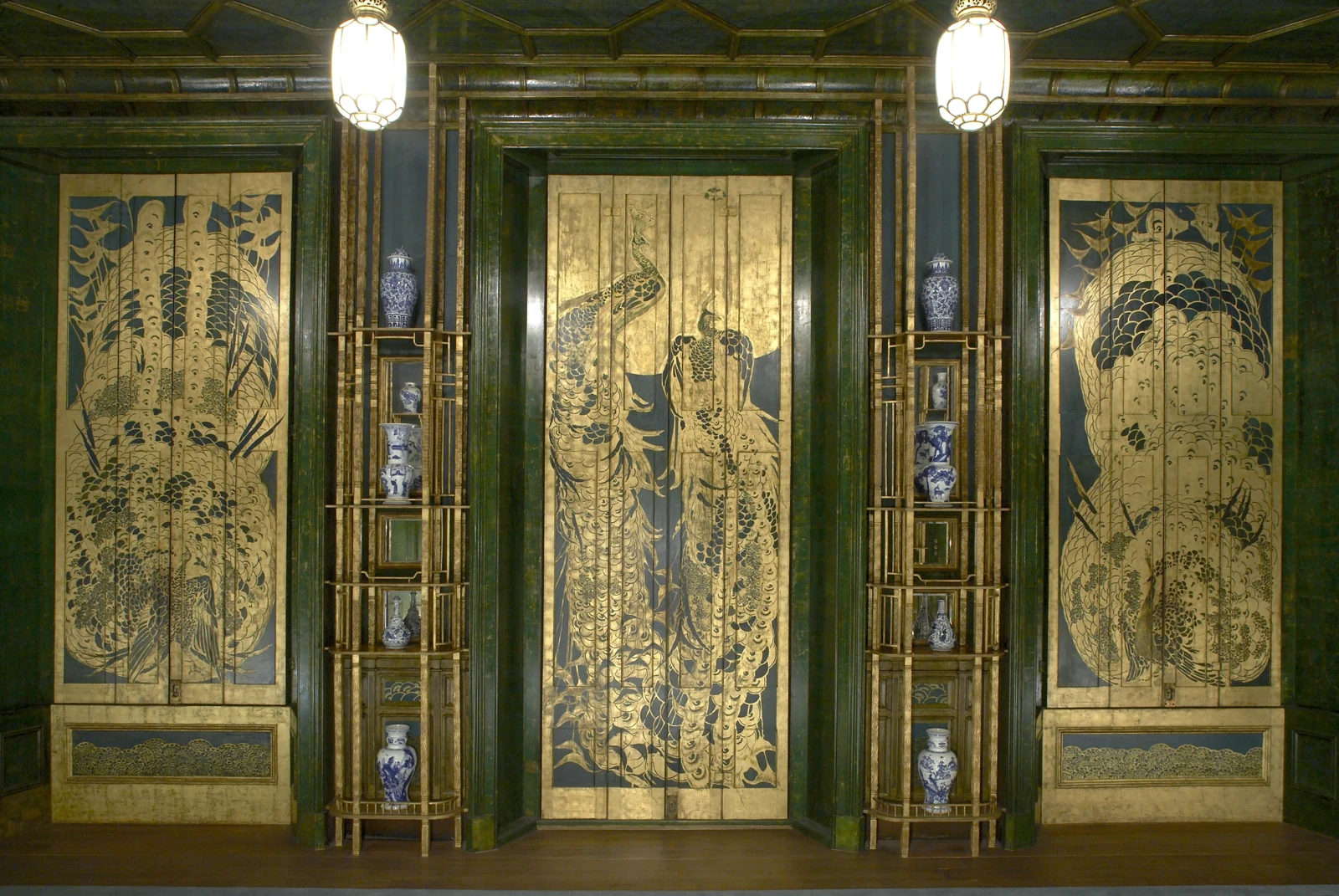
The Peacock Room, photographed in the Freer Gallery. Smithsonian photograph, reproduced from Wikimedia Commons as public domain.
The Freer Gallery in Washington is a case study in how a gift can be generous and restrictive at once. To read it well, it helps to keep apart the money that built the collector's fortune, the money pledged for a building, and the paper that records each step. The Smithsonian's agency history for the Freer Gallery presents the gift as a package: a collection, funding for a building, and a proposed endowment for study and acquisition.
Where the money came from
The National Museum of Asian Art's account of collectors and dealers describes Charles Lang Freer's early work as a railroad bookkeeper, the 1879 Peninsular Car Works, and a role in the 1899 merger of thirteen railroad car companies into American Car and Foundry. In plain terms, the fortune came from manufacturing and company ownership.
The sources used here give no personal sale price and no profit margin for that merger, so none is stated. Any figure offered without an audited source deserves caution.
A gift that developed in 1906
The Smithsonian Archives record that a conveyance of the Freer gift was executed on January 24, 1906. The accompanying inventory lists more than 2,250 objects. That was an initial inventory, not the eventual full transfer.
A separate entry, Freer Donates Collection to SI, dated May 5, 1906, describes a deed of gift specifying $500,000 for building construction, later increased to $1 million. The same entry notes roughly 9,500 objects by Freer's death in 1919. The January and May dates describe different documented events, so the safest summary is that the agreement developed during 1906 rather than being completed in one signing.
The $1 million was for construction. It was construction funding, not an operating endowment. Combining unlike amounts into one unrestricted cash figure would obscure their purposes. The agency history says construction began in 1916 and the museum opened to the public on May 9, 1923. It also says Freer proposed an endowment for study and acquisition, but the cited summary establishes no numerical balance, and none is claimed here. All amounts are historical nominal dollars, not adjusted for inflation.
What vouchers, invoices and deeds each tell us
The museum's Accounting for Art resource explains that Freer began using purchase vouchers in 1893, and that the records allow purchases and payment processes to be studied. This article has not read the original vouchers and does not claim to.
The document types still matter, because they answer different questions. A sales invoice shows what a seller asked for an object. A payment voucher records a step in a payment process; a receipt or bank record may be needed to establish completion. A gift instrument shows what was handed to the public and on what terms. A researcher who mixes them up can end up with a wrong price, a wrong date or a wrong idea of who controlled an object.
The Peacock Room and what remains unclear
The Peacock Room, object record F1904.61, is by James McNeill Whistler and dates to 1876 to 1877. It was originally made for Frederick Richards Leyland's London house. The published provenance runs from the Leyland estate to Mrs. James Watney, then to Obach & Co. in 1904, then to Freer and eventually the Smithsonian.
The record itself says the precise relationship between the intervening dealers is somewhat unclear, and that uncertainty should stay in the story. Freer reinstalled the room in Detroit, and it later moved to Washington. The record lists the object's current media rights as CC0. A photograph's date is not the room's creation date, so a dated image should never be read as a date for the room.
Generous, and restrictive
An archived Freer loan policy states that Freer Gallery objects are not lent outside the museum, while the separate Freer Study Collection and the Sackler collection may lend. That is one archived policy about named collections. It does not mean every museum object is immovable, and it does not describe every institution called Smithsonian.
The tradeoff is easy to state. Physical preservation, access in Washington and online research are real successes. A donor's frozen preferences and limits on circulation are real constraints. Neither point requires a claim of misconduct, and none is made. What remains unknown is the amount of the maintenance endowment and a full history of institutional costs. Those are open research questions.
For a contrast with other donor arrangements, including the National Gallery's administratively separate collections, read the earlier article Kress, Corcoran, Clark: art, money and legacy.
Fact check notes and sources
- Fortune origin, 1879 Peninsular Car Works, 1899 merger: National Museum of Asian Art, Collectors and Dealers of Asian Art. No sale price or profit margin is given.
- January 24, 1906 conveyance and inventory of more than 2,250 objects: Smithsonian Archives. This is an initial inventory.
- May 5, 1906 deed, $500,000 later $1 million for building construction, roughly 9,500 objects by 1919: Smithsonian Archives. The two 1906 dates are separate events.
- Construction from 1916, opening May 9, 1923, proposed endowment with no stated balance: Smithsonian Archives agency history.
- Purchase vouchers from 1893: Accounting for Art. Original vouchers were not reviewed for this article.
- Peacock Room provenance, dealer uncertainty and CC0 rights: object record F1904.61.
- Loan policy: archived museum loan page. It is archived and applies to the named collections only.
- Dollar figures are nominal historical amounts. No source reviewed establishes a current endowment balance or a complete lifetime donation total.
Read the companion story on Huguette Clark and Bellosguardo or download this article as Markdown and the research guide.

