
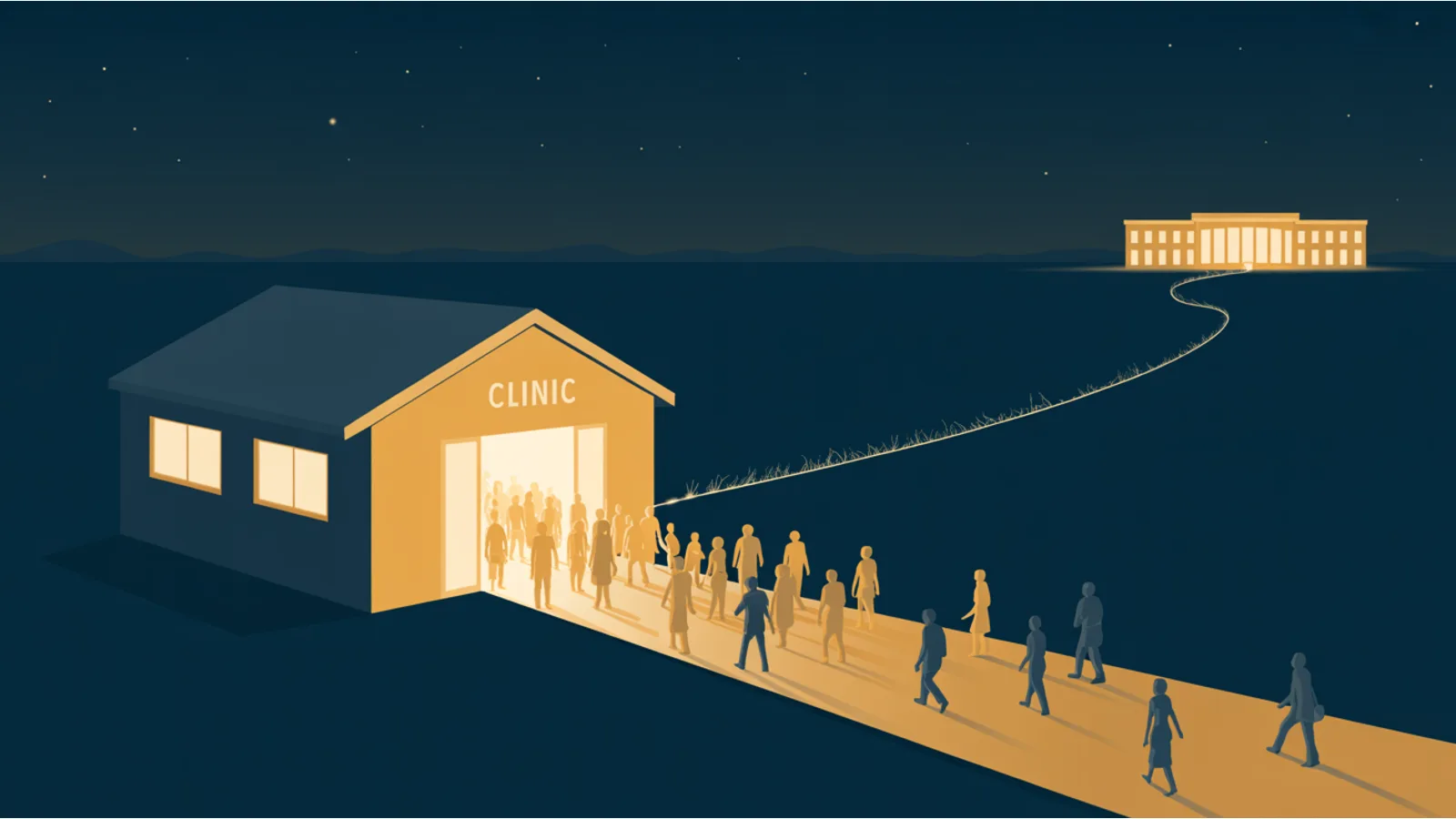
There is a network of clinics in the United States that treated more than 32 million people in a single year, roughly one in every eleven Americans, and that is legally forbidden from turning any of them away for inability to pay. It sits in the poorest neighborhoods and the emptiest counties, it charges on a scale keyed to your income, and it is run, by federal rule, by boards that are majority patients. It is also chronically, structurally short of certainty about its own money, living for years at a time on funding that Congress keeps renewing in short bursts just before it lapses. These are the Federally Qualified Health Centers, and like a lot of public-money machinery, whether they look like a bargain or a boondoggle depends less on the arithmetic than on which ledger you decide to read.
What it is, and who actually runs it
The Health Center Program is administered by the Health Resources and Services Administration, or HRSA, an agency inside the Department of Health and Human Services. Its origins are older than the agency's current form. The first two neighborhood health centers were funded in the mid-1960s under the Office of Economic Opportunity, the engine of Lyndon Johnson's War on Poverty: Columbia Point, in the Dorchester section of Boston, which opened in 1965, and the Tufts-Delta Health Center in Mound Bayou, Mississippi, the first rural one, which began clinical service in 1967. Their founders, the physicians H. Jack Geiger and Count Gibson, are generally credited as fathers of the American community health center movement, as a Tufts University archival guide documents. The modern legal scaffolding came much later. What people now call the Section 330 program, after its section of the Public Health Service Act, was consolidated into its current shape by the Health Centers Consolidation Act of 1996. It is worth keeping those two dates apart: the idea is a War on Poverty demonstration from the 1960s, but the program structure is a 1990s consolidation.
What makes a clinic a Federally Qualified Health Center is not that it is poor or well-meaning. It is that it meets a specific set of federal requirements, and here the model gets genuinely unusual. A health center must sit in, or serve, a designated Medically Underserved Area or Medically Underserved Population. It must provide comprehensive primary and preventive care to every age group, regardless of ability to pay. It must run a sliding fee discount scale tied to income and family size, with a full discount for patients at or below the federal poverty guideline and a sliding charge from there up to twice that line. And it must be governed by a board on which a majority of members, at least 51 percent, are themselves patients of the center. That last rule is the defining oddity. These are institutions accountable, by law, to the community that uses them rather than to shareholders, and the requirements trace to HRSA's Health Center Program Compliance Manual, summarized by the HRSA-funded Rural Health Information Hub.
One distinction has to be nailed down before any funding conversation makes sense, because nearly everyone gets it wrong. "Federally Qualified Health Center" is a payment status, not a synonym for "grant recipient." There are organizations HRSA has certified as meeting every Health Center Program requirement that receive no federal grant at all. They are called look-alikes, and they still get the FQHC payment benefits, including the enhanced Medicaid and Medicare reimbursement and access to the 340B drug-discount program, per the Rural Health Information Hub. The status also covers certain tribal and urban-Indian clinics. So when you read a count of health centers, check what it is counting. In the 2024 reporting year there were 1,359 grantee organizations, by HRSA's own Uniform Data System. That figure is grantees only. Look-alikes report separately and are not in it. HRSA's press prose often rounds up to "nearly 1,400," but the exact grantee number is 1,359.
Where the money goes, and the two streams people conflate
The whole subject becomes clear the moment you accept that health centers are paid through two entirely separate federal channels that do different jobs and fail in different ways. Confusing them is the single most common error in coverage of this program, so it is worth being deliberate.
The first stream is the Section 330 grant. This is a federal appropriation HRSA hands to health centers to underwrite the care that no one pays for: the uninsured patient, the sliding-fee discount, the infrastructure of a clinic in a place the market would never build one. Counting both its mandatory and discretionary pieces, total federal Health Center Program funding runs on the order of roughly 6.5 billion dollars a year around fiscal 2026. The Consolidated Appropriations Act of 2026 assembled that from about 4.6 billion dollars in mandatory money plus about 1.9 billion in annual discretionary appropriations, alongside a separate pot of roughly 1.4 billion for rural and underserved-area health workforce programs, as the bipartisan Primary Care Collaborative laid out. Two things about that grant deserve emphasis. It is large in absolute terms, and it is a minority of what actually keeps health centers running: Section 330 grant dollars are only somewhere around 11 to 18 percent of total health-center sector revenue, by KFF's synthesis of the HRSA data. The rest is mostly patient revenue, and most of that is Medicaid.
Which brings in the second stream, and the reason Medicaid policy is existential for these clinics. Medicaid and the Children's Health Insurance Program cover 48.56 percent of health-center patients, by the 2024 Uniform Data System, making it the single largest payer in the sector. Federally Qualified Health Centers are not paid ordinary clinic rates for those visits. They are paid under a Prospective Payment System, a bundled, cost-based, per-visit rate that is generally higher than what a standard fee-for-service clinic collects. The Medicaid version of this was created by the Medicare, Medicaid, and SCHIP Benefits Improvement and Protection Act of 2000, took effect on the first day of 2001, and set each center's initial rate from its own average reasonable cost per visit in fiscal 1999 and 2000, trended forward from there. A separate Medicare Prospective Payment System for these centers came much later, effective October 1, 2014, by the Centers for Medicare and Medicaid Services. Do not give the two the same birthday.
The enhanced rate was not a gift. Its explicit purpose, documented by the non-partisan Medicaid and CHIP Payment and Access Commission, was to stop one stream from cannibalizing the other. Before it existed, Medicaid often paid health centers less than their cost to deliver a visit, which meant the Section 330 grant money that Congress had appropriated to care for the uninsured was being quietly drained to cover the shortfall on insured Medicaid patients. The cost-based Prospective Payment System closes that leak by paying the actual cost of a Medicaid visit, so the grant can do the job it was funded for, as the commission's payment-policy review explains. The two doors, grant and Prospective Payment System, open onto different rooms. A cut to one is not backfilled by the other. That is why a health center can be squeezed from two directions at once, by a grant lapse and by Medicaid policy, and why the people who run them watch both.
Why it looks like a loss
The sharpest efficiency criticism of this program is not about waste in the usual sense. It is about the way the money is authorized. Most of the federal grant flows through the Community Health Center Fund, a mandatory appropriation that is nonetheless not permanent. It is authorized in short windows and has to be renewed before it expires, which produces a recurring event the sector has learned to dread and to name: the funding cliff. The fund has lapsed or come to the brink before, most visibly in a drawn-out 2017 and 2018 standoff, and it has been rescued each time by a short-term extension rather than a durable reauthorization. As of mid-2026 the pattern is holding exactly. The Consolidated Appropriations Act of 2026 set the fund at about 4.6 billion dollars for fiscal 2026, which advocates at the National Association of Community Health Centers called the largest single increase in a decade, but it did so as a short-term rather than a multi-year deal, as the American Action Forum's analysis of the enacted law describes. The mandatory authorization runs only through December 31, 2026, carried the last stretch by a bridge of roughly 1.2 billion dollars, while the annual discretionary appropriation runs out at the fiscal-year end on September 30, 2026. The sector is staring at a double expiration inside a single calendar year.
The inefficiency here is real and it is structural. A hospital system that does not know whether its largest federal funding line will exist in six months cannot plan a multi-year hire, break ground on a new site, or commit to a service expansion with any confidence. Managing to a cliff burns administrative attention, forces defensive pauses in recruitment, and pushes decisions toward the short term, which is the opposite of what you want from an institution whose whole value is being a stable, permanent primary-care home. The instability is not a side effect of the program. Because of how the fund is authorized, it is a feature of it.
There is a second, more open critique worth stating honestly rather than overstating. The enhanced cost-based Prospective Payment System pays per visit, and any per-visit payment invites the question of whether it rewards the volume of visits rather than the health of patients, and whether the cost per patient at grantee centers is justified by measurably better outcomes than other primary-care settings would produce for the same money. That is a legitimate evaluation question. It is not, at least not in the sources reviewed here, a settled finding. I did not locate a specific Government Accountability Office or Congressional Research Service verdict declaring the outcomes-per-dollar case lost, so the fair framing is skepticism as an open question, not skepticism as a proven failing. The two-stream design also carries genuine complexity and audit burden, which is the price of keeping grant money and payment money in separate accounts on purpose.
Ratio-adjusted for who it serves
Now change the denominator, and the picture turns over. The reason health centers survive every budget fight is not that they are efficient by a clinic-margin yardstick. It is who is standing behind them.
Start with scale. In 2024, HRSA grantee health centers served 32,387,774 patients, the most in the roughly sixty-year history of the program, by the Uniform Data System. Against a national population somewhere north of 335 million, that is on the order of one American in ten or eleven; the "about 1 in 11" phrasing is a conservative rounding of a number that, done strictly, sits closer to one in ten. Those patients are not a cross-section of the country. Nearly 90 percent of them, 89.97 percent, live at or below twice the federal poverty guideline. About 18 percent, 18.09 percent, have no insurance at all. Roughly 64 percent, 63.76 percent, are racial or ethnic minorities. And the reach into specific hard-to-serve groups is striking: in 2024 health centers cared for about 1 in 5 rural residents, 1 in 8 children, and 1 in 15 adults aged 65 and older, by HRSA's own 2024 data release. This is delivered across more than 16,000 service delivery sites nationwide, also per that HRSA release.
Read against that population, the four requirements stop looking like red tape and start looking like the entire point. A clinic that must sit in a medically underserved place, must treat everyone regardless of whether they can pay, must discount by income on a published scale, and must be governed by its own patients is carrying a payer mix, heavy on Medicaid and heavy on the uninsured, that would sink an ordinary private practice inside a year. The enhanced Prospective Payment System is the deal that keeps it solvent while it does that. It is not a premium for being special; it is the cost of the all-comers mandate, priced at what the visits actually cost so the arrangement can hold. The public-money logic underneath is the standard safety-net case: give a person a regular primary-care home and you tend to reduce the avoidable emergency-room visit and the downstream hospitalization, and you reach populations that commercial providers do not find profitable to serve. The grant covers the uninsured and the building; the payment covers the insured visit; together they let a clinic keep its doors open in a place the market has already left.
One nearby number deserves a careful footnote, because it is constantly misused in this space. Health centers rely heavily on the 340B drug-pricing program, which lets them buy outpatient drugs at deep manufacturer discounts. It is worth knowing what 340B is and is not. Enacted in 1992, it is a mandatory discount funded by drug manufacturers, not a federal appropriation, with zero direct taxpayer outlay. The widely cited figure of 66.3 billion dollars for 2023 is the value of drugs purchased at the program's discounted ceiling prices, as the Commonwealth Fund explains. It is not federal spending, it is not the program's cost to taxpayers, and it is not the dollar savings. If you see 340B's throughput described as a government expenditure, the description is wrong.
The ledger reading
Federally Qualified Health Centers are one of those programs that reads as fragile and reads as durable at the same time, because those are answers to two different questions. Measured as an ongoing federal commitment, they look precarious: the largest slice of their grant money lives in a fund that is mandatory but never permanent, that has to be rescued from a cliff every couple of years, and that in 2026 got another short-term patch rather than the multi-year certainty the sector keeps asking for. Measured by what they hold up, they look close to untouchable: 32 million of the country's poorest and least-insured patients, a fifth of rural America, an eighth of its children, run through clinics that answer to their own communities. The recurring cliff is a genuine structural inefficiency, and the same cliff keeps getting bridged at the last minute because no member of Congress wants to be the one whose district loses its only clinic.
That is the pattern that shows up wherever public money meets a thin, dispersed public good. The efficiency yardstick and the access yardstick are not the same instrument, a program can score badly on one and be nearly unanswerable on the other, and the choice of which number to lead with is usually made before anyone opens the spreadsheet. With health centers, the honest version keeps both numbers in view: a funding structure that wastes planning capacity by design, wrapped around a safety net that one American in eleven actually stands on.
Related reading
- Essential Air Service: What It Costs to Keep Small-Town America Flying: the same funding-cliff dynamic in a different sector, where a mandatory-but-temporary stream keeps a dispersed rural public good alive.
- Critical Access Hospitals and Rural Medicare: the inpatient half of the rural safety net, paid by its own cost-based rule for many of the same reasons.
- The 340B Drug Pricing Program: the manufacturer-funded discount that health centers lean on, and why its headline number is so often misread as federal spending.
Fact-check notes and sources
- Scale and demographics, 2024 (32,387,774 patients; 1,359 grantee organizations; 89.97 percent at or below 200 percent of the poverty guideline; 18.09 percent uninsured; 48.56 percent Medicaid/CHIP; 63.76 percent racial or ethnic minorities): all verified verbatim on the HRSA Uniform Data System national page. The "1,359" is grantee organizations only; look-alikes are counted separately. The "about 1 in 11 Americans" framing is a derived ratio, not a Uniform Data System field; strict arithmetic against current population is closer to 1 in 10, so it is stated here as approximate and anchored to the 32.4 million patient count.
- More than 16,000 service delivery sites, and the 1 in 5 rural / 1 in 8 children / 1 in 15 seniors reach: the HRSA 2024 data release. A precise site count (some sources cite 16,200 or 16,300 or more) is not printed here because it was not confirmed against the Uniform Data System full table.
- Program history (Columbia Point, Boston, 1965; Tufts-Delta, Mound Bayou, Mississippi, 1967; founders Geiger and Gibson; Office of Economic Opportunity origin; modern Section 330 structure consolidated by the Health Centers Consolidation Act of 1996): a Tufts University archival guide, corroborated by the general history at Wikipedia. The 1960s demonstration date and the 1996 consolidation date are kept distinct on purpose.
- The four Section 330 requirements (medically underserved area or population; comprehensive care regardless of ability to pay; income-based sliding fee scale; patient-majority governing board of at least 51 percent), and the FQHC look-alike distinction (meets all requirements, receives no Section 330 grant, still gets Prospective Payment System reimbursement and 340B access): the Rural Health Information Hub, a HRSA-funded resource summarizing the HRSA Health Center Program Compliance Manual.
- The FQHC Prospective Payment System (Medicaid version created by the BIPA law of 2000, effective January 1, 2001, with initial rates set from fiscal 1999 to 2000 average reasonable cost per visit; a separate Medicare version effective October 1, 2014): the Centers for Medicare and Medicaid Services. The grant-versus-Prospective-Payment-System separation and its purpose (keeping Section 330 grant dollars for the uninsured from subsidizing underpaid Medicaid visits): the non-partisan Medicaid and CHIP Payment and Access Commission.
- Total federal Health Center Program funding around 6.5 billion dollars for fiscal 2026 (about 4.6 billion mandatory Community Health Center Fund plus about 1.9 billion discretionary, plus about 1.4 billion in related workforce funding), and Section 330 grants as roughly 11 to 18 percent of total sector revenue: the bipartisan Primary Care Collaborative's analysis of the Consolidated Appropriations Act of 2026 and KFF. Figures are given as "roughly" because sector-revenue shares and program totals vary by accounting method.
- The Community Health Center Fund as mandatory but not permanent, set at about 4.6 billion dollars for fiscal 2026 in a short-term rather than multi-year deal, with the mandatory authorization running through December 31, 2026 (carried by an approximately 1.2 billion dollar bridge) and the annual discretionary appropriation ending at the September 30, 2026 fiscal-year close: the American Action Forum's analysis of the enacted law. The December 31, 2026 mandatory expiration and the "short-term, not multi-year" characterization are well corroborated; the September 30, 2026 discretionary expiry is the standard fiscal-year end and is presented as such. A separate fiscal-2025 fund figure sometimes seen in industry write-ups was not confirmed and is deliberately omitted. The "largest increase in a decade" phrasing originates with the National Association of Community Health Centers, an advocacy organization, and is labeled as such. Industry summaries of the 2026 landscape (for example SynergyBilling) and advocacy framing of the cliff (for example the National Association of Community Health Centers) are used for narrative context only, not as neutral authority. The exact public-law and bill number for the 2026 appropriations act is not printed here because sources disagreed on it; the funding facts hold regardless. Background on the program's mandatory and discretionary structure and cliff history is also documented in Congressional Research Service report R43937.
- 340B as a manufacturer-funded mandatory discount enacted in 1992, not a federal appropriation, with the 66.3 billion dollar 2023 figure representing the value of drugs purchased at discounted ceiling prices rather than federal spending or savings: the Commonwealth Fund.
This post is informational and journalistic, describing a public program and public records. It is not legal, financial, or medical advice. Figures are drawn from government data and non-partisan analyses, with derived calculations noted as such; where advocacy or industry sources are cited, they are labeled.
