
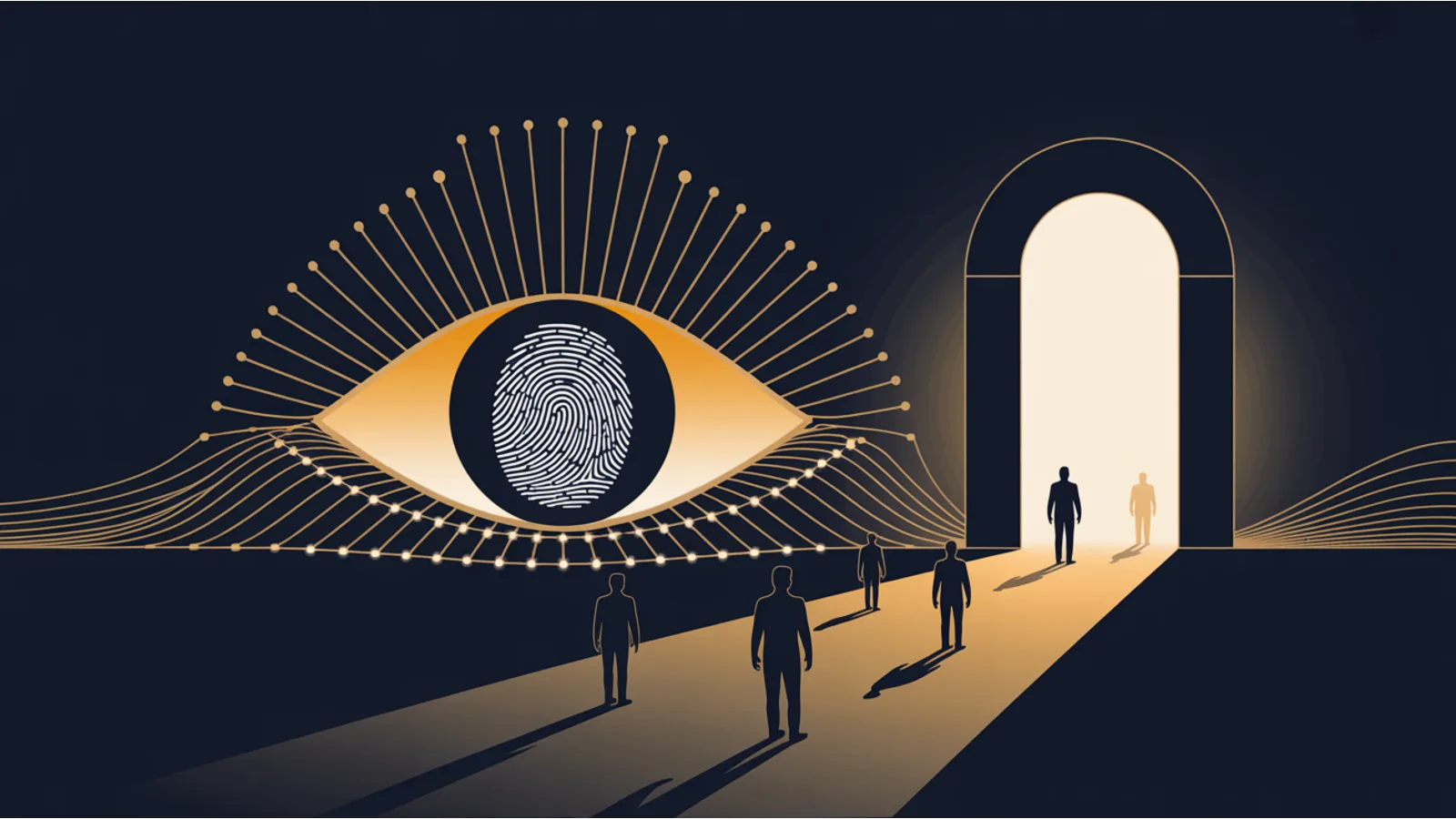
A soldier at a checkpoint outside Kandahar holds a device the size of a paperback against a man's face, then asks him to press his fingers onto a glass plate and hold still while a camera reads the fine rings of his iris. Ten seconds later a small screen answers a single question that a paper identity card never could. Is this man a stranger passing through, or is he a fingerprint the coalition already lifted off the wiring of a roadside bomb two years ago and three provinces away. That question, asked millions of times across two decades of war, is the whole reason the Department of Defense built an enterprise called DoD Biometrics, and the reason the Government Accountability Office reported the department planned to spend about $3.5 billion on it for fiscal years 2007 to 2015. This is the story of that machine, the money behind it, and the day some of its data ended up in the wrong hands.
What it is and why it exists
DoD Biometrics is the Pentagon's system for turning a body into a searchable identity. It collects fingerprints, iris scans, facial images, palm prints, and voice, stores them in a central repository, and matches new samples against everything already on file. The point is deceptively simple. A name can be borrowed, a passport can be forged, and an insurgent can carry three different sets of documents in three different pockets. A fingerprint and an iris cannot be swapped out at a checkpoint. If a coalition force lifted a latent print off a bomb component, and the same print later showed up on the hand of a man applying for a base job, biometrics closed the gap between those two moments.
The wars in Iraq and Afghanistan drove the whole thing. Troops needed a way to sort a known or suspected threat from the enormous population of ordinary people moving through checkpoints, base gates, and detention facilities every day. Out of that need grew handheld collection devices, a biometrically enabled watchlist that could be pushed forward to the field, and a central database that everything fed into. What started as a wartime workaround eventually hardened into doctrine, a standing organization, and a line in the budget that survives long after the checkpoints came down.
The people and the mechanism
The designation matters here, because in the Pentagon someone has to own a mission or it drifts. For biometrics, that owner is the Army. According to the DoD Executive Agent registry and DoD Directive 8521.01E, the Secretary of the Army is the designated DoD Executive Agent for the department's biometrics enterprise. Congress first pointed at the Army for this role back in 2000, and the Secretary of Defense reaffirmed it in the directive that governs the enterprise today.
The Army does not run the machine from the Secretary's office. The mission is delegated down through the Provost Marshal General to the Defense Forensics and Biometrics Agency, or DFBA, which describes its own job as fulfilling the Secretary of the Army's Executive Agent responsibilities for DoD forensics and biometrics. DFBA operates the DoD Automated Biometric Identification System, known as ABIS, which is the authoritative repository at the center of everything. ABIS is where the fingerprints, irises, and faces live, where new submissions get matched, and where the biometrically enabled watchlist is built and pushed out to forces in the field. When a device at a checkpoint gets an answer, that answer traces back to ABIS.
The money, and what kind of money it is
The load-bearing figure comes from GAO-11-276, the accountability office's 2011 review of defense biometrics. GAO reported that the Department of Defense planned to spend about $3.5 billion on biometrics for fiscal years 2007 to 2015. It is worth being precise about what that number is and is not. It is a planning figure, DoD's own projection of spending across a window that at the time was part past and part future, and it is the figure GAO reported rather than an independent audit of confirmed outlays. It is not a contract ceiling, and it is not money proven out the door. Read it as the department's own estimate of what the enterprise would cost across that nine-year span.
For that investment, the department got scale. Around 2015, DoD ABIS was rated to hold roughly 18 million records. Press accounts now put the repository above 30 million records, processing tens of thousands of submissions a day, with surge capacity reported near 100,000. That growth is the physical footprint of two decades of enrollments, watchlist entries, and interagency checks piling up in one authoritative place.
The striking part of the money story is how cheap the system has become to keep running now that the wars are over. The program has moved into low-cost sustainment. The FY2027 Army budget justification, the kind of document now hosted on war.gov following the 2025 rename of the department to the Department of War, lists only about $65,000 for Biometric Enabling Capability software and cybersecurity and about $1.64 million for the Family of Biometrics development line. Leidos holds the current operating contract. A capability that once carried a multibillion-dollar plan now costs a rounding error to sustain, which is either a sign of admirable efficiency or a sign that the heavy building is simply done.
The Afghan chapter shows the scale from a darker angle. DoD had set out to enroll biometrics on a large share of the Afghan population, and reporting states ABIS held more than 1 million entries tied to that effort, with related Afghan systems covering the records of at least 2.5 million people. That is a lot of human identity concentrated in a few systems, which turns out to matter a great deal.
The honest critique
The accountability record on this program is not a hit piece, but it is not clean either. GAO-17-580, the 2017 review, found three real gaps. First, DoD had no enterprise strategic plan for biometrics, for the plain reason that no entity had been assigned to write one, so the enterprise ran without a single guiding document. Second, the Army pursued a Near Real Time Identity Operations capability outside standard acquisition protocols and, in GAO's words, may have missed an opportunity to use existing, viable, and less costly alternatives. Third, and most alarming for a system billed as authoritative, the biometric database had no geographically dispersed backup, meaning a natural disaster or an attack on one location could have taken the whole repository down.
The earlier 2011 review, GAO-11-276, had already flagged the plumbing problems. Collection devices did not all conform to the standards the department had adopted, which undercuts the value of a shared database when the inputs do not line up. Information sharing with the Department of Homeland Security and the FBI lagged behind the mandate, with the biometric-sharing agreement with DHS not finalized until March 2, 2011. A central identity system is only as good as its ability to talk to the other central identity systems, and for years that conversation was slow.
The hardest lesson is not in a GAO report at all. In August 2021, during the withdrawal from Afghanistan, HIIDE handheld devices and Afghan enrollment data that fed ABIS were left behind and reportedly fell to the Taliban. Reporting describes a repository of more than 1 million entries and related Afghan systems holding records of at least 2.5 million people, now potentially in the hands of exactly the force the coalition built the system to fight. A tool designed to protect people who helped the coalition became, in the worst readings of that week, a targeting list against them. No efficiency metric captures that kind of failure, and no defense of the program can be honest without naming it.
The honest defense
And yet, on the merits, this was a system that delivered rather than a failed acquisition. GAO-17-580 credited DoD's biometric and forensic capabilities, since 2008, with helping capture or kill about 1,700 individuals, deny about 92,000 individuals access to US military bases, and identify and place about 213,000 individuals on the department's biometrically enabled watchlist. Read those figures carefully, because GAO attributed them to biometric and forensic capabilities together rather than biometrics alone, but even with that caveat they describe a capability that repeatedly did the specific job it was built to do.
The value is in what a fingerprint or an iris can do that a document cannot. Biometrics let troops identify enemy combatants, bomb makers, and insider threats by a physical trait that cannot be forged the way a paper card can. The same repository that powered wartime targeting also supports the ordinary, unglamorous work that continues in peacetime, base access control, background vetting, and interagency identity checks with DHS and the FBI. And the existence of a standing DFBA, a clear Executive Agent, sustained doctrine, and a stable if modest budget means the identity mission no longer depends on the ad hoc wartime workarounds that improvised it into being. The institution outlasted the war it was born in, which is often the mark of a capability that was actually worth keeping.
The ledger reading
Set the two verdicts side by side and neither erases the other. On one side of the ledger, DoD Biometrics is one of the clearer success stories in the whole catalog of post-2001 defense spending. The department planned about $3.5 billion, built an authoritative repository that now holds north of 30 million records, and used it to capture or kill roughly 1,700 people, keep 92,000 off its bases, and populate a watchlist of 213,000, and it did all of that while ending in cheap, stable sustainment rather than a canceled boondoggle. On the other side, the same program ran for years without a strategic plan, chased a costly identity capability when cheaper alternatives may have existed, kept its crown-jewel database without a geographic backup, and then presided over the loss of Afghan enrollment data to the Taliban in the single worst way a biometric system can fail. A tool that told friend from foe better than any ID card also concentrated the identities of millions of vulnerable people in systems that were not always defended as carefully as they were built. Both of those things are true, they were true at the same time, and the honest reading of this ledger is to hold them both rather than to pick the one that makes a cleaner headline.
Related reading
- The Afghan networks that fed the identity machine: the tactical systems behind the enrollment effort whose data ended up at risk in 2021.
- The biometric exit system at the border: the civilian counterpart that DoD Biometrics was mandated to share data with, and struggled to.
- The Army intelligence platform versus Palantir: the fight over the analysis layer that sits alongside the identity layer in Army systems.
- The index of programs, lifelines, and boondoggles: the full catalog this series is building, one program at a time.
- The working ledgers: the running notes and figures behind these program reviews.
Fact-check notes and sources
- The Army is the designated DoD Executive Agent for biometrics, delegated through the Provost Marshal General to the Defense Forensics and Biometrics Agency, which runs DoD ABIS. This designation traces to the DoD Executive Agent registry and the governing directive, and DFBA describes its own role in exactly these terms. GAO-17-580; DFBA, About DFBA; DoD Directive 8521.01E (Jan. 13, 2016).
- The $3.5 billion figure is money DoD PLANNED to spend on biometrics for fiscal years 2007 to 2015, a planning projection reported by GAO rather than confirmed outlays or a contract ceiling, and the window is exact. GAO-11-276.
- The capability figures (about 1,700 individuals captured or killed, about 92,000 denied base access, and about 213,000 placed on the biometrically enabled watchlist since 2008) are attributed by GAO to DoD's biometric AND forensic capabilities together, not biometrics alone. GAO-17-580.
- The 2017 gaps (no enterprise strategic plan, a near-real-time identity capability pursued outside standard acquisition where less costly alternatives may have existed, and an authoritative database with no geographically dispersed backup) and the 2011 gaps (collection devices not all conforming to standards, slow DHS and FBI sharing, DHS agreement finalized March 2, 2011) come from the two GAO reviews. GAO-17-580; GAO-11-276.
- The current low-cost sustainment figures (about $65,000 FY2027 for Biometric Enabling Capability software and cybersecurity, about $1.64 million for the Family of Biometrics line, with Leidos as operating contractor) and the 30-million-record scale are drawn from trade reporting on the current defense bill and are approximate; the Afghan data-loss account (HIIDE devices and Afghan enrollment data reportedly seized by the Taliban in August 2021, more than 1 million ABIS entries, related systems holding at least 2.5 million records) comes from press reporting and is contested in its precise scope. Biometric Update (May 2026); The Intercept (Aug. 2021).
This post is informational and journalistic, drawn from public records and cited reporting, and is not legal, financial, or policy advice, with all dollar figures attributed to their stated fiscal year.
