
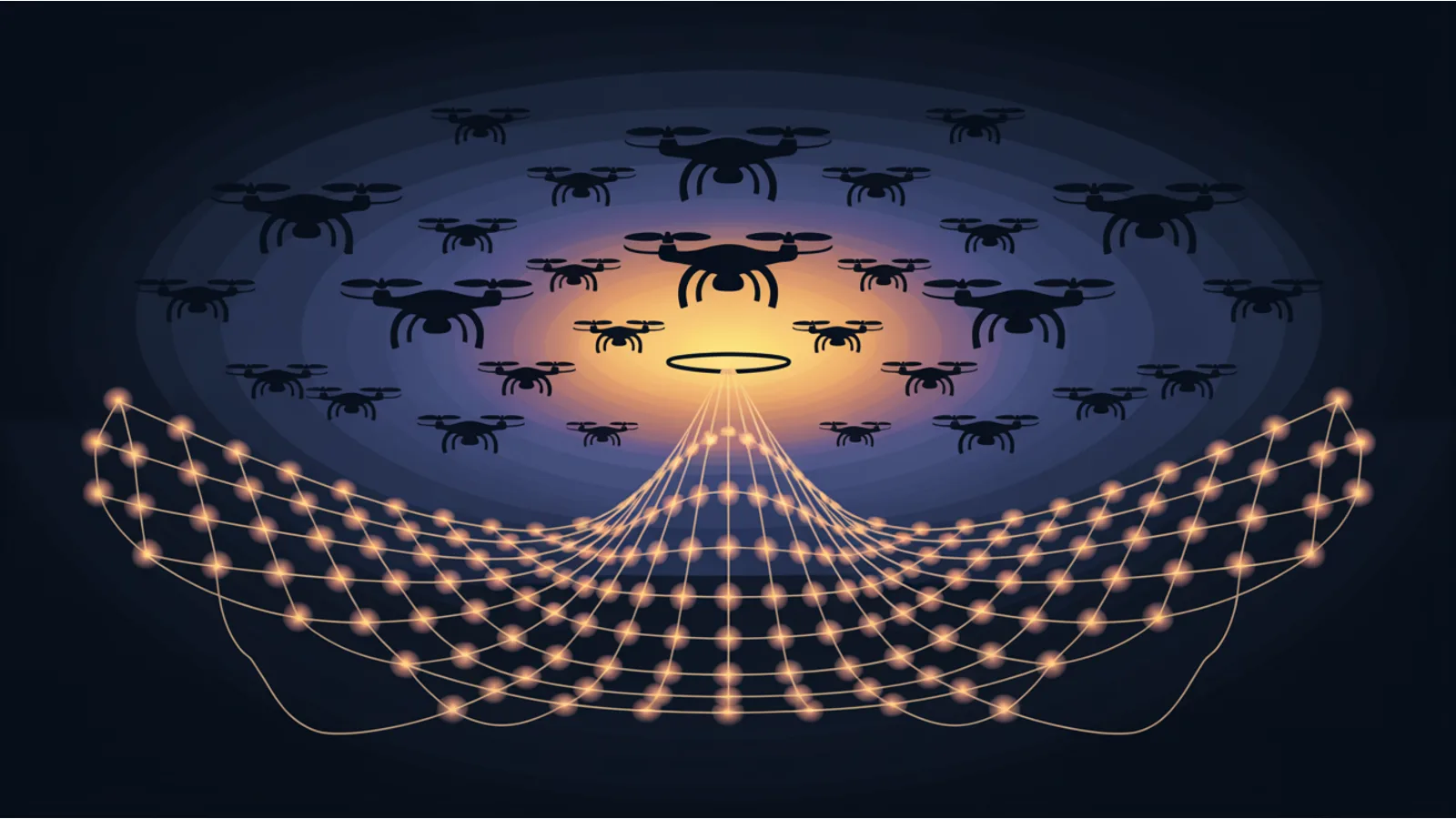
Picture a soldier at a plywood-and-sandbag outpost somewhere in the Middle East, eyes fixed on a small screen, watching a dot drift toward the wire. The dot costs a few hundred dollars. It is a small quadcopter, maybe strapped with a grenade, maybe just filming, and for years the tools meant to stop it were a scramble of one-off gadgets, each service buying its own, most of them unable to share a picture of the sky. The effort built to fix that mess is called Counter-Small Unmanned Aircraft Systems, or C-sUAS, and since November 2019 the Army has run it for the entire Department of Defense as the designated Executive Agent. The Government Accountability Office found that Army funding requests for these systems climbed from an anticipated $551.5 million to roughly $1.2 billion by 2025. Then, barely five years into the job, the Pentagon moved to dismantle the office it had built to run the mission and stand up something new in its place.
What the counter-drone office was built to do
C-sUAS is the shorthand for detecting, tracking, and defeating small hostile drones. The "small" is a specific thing, not a vibe. The military sorts drones into groups by weight and altitude, and C-sUAS covers Groups 1, 2, and 3, meaning aircraft up to about 1,320 pounds. That band captures the cheap commercial quadcopters and the slightly larger fixed-wing types that have become the signature weapon of modern battlefields, the kind that loiter over a position, drop munitions on parked vehicles, or dive into a target for the price of a used car.
For most of the last decade, the problem was not that the military lacked counter-drone tools. It was that it had too many, bought in too many directions. Each service, and often each unit inside a service, fielded its own detection radar, its own jammer, its own interceptor, tuned to its own needs and speaking its own data language. A sensor that spotted a drone for the Army could not necessarily hand that track to a shooter that belonged to the Air Force or the Marines. The Department of Defense created a single office to force order onto that sprawl, to set common requirements, a shared command-and-control backbone, doctrine, and training, so the services would stop buying incompatible one-off gear and start buying pieces that fit together.
The Army as Executive Agent, and the office it ran
In November 2019 the Secretary of Defense named the Army the DoD Executive Agent for C-sUAS. It is worth being precise about the paperwork, because the designation is often described loosely. The role was established by a Deputy Secretary of Defense memorandum dated November 18, 2019, and it is logged in the DoD Executive Agent registry. There is no C-sUAS-specific numbered directive standing behind it. The general rules that govern every Executive Agent live in the umbrella issuance, DoD Directive 5101.1, "DoD Executive Agent." Being Executive Agent means the Army carries a defined department-wide responsibility on behalf of the Secretary, not just an Army-sized slice of it.
The Army ran the mission through the Joint Counter-small UAS Office, the JCO, stood up in 2020. Its first real act was triage. According to the Congressional Research Service and defense-industry reporting, the JCO reviewed more than 40 counter-drone systems already fielded across the force and endorsed eight interim systems as the near-term standard. Over time that shortlist consolidated into six formal Army acquisition programs: FS-LIDS and M-LIDS (the fixed-site and mobile low, slow, small unmanned aircraft integrated defeat systems), the Coyote launchers and interceptors, a Ku-band radar family, handheld and dismounted systems for individual soldiers, and a broader family-of-systems line. Just as important, the JCO pushed everyone onto a common command-and-control system, the Forward Area Air Defense Command and Control network, so that sensors and shooters from different services could finally share one picture and one kill chain.
The money, and what kind of money it is
The clearest number in this story comes straight from GAO. The Army created a dedicated C-sUAS funding line starting in 2022, and once it did, the requests grew fast. GAO-25-107491, issued in June 2025, states that Army funding requests for C-sUAS systems increased from an anticipated request of $551.5 million to approximately $1.2 billion by 2025, with the procurement share alone rising from $473 million to about $1 billion over the same stretch. That is the load-bearing figure, and it needs a careful label. GAO calls these funding requests and an anticipated request, not obligations and not a contract ceiling. This is money the Army asked for, not a receipt for money spent.
It also needs to be kept separate from a bigger headline in the same report. GAO found that the Army's seven air and missile defense efforts, taken together, grew from about $8.8 billion to $11.8 billion, but C-sUAS is not one of those seven. GAO notes the Army identified C-sUAS as an additional air and missile defense capability in 2022, so the $551.5 million to $1.2 billion line is its own separate track, not a slice of the larger number.
On the acquisition side, GAO found that five of the six programs became formal acquisition programs in fiscal year 2022 and reached full-rate production decisions in fiscal year 2024. The sixth, the family of counter-UAS systems, took a longer road, starting from a 2019 Special Operations Command rapid requirement document, moving to the Army's Rapid Capabilities and Critical Technologies Office in February 2021, and only becoming a formal program in July 2024.
The more recent budget figures are harder to pin to a primary document, so treat them as reported rather than confirmed. Defense trade press reported that Congress enacted roughly $596 million for small C-sUAS procurement in fiscal year 2026 (about $336 million in discretionary funding plus about $260 million from reconciliation), and that the Army requested about $994 million in procurement for fiscal year 2027, part of a total C-sUAS request reported near $2.9 billion. Those numbers point the same direction as the GAO trend, steeply up, but they come from budget reporting rather than a document I could verify line by line, so the honest move is to flag them and keep them separate from the confirmed GAO figure.
Where the criticism lands
The honest critique here is not fraud. Nobody has shown money vanishing into a hole. The critique is coherence and churn. GAO's review found that the C-sUAS programs leaned heavily on rapidly buying and integrating commercial off-the-shelf gear rather than following a disciplined, iterative development process, and that the programs had not made much use of the modern design and engineering tools GAO considers leading practice. Layer that on top of funding that more than doubled in three years, and you get the classic risk of buying fast: purchasing many overlapping systems in a hurry, then paying a second time to make them talk to each other.
The governance told the same story. The whole point of naming an Executive Agent and building the JCO was to create a stable, single point of authority. Yet barely five years after handing the Army the job, the Department of Defense moved in 2025 to disestablish the JCO and stand up Joint Interagency Task Force 401, reporting to the Deputy Secretary of Defense, expressly to accelerate delivery of counter-drone capabilities. Reorganizing an office that young is a quiet admission that the Executive Agent model had not moved fast enough or unified the field cleanly enough. When the answer to an urgent threat gets restructured that quickly, it is fair to ask whether the first structure was ever given time to work, or whether it was the wrong structure to begin with.
The case for moving fast
Set against that, the threat is real and it is not waiting. Cheap drones now destroy armored vehicles that cost a thousand times as much, and they kill people. In January 2024 a drone slipped past the defenses at Tower 22, a small logistics post in Jordan, and killed three U.S. soldiers. When the enemy's weapon costs a few hundred dollars and arrives in minutes, the traditional multiyear acquisition cycle, with its long requirements documents and deliberate testing, is simply too slow to be the only tool. Speed has genuine value here, and buying proven commercial equipment off the shelf is a defensible answer to a threat that outpaces the normal process.
By that measure, the office did real work. It imposed order where there had been none, cutting a chaotic field of more than 40 systems down to a vetted handful, and it forced the services onto a shared command-and-control backbone so that a track from one service's sensor could cue another service's shooter. Several of the systems the JCO endorsed did not stay experiments. They became formal programs of record and are fielded and defending troops today. A messy, fast answer that puts working defenses in soldiers' hands can be worth more than an elegant one that arrives after the funerals.
Reading the ledger
Both readings are true at once, and the honest thing is to let them sit together rather than crown one. On one side of the ledger, the Army took a genuine mess and made it more coherent, narrowed a bloated field, built a common backbone, and got real counter-drone systems fielded against a threat that has already killed American troops. Funding requests that ran from $551.5 million toward $1.2 billion bought capability that units are using now, and against Tower 22 that speed is not a scandal, it is the point. On the other side, GAO documents rushed buying, thin engineering discipline, and cost that more than doubled in three years, and the Pentagon's own decision to tear down the JCO after five years is evidence that even its architects did not think the structure was working well enough. The same story reads as an agile response to a deadly, fast-moving threat and as an unsettled, expensive scramble that keeps reorganizing itself. Whether the money bought lasting capability or an interoperability bill that has not yet come due is the question the next few budgets, and the new task force, will answer.
Related reading
- The Army's Future Combat Systems: another attempt to network sensors and shooters into one system, and a cautionary tale about scope and cost.
- JLENS, the runaway surveillance blimp: a very different and very expensive answer to the same job of spotting low, slow threats.
- Land Warrior, the wearable soldier system: a companion study in fast-evolving soldier technology that struggled to justify its price.
- The index of programs, lifelines, and boondoggles: the full catalog this piece belongs to.
- The working ledgers: the running tally of what public money actually bought.
Fact-check notes and sources
- The Army is the DoD Executive Agent for Counter-Small Unmanned Aircraft Systems, covering drone Groups 1, 2, and 3, a role assigned November 18, 2019. The designation came through a Deputy Secretary of Defense memorandum, not a C-sUAS-specific numbered directive; the general framework that governs all Executive Agents is DoD Directive 5101.1. DoD Executive Agent Registry.
- The load-bearing figure: Army C-sUAS funding requests grew from an anticipated $551.5 million to approximately $1.2 billion by 2025, with procurement rising from $473 million to about $1 billion, starting from a dedicated funding line in 2022. GAO calls these funding requests, not obligations and not a contract ceiling. C-sUAS is a separate track the Army added as an additional air and missile defense capability in 2022, distinct from the $8.8 billion to $11.8 billion growth GAO reports for its seven core air and missile defense efforts taken together. GAO-25-107491.
- The effort consolidated into six formal Army programs (FS-LIDS, M-LIDS, the Coyote launchers and interceptors, a Ku-band radar family, handheld and dismounted systems, and a family-of-systems line). Five became formal acquisition programs in FY2022 and reached full-rate production in FY2024; the sixth became a formal program in July 2024. GAO-25-107491.
- The Joint Counter-small UAS Office reviewed more than 40 fielded counter-drone systems and endorsed eight interim systems, and pushed a common command-and-control backbone (Forward Area Air Defense Command and Control) to integrate them across services. GAO's report does not carry these specifics; they rest on Congressional Research Service and defense-industry reporting and are consistent with the public record. CRS R48477; National Defense Magazine.
- In 2025 the Department of Defense directed disestablishment of the JCO and establishment of Joint Interagency Task Force 401, reporting to the Deputy Secretary of Defense. The more recent budget figures (about $596 million enacted for FY2026, split roughly $336 million discretionary and $260 million reconciliation; about $994 million requested for FY2027; a total request reported near $2.9 billion) come from defense trade reporting and are not confirmed here against primary appropriations or budget documents. Secretary of Defense memorandum, Aug 28, 2025; Breaking Defense.
This post is informational and journalistic, drawn from public records, and is not legal, financial, or policy advice; dollar figures are attributed to their fiscal year and, where noted, are requests or reported figures rather than confirmed obligations.
