
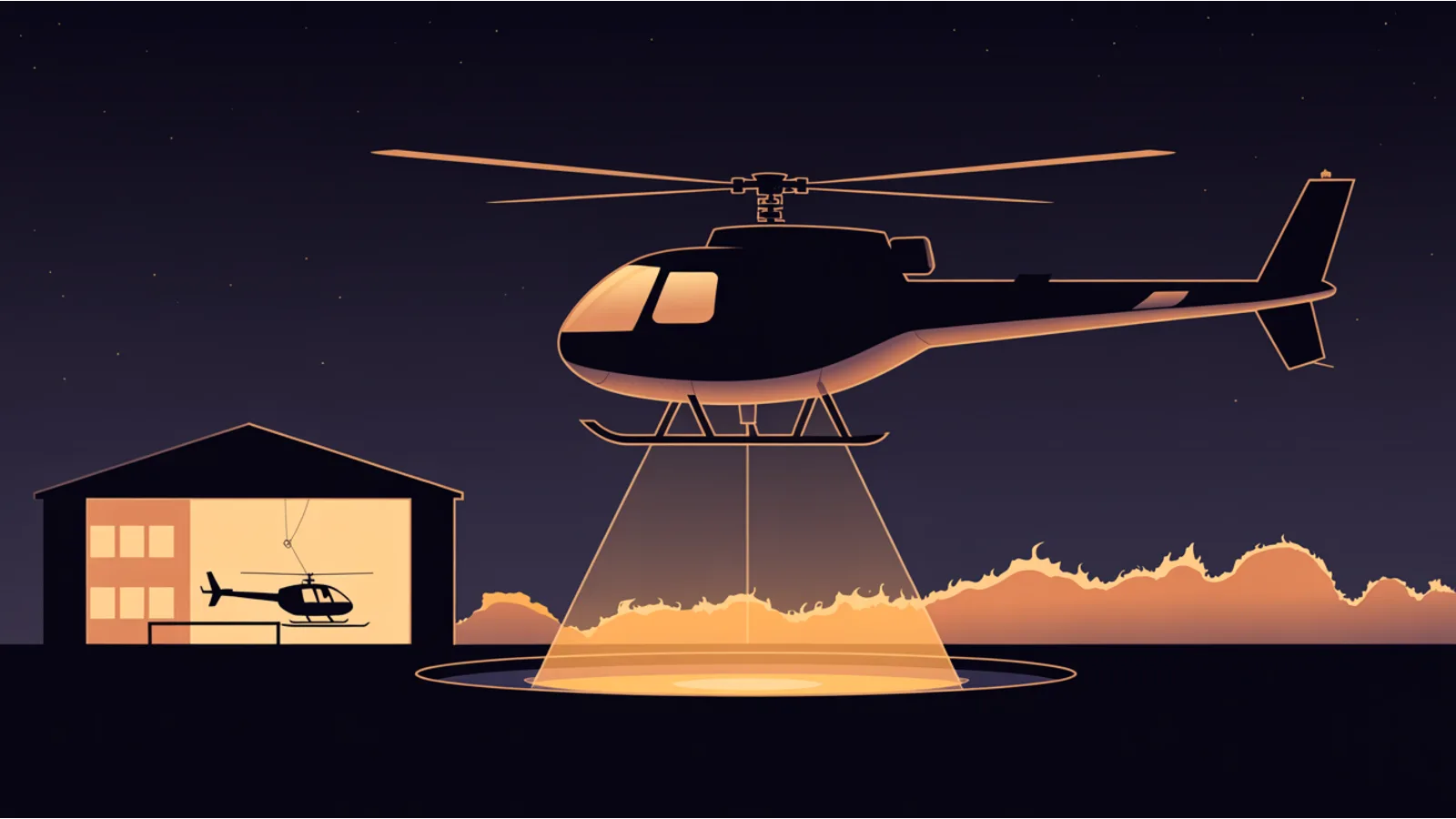
This is a companion to the wildfire series that already ran here, but it looks at a different link in the chain. The earlier pieces followed the money out to the operators who rent the government a fleet of converted airliners, and to the one company that mixes almost all the retardant. This one steps back to the workshop that builds the aircraft in the first place, a low-slung set of hangars at Centennial Airport in the Denver suburbs, and asks the two questions the local news coverage skips. How does that shop actually make its money, and who owns it now. The answers turn out to run through a private-equity buyout and a bankruptcy that has nothing to do with fire at all. Every figure below is cited to a company release, a securities filing, a bankruptcy docket, a government contract or press release, a court or safety-board record, or named local reporting. Where a number is an estimate, an attributed claim, or something I could not pin to a primary source, I say so.
A local station in Colorado ran a friendly feature not long ago about a company at Centennial Airport that, in the headline's words, "transforms military helicopters into firefighting machines." The pictures are exactly what you would expect: a green Black Hawk on jacks in a hangar, a thousand-gallon tank being fitted under its belly, technicians in a clean bay, a spokesperson talking about how the airframe that was built for the battlefield turns out to be perfect for a fire. It is a good story, and most of it is true.
The one word to hold lightly is "military." It is the hinge the whole business turns on, and getting it right is the difference between a tidy myth and the more interesting reality. The company is United Rotorcraft, and what it sells is not, for the customers you have heard of, a hand-me-down from the Army. It is close to the opposite.
What United Rotorcraft actually sells
United Rotorcraft is a completions and engineering shop. That is the plain trade word for a business that takes a helicopter and turns it into a specific working tool: it designs, certifies, and installs the equipment that makes a bare airframe into a firefighter, an air ambulance, a police helicopter, or a search-and-rescue aircraft. It runs those four mission lines out of Englewood, Colorado, at 7301 South Peoria Street in the Centennial Airport area, with additional sites in Mesa, Arizona and West Mifflin, Pennsylvania. It has held the aerospace quality certifications the work requires, ISO 9001 since 2000 and AS9100 since 2013.
Its signature product is the Firehawk. Start with a Sikorsky S-70, the civilian designation of the UH-60 Black Hawk, and United Rotorcraft adds the kit that makes it fight fire: a roughly 1,000-gallon composite belly tank built by DART Aerospace, the company's own extended "high" landing gear so the tank clears the ground, a retractable snorkel that lets the aircraft refill the tank in under a minute while hovering low over a lake or a pool, and an upgraded avionics suite. Loaded, it drops up to about 8,000 pounds of water in a pass, carries a small charge of foam or retardant additive, and can still seat around a dozen firefighters or run a hoist rescue. It cruises back to the water at about 155 knots, which matters more than the tank size, because in firefighting the number that wins is turnaround, how fast you can drop, refill, and drop again.
United Rotorcraft is the only company Sikorsky authorizes to build the Firehawk, and by its own 2025 count more than 25 of them are flying. The rest of the catalog is quieter but real: it holds a European aviation-authority certificate for modular air-ambulance interiors on the Leonardo AW139 and AW169, and it does law-enforcement and special-mission fit-outs.
Here is the part that defines how it earns. United Rotorcraft buys unfinished "green" Black Hawks from Sikorsky, completes them over roughly six months in Colorado, and sells the finished aircraft, plus the parts and support that follow. That is one-time build revenue on each airframe, not a flying contract. The company does not fight fires and does not hold a federal suppression contract. It builds the machine and hands it to whoever will fly it. The fire agency or the utility or the foreign air force is the operator. United Rotorcraft is the manufacturer. Keeping those two roles separate is the key to reading everything else.
The word "military," handled honestly
Now back to the hinge. When the coverage says United Rotorcraft "converts military helicopters," it is describing the design, not the airplane's history, and for the flagship customers those are two very different claims.
For Cal Fire and for the State of Colorado, the Firehawks are brand-new aircraft. They are S-70i Black Hawks built new by Sikorsky at its PZL Mielec plant in Poland, shipped to the United States, and completed by United Rotorcraft. They were never in any army. The Black Hawk is a military design, and a superb one, which is the whole reason a fire agency wants its ruggedness and twin-engine margin. But a new S-70i coming off the Polish line is no more a surplus soldier than a civilian pickup is a surplus tank because it shares a frame with one. Colorado's own aircraft, the local hero of that Centennial Airport story, was built in Poland, trucked in through Texas, and finished in Colorado. It is factory fresh.
There is a genuine surplus-Black-Hawk pipeline in American firefighting. It just is not this company's main business. As the Army fields newer UH-60M models, it pulls its oldest UH-60A airframes, strips the military gear, and sells them off through a program it calls the Black Hawk Exchange and Sales Transaction, or BEST, which has moved on the order of 500 Black Hawks to government and civil buyers since 2014 and plows the proceeds back into buying new ones. Separate, older channels, the Forest Service's Federal Excess Personal Property loans to state foresters and the Defense Department's Firefighter Property program, move surplus federal gear to fire agencies too, though those mostly carry engines and trucks rather than helicopters. Ex-Army Black Hawks really do fly fires: Helinet Aviation runs one out of Van Nuys with a water bucket, a Florida operator called Firehawk Helicopters flies restricted-category UH-60A conversions, and Pacific Gas and Electric fields four ex-military "Blue Hawks," flown for it by PJ Helicopters, on its own wildfire program. Those are the true conversions of old soldiers. United Rotorcraft has done that kind of work, most visibly on its first international deal, two legacy UH-60L Black Hawks it is converting for the Colombian Air Force, announced in August 2025, using the customer's own aircraft. But that is a side of the shop, not the center of it.
The reason the distinction matters is that it is the entire economic engine of the trade, and it cuts against United Rotorcraft's own model in a revealing way. A used UH-60A bought at government auction runs around a million dollars, and the civilian modifications to make it useful add somewhere between 500,000 and 800,000 more, so an operator can get a converted surplus Black Hawk into the field for roughly 1.5 to 1.8 million dollars. A new, fully outfitted Firehawk of the kind United Rotorcraft sells to Cal Fire and Colorado runs about 20 to 26 million dollars each. That is close to a tenfold gap. It is not a perfectly fair comparison, because the new aircraft is a zero-hour machine with modern avionics and a warranty while the surplus airframe is decades old and carries a heavier maintenance and training burden. But the gap is why the surplus market exists at all, and it tells you what United Rotorcraft is really selling to a state government: not the cheapest way to put water on a fire, but a new, warrantied, agency-owned aircraft that will still be flying in thirty years. The premium is the point.
How it got started, in two layers
The origin story has two layers, and the coverage tends to collapse them.
The first layer is the product. The Firehawk was not born in Colorado; it was born in Los Angeles. After the Old Topanga Fire tore through the hills above Malibu in November 1993, destroying hundreds of homes, the Los Angeles County Fire Department went to Sikorsky and asked for something bigger and more capable than the aging helicopters it had. The answer was to adapt the Army's Black Hawk, and after a few years of trials with a belly tank and a snorkel, Los Angeles County put the first S-70A Firehawks into fire-department service in 2001, the first anywhere in the country. The people who pioneered that conversion at Sikorsky carried the idea forward, and one of them, by the local station's account, now helps run the Colorado shop.
The second layer is the company. What is now United Rotorcraft grew out of the aircraft-products arm of Air Methods, which traces its completions work to the mid-1990s. The name itself, though, came from a purchase. In March 2011, Air Methods acquired a Texas outfit called United Rotorcraft Solutions, a full-service completions and maintenance center founded in 2005 by Dave and Traci Brigham in Decatur, Texas, with two hangars and 43 employees. Air Methods folded that shop into its own products division and put the acquired company's name on the front of the combined business. So the "United Rotorcraft" you see on the hangar is a 2011 rebrand built on a 2005 acquisition, sitting on top of a firefighting product that dates to a Los Angeles wildfire in 1993. All three layers are true; none of them is the whole thing.
Who owns it now, and the bankruptcy that decided that
This is where the story stops being about helicopters. To know who owns the Firehawk shop, you have to follow its parent through a debt-funded buyout and a bankruptcy, neither of which had anything to do with fire.
Air Methods is not primarily a firefighting company. It is the largest air-ambulance operator in the United States, the company whose medical helicopters fly patients to trauma centers from a few hundred bases across most of the country. It was founded in 1980 by Roy Morgan and is headquartered in Greenwood Village, Colorado, in the Denver Tech Center, a separate address from the United Rotorcraft hangars out at Centennial Airport. For years it was a public company, traded on the Nasdaq under the ticker AIRM.
In 2017 it went private. The private-equity firm American Securities agreed in March of that year to buy Air Methods for 43 dollars a share in cash, a deal worth about 2.5 billion dollars once you count the debt, and closed it that April. That is the standard debt-funded buyout shape: a private-equity owner puts in some equity and borrows the rest against the company, so the company itself now carries the debt that bought it.
For a while the model worked, because the air-ambulance business had an unusually lucrative revenue engine, and it is worth understanding because its removal is what eventually broke the parent. A large share of air-ambulance flights went to patients whose insurers had no contract with the operator, and the operator could then bill enormous out-of-network charges. A federal watchdog found that roughly 69 percent of air-ambulance transports were out-of-network in 2017, with a median helicopter transport priced around 36,400 dollars. Air Methods, in that era, billed an average charge above 50,000 dollars per transport while actually collecting net revenue somewhere north of 12,000. The gap between those two numbers, and the surprise bills patients got stuck with in between, was the business.
Then Congress closed it. The No Surprises Act, signed at the end of 2020 and in force from January 2022, barred air-ambulance operators from balance-billing patients above their in-network share and sent the disputes to arbitration instead. The single most profitable lever in the air-ambulance model was gone, at the same moment interest rates and labor costs were climbing and the buyout debt still had to be serviced. The math stopped working.
In October 2023, Air Methods filed for Chapter 11 bankruptcy in the Southern District of Texas. It went in carrying about 2.24 billion dollars of debt, and it came out roughly two months later, in late December 2023, having shed about 1.7 billion of it in a debt-for-equity swap, keeping perhaps half a billion, and taking in around 185 million dollars of new money. The people who used to be the company's lenders became its owners. And American Securities, the private-equity firm that had held about 95 percent of the equity, was wiped out. Its stake went to essentially nothing. Restructuring-trade outlets that cover these dockets, including Debtwire and ABF Journal, reported the largest new owners as the credit investors Fortress Investment Group and Ares Management, though the company's own releases name only "lenders and noteholders," so treat the specific names as reported rather than confirmed by Air Methods itself.
United Rotorcraft rode through all of it untouched in the operational sense. It was never sold, never spun off. It kept building Firehawks straight through the bankruptcy, and it is still, in the company's own August 2025 wording, "a division of Air Methods LLC," the post-bankruptcy entity now owned by the former creditors. So the answer to "who owns the Firehawk shop" is: whoever ended up holding Air Methods' debt when the music stopped. The firefighting-conversion business turned out to be the sturdy, cash-generating corner of a company whose glamorous, high-margin core, the air ambulance, was the part that blew up. The steady toll-taker survived the speculative bet built on top of it. That is a pattern worth remembering, because it is the same one the toll series keeps finding.
The contract economy the Firehawk feeds
The earlier wildfire pieces here laid out how the federal government mostly rents its firefighting aircraft rather than owning them, and how it pays for them through two kinds of contract. Exclusive-use contracts reserve an aircraft and crew for the season at a daily availability rate plus an hourly rate when it flies. Call-when-needed contracts pay nothing until the aircraft is summoned but cost materially more per hour, on the order of 54 percent more per day for a large air tanker by the government's own 2017 figures. That is the rented model, and it is enormous: the Forest Service spent about 751 million dollars on contract aircraft in 2021, most of it on helicopters, and in October 2024 it set up a ten-year contracting vehicle with a ceiling of 3.5 billion dollars just for heavy-helicopter support.
United Rotorcraft's aircraft mostly feed a different model, and it is the one growing fastest. Some buyers own their fleets outright instead of renting. California's state fire agency, Cal Fire, is the marquee example. It contracted United Rotorcraft in 2017 for up to a dozen new S-70i Firehawks at roughly 240 million dollars, about 24 million each with pilot training and warranty, to replace its Vietnam-era UH-1H "Super Hueys." That fleet has since grown to 16 aircraft, the last two delivered on July 31, 2025, stationed across all ten of Cal Fire's helitack bases, which the state now bills as the largest civilian helicopter firefighting fleet in the world. Colorado did a smaller version of the same thing, buying its first Firehawk for about 24 million dollars under a 2021 state law and a second for 26 million under a 2023 law, roughly 50 million in state money for two aircraft, both completed by the company in its own backyard.
The newest payer is not a government at all. It is the electric utility, and the reason is liability. Under a California doctrine called inverse condemnation, an investor-owned utility can be held strictly liable for property damage when its equipment starts a fire, even if it did nothing negligent. That no-fault exposure is what pushed Pacific Gas and Electric into bankruptcy in January 2019 over an estimated 30 billion dollars in wildfire liabilities, later settled with victims for 13.5 billion. Since then the big California utilities have decided it is cheaper to help put fires out than to pay for them, and they have started funding their own aircraft. San Diego Gas and Electric, which has poured something like 6 billion dollars into wildfire mitigation, runs firefighting helicopters and, notably, bought its own Firehawk from Sikorsky for 31.4 million dollars in 2020 and had United Rotorcraft outfit it. That aircraft became a small cautionary tale: a private utility could not get it certified by the Federal Aviation Administration to fly, so it sat at the Denver completion facility unused, and in 2025 the utility sold it to San Diego County, a public agency that can more easily certify it, in a deal worth about 38 million. Southern California Edison put roughly 18 million into leasing a "Quick Reaction Force" of Chinook helitankers and support aircraft. Pacific Gas and Electric fields those four ex-military Blue Hawks. The liability shifted, and a new class of buyer walked into the same showroom.
There is an oversight footnote worth keeping in view, because owning is not automatically cheaper than renting once you count the friction. Colorado's first Firehawk slipped from an expected 2022 delivery to operational readiness in July 2024, held up in part by an engine recall, and a local investigation found the state paid pilots and mechanics about 2.3 million dollars over a year to staff a helicopter that had not yet arrived. The second Firehawk ran late too. Buying the asset does not make the bill predictable; it just moves the risk onto the buyer's books.
The caveat the brochure leaves out
One more thing belongs in an honest account of turning helicopters into firefighters, and it is not on any brochure. The conversion is real engineering with real consequences when it is done wrong.
On May 25, 2021, a converted ex-Army UH-60A operated by that Florida company, Firehawk Helicopters, crashed near Leesburg, Florida on a maintenance check flight, killing all four people aboard. The National Transportation Safety Board found that the support structure for the aircraft's water-tank snorkel failed and let the snorkel swing up into the main rotor. Investigators found the structural analysis behind the modification had used the wrong weight for the part, about 100 pounds against an actual 137.5, and had considered only a simple static load while ignoring the dynamic forces of flight. The board's probable cause named that structural failure and, pointedly, added a contributing factor: insufficient FAA oversight of the supplemental type certificate process that approved the firefighting system in the first place. That accident involved a different operator and a different modification kit, not United Rotorcraft's, but it is the honest reminder that sits under this entire industry. A helicopter is a system of parts spinning very fast, and hanging a heavy new tank and a swinging snorkel off one is not a decoration. It is a certification problem where the margin for a shortcut is zero.
The ledger reading
Follow the Firehawk from the hangar out to the fire and the picture is not a scandal, but it is not the postcard either. A Colorado shop takes a new Black Hawk, built in Poland to a design the Army made famous, and turns it into the most capable civilian firefighting helicopter money can buy, then sells it, one airframe at a time, to states and counties and utilities that have decided to own their air support rather than rent it. That is a legitimate, skilled, useful business, and it happens to be the durable corner of a company whose flashier half, the air ambulance, was loaded with buyout debt, stripped of its surprise-billing engine by a new federal law, and handed to its creditors in bankruptcy while the quiet manufacturing arm kept building helicopters straight through.
The honest questions here are narrow and worth naming. Whether a new 24-million-dollar aircraft is the right buy for a given agency against a converted surplus airframe at a tenth the price. Whether owning a fleet actually beats renting one once you count the delivery delays and the crews you pay to wait. Whether the certification of these firefighting modifications gets the oversight a spinning rotor demands. And, underneath all of it, the ownership question this piece started with: that the workshop keeping the West's fire fleet flying is now owned by whoever held its parent's debt, which is the same lesson that runs through The W-2 Trap, the book this series grew out of. The people who fly the aircraft change slowly. The people who own the company that builds them can change overnight, in a courtroom, for reasons that have nothing to do with fire.
Related reading
- Who Gets Paid to Fight the Fire: the companion on the rented federal air force, the exclusive-use versus call-when-needed contracts, and the near-sole-source retardant deal.
- Who Pays to Put Out the Fire: what wildfire suppression actually costs and how the interagency machine works.
- Wildfire Contractors: Ownership and Service Roots: who owns the tanker operators, and the military and government roots behind them.
- How Firefighters Are Paid: the human side of the ledger, and the gap between the federal crew and the contractor beside them.
- The Toll Booth: the full index: where the contract-and-ownership economy this piece sits in gets mapped end to end.
Fact-check notes and sources
Company facts come from United Rotorcraft's and Air Methods' own pages and releases. Ownership and bankruptcy facts come from securities filings, the company's restructuring releases, and restructuring-trade reporting. Contract and fleet facts come from company announcements, government press releases, and named local reporting. The safety case comes from the National Transportation Safety Board record. Where a figure is an estimate, an attributed spokesperson claim, or could not be confirmed at a primary source, it is flagged here and in the text.
- United Rotorcraft's business, locations, certifications, and the Firehawk kit (Englewood, Colorado headquarters at 7301 South Peoria Street plus Mesa, Arizona and West Mifflin, Pennsylvania; four mission lines; ISO 9001 since 2000 and AS9100 since 2013; the roughly 1,000-gallon DART Aerospace composite belly tank, high landing gear, sub-one-minute snorkel refill, and about 8,000-pound water drop; more than 25 Firehawks in service; exclusive Sikorsky authorization; the six-month completion of new "green" S-70 airframes) are from the United Rotorcraft company page and its Colombian Air Force contract release. The 155-knot return speed and up to 9,000-pound external load on the UH-60L are from Vertical Magazine; the Lockheed Martin Firehawk product page states the 1,000-gallon, 8,000-pound figure. The sub-one-minute refill and small foam charge are company-sourced, not from the Lockheed spec sheet.
- The new-build versus surplus distinction is the load-bearing nuance. Cal Fire's and Colorado's Firehawks are new S-70i aircraft built at Sikorsky's PZL Mielec plant in Poland and completed by United Rotorcraft, not converted Army surplus, per helis.com and the Colorado Sun. The genuine surplus pipeline, the Army's Black Hawk Exchange and Sales Transaction (BEST) program divesting roughly 500 UH-60As since 2014, and ex-military firefighting operators, is from Vertical Magazine; the Federal Excess Personal Property and Firefighter Property programs are described by the National Association of State Foresters. Cost ranges (about 1 million dollars at auction plus 500,000 to 800,000 in modifications for a surplus airframe, versus about 20 to 26 million for a new outfitted Firehawk) are trade-press estimates from Vertical Magazine and the Cal Fire and Colorado procurements, not audited figures; a green S-70i sticker price is not published.
- Firehawk origins (the Los Angeles County Fire Department's response to the November 1993 Old Topanga Fire, and the first S-70A Firehawks entering fire-department service in 2001) are from Key.Aero and Vertical Magazine; the Old Topanga Fire is usually cited at roughly 16,500 to 18,000 acres and several hundred structures. The corporate origin (Air Methods' March 7, 2011 acquisition of United Rotorcraft Solutions, founded in 2005 by Dave and Traci Brigham in Decatur, Texas with 43 employees, merged into Air Methods' products division under the United Rotorcraft name) is from the acquisition announcement.
- Air Methods ownership and bankruptcy: the company is the largest U.S. air-ambulance operator, founded 1980, headquartered in Greenwood Village, Colorado. American Securities agreed on March 14, 2017 to take it private at $43.00 per share, about $2.5 billion including debt, closing April 21, 2017, per the Air Methods definitive-agreement release and the SEC Form 8-K on completion. Air Methods filed prepackaged Chapter 11 on October 24, 2023 in the Southern District of Texas with about $2.24 billion of debt and emerged in late December 2023 having reduced debt by about $1.7 billion with roughly $185 million of new capital, per the company's emergence release and Davis Polk. American Securities held about 95 percent of the equity (reported at 94.7 percent at the petition date) and was wiped out, per Vertical Magazine and ION Analytics/Debtwire; ownership passed to former lenders and noteholders. The names Fortress Investment Group and Ares Management as largest new owners are reported by Debtwire and ABF Journal; Air Methods' own releases name only "lenders and noteholders," so those names are reported, not company-confirmed. United Rotorcraft remained a division throughout, styled "a division of Air Methods LLC" as of the August 2025 Colombia release.
- The No Surprises Act and the air-ambulance revenue model: the Act (enacted December 27, 2020, effective January 1, 2022) barred out-of-network air-ambulance balance billing and routed disputes to arbitration, per CMS. The pre-reform figures (about 69 percent of transports out-of-network in 2017; a median helicopter transport price of $36,400; Air Methods' average charge above $50,200 in 2016 against net revenue above $12,000 per transport) are from GAO-19-292 and the HHS ASPE air-ambulance issue brief. Reuters and trade outlets attribute Air Methods' distress to the loss of that billing plus the buyout debt and rising rates.
- The fire-contract economy: the exclusive-use versus call-when-needed structure and the 54 percent 2017 call-when-needed premium are from Wildfire Today, with rate figures dated to 2017 and 2018 because the Forest Service does not release current exact rates. Federal aviation spending of about $751.5 million for contract aircraft in 2021 (helicopters $440.5 million, air tankers $179.1 million, fixed-wing $77.7 million, plus scoopers and others) is from the USFS 2021 Aviation Annual Report; the $3.5 billion ten-year Type 1 helicopter contracting ceiling (October 2024, 38 vendors) is per GovCon Wire. Total federal wildfire funding was about $7.0 billion in FY2024 per the Congressional Research Service.
- Agency-owned and utility-owned fleets: Cal Fire's contract for up to 12 S-70i Firehawks at about $240 million (2017), roughly $24 million each with training and warranty, replacing UH-1H Super Hueys, and the fleet reaching 16 aircraft across all 10 helitack bases with the final two delivered July 31, 2025, are from AerialFire Magazine and the Office of the Governor of California. Colorado's first Firehawk (about $24 million, Senate Bill 21-113 signed March 21, 2021, operational July 2024) and second (about $26 million, Senate Bill 23-161, 2023, delivered later than first reported) are from the Colorado Sun and Denver7; the roughly $2.3 million paid to crews before delivery is from 9News. San Diego Gas and Electric's $31.4 million Firehawk that was never FAA-certified and its roughly $38 million sale to San Diego County are from KPBS; Southern California Edison's roughly $18 million Quick Reaction Force is from Edison International; Pacific Gas and Electric's four ex-military Blue Hawks are from PG&E. Inverse condemnation and PG&E's January 2019 bankruptcy over an estimated $30 billion in liabilities, later settled at $13.5 billion, are from Claims Journal and NPR.
- The Leesburg accident: a restricted-category UH-60A (registration N9FH, operated by Firehawk Helicopters/Brainerd Helicopters) crashed near Leesburg, Florida on May 25, 2021, killing all four aboard. The National Transportation Safety Board (report dated April 19, 2023) found the probable cause to be the failure of the water-tank snorkel support structure allowing the snorkel to strike the main rotor, with insufficient FAA oversight of the supplemental type certificate process as a contributing factor; the structural analysis used 100 pounds against an actual 137.5 and omitted dynamic loads. Summary via Aerossurance and the NTSB record. This involved a different operator and modification than United Rotorcraft's.
- Not verified: United Rotorcraft's standalone revenue and headcount are not publicly broken out from Air Methods, and third-party estimates conflict, so none is cited. The local report's figures of 10 to 12 aircraft per year, 50 to 60 jobs per aircraft, and 32 Firehawks supplied to California are attributed spokesperson claims that could not be confirmed against primary records; identifiable deliveries total closer to the mid-20s.
This post is informational and journalistic, describing company disclosures, securities and bankruptcy filings, government contracts and press releases, and a federal safety record. It is not legal, financial, or investment advice, and nothing here is a recommendation about any security or company. Figures are drawn from primary and named secondary sources, with estimates, attributed claims, and unverified figures labeled as such. Mentions of specific companies, agencies, and individuals are nominative fair use, and no affiliation is implied.
