
The most useful thing our server did was not generate an impressive paragraph. It answered a question about its own current setup and showed the document behind the answer.
That sounds modest until you have spent a morning looking for the right project folder, the latest deployment note, or the instructions that lived only in yesterday's chat. A powerful assistant is less useful when it starts every session without the working knowledge of the business.
The Sovereign AI Playbook explained how to build a persistent workstation around a dedicated server, local models, coding clients, and a private dashboard. This follow up is about the advantage that survives contact with real work: keeping the files, tools, evidence, and recovery path under your control while deciding deliberately which model gets each task.
There is a case for this architecture. It does not require pretending every cloud VM is slow, every home computer is unreliable, or a subscription gives you unlimited AI.
Put the comparison to work: Download the evaluation kit, the redacted measurement summary, or this article as Markdown.
The advantage is a persistent workshop
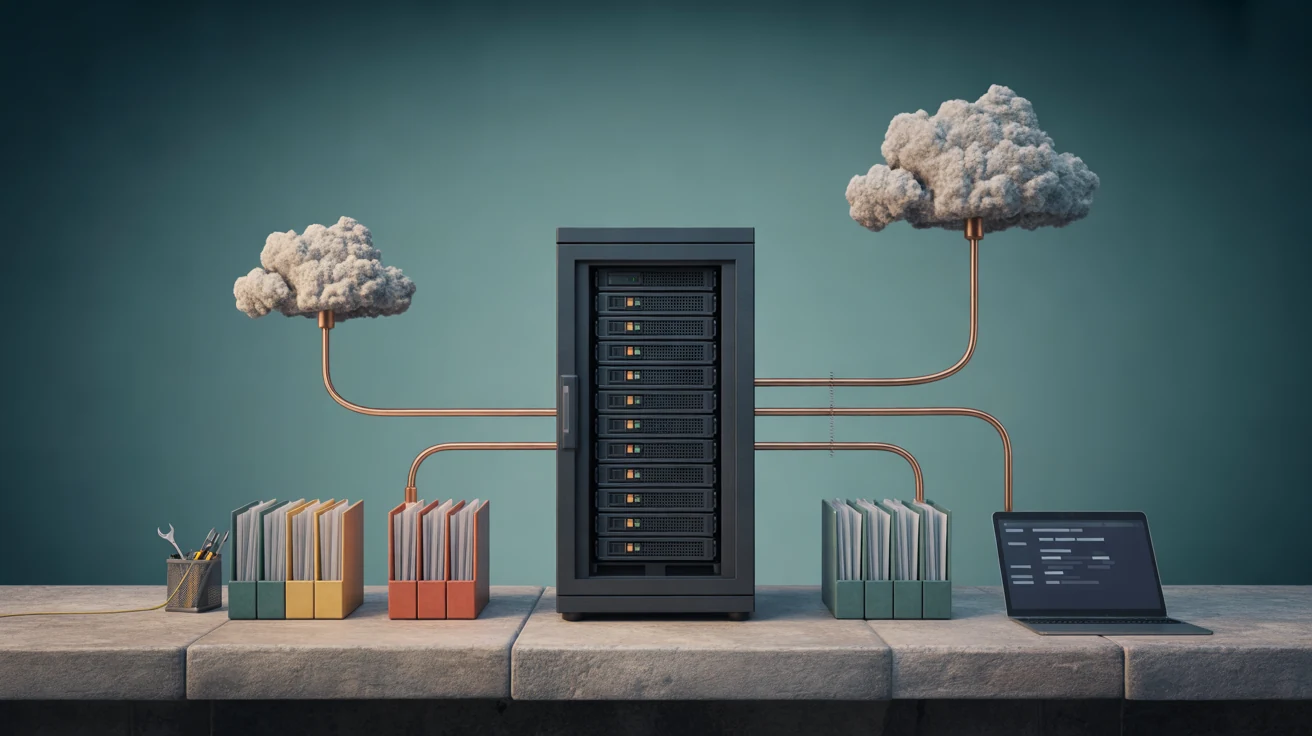
Think of the server as a workshop rather than a bigger chat window. Your repositories, scripts, local model files, job records, and operational notes live there. A laptop or phone is a way into the workshop, not its only home.
Ollama serves the local models. LiteLLM gives applications a controlled model entry point. Open WebUI supplies a chat interface. The browser desktop and native coding clients work alongside the same project directories. Ordinary scripts still do the jobs that do not need a language model.
This arrangement reduces a particular kind of dependence. Changing a laptop or reaching one provider's usage limit does not remove your working copies, deployment tools, or ability to inspect the last completed task. It does not remove dependence on the hosting company, your internet connection, or any outside model you choose to use.
The software layout is also portable. Much of it can run on a suitable cloud VM or office server. Bare metal is a capacity and operating choice, not an exclusive license to organize your work properly.
Compare the right cloud instance, not a caricature
A small cloud instance can be an excellent place for a website, a webhook receiver, or a lightly used automation. It becomes a poor comparison when you ask it to hold a large model, run browser sessions, and build several projects without giving it enough memory or sustained CPU capacity.
AWS distinguishes fixed performance instances from burstable instances. CPU credits apply to the burstable families, not all EC2 machines. In standard mode, exhausted credits bring a burstable instance toward its baseline; other families and configurations have different behavior. Dedicated instance options also exist. AWS CPU credit concepts, standard mode, and dedicated instances.
That is not the same as saying a hypervisor always reduces clock speed or that starting a browser makes CPU steal time spike. Diagnose the actual machine. Look at its instance family, CPU allocation, memory pressure, storage behavior, and workload before blaming virtualization.
An undersized machine may kill a process when memory runs out. It does not follow that the kernel must panic within thirty seconds. There is no such comparison in our measurements.
For steady workloads, a dedicated machine gives you a clearer hardware boundary and a predictable capacity bill. For temporary work, rapid resizing, managed services, or recovery across multiple locations, cloud infrastructure can be the better fit. The honest question is which arrangement makes your actual workload easier to operate and recover.
A good home machine is still a serious alternative
A modern workstation can be a very capable local AI machine. Apple's current Mac Studio specifications include configurations with substantial unified memory and built in 10 Gigabit Ethernet. That alone should stop anyone from dismissing the entire category as unable to support demanding local work. Apple specifications.
ECC memory is useful server hardware, but it is not exclusive to rented servers. Nor is the absence of ECC a forecast that a particular long running task will crash. The relevant questions are the machine's actual memory configuration, power protection, cooling, storage, update policy, and the consequences of an interruption.
The practical reason to rent a server is often location and availability. I do not want a sleeping laptop, an office power cut, or somebody closing a desktop session to be the unrecorded dependency behind every job. A properly administered office server can solve much of that too. It simply leaves those responsibilities with the office.
A GPU workstation may be the better purchase when fast local inference is the main job. A dedicated CPU server is more attractive when its memory, storage, remote access, and ability to host the surrounding tools are useful throughout the day. We have not run a controlled comparison against a current Mac Studio or GPU workstation, so this article does not award a performance winner.
What the OVHcloud example really buys
At the October 5, 2026 check, the US Eco catalog listed the SYS 5 family from $125 per month, with a $125 installation fee, memory starting at 96 GB, and public bandwidth starting at 1 Gbps. The page also showed availability limitations. Check the selected location, configuration, taxes, bandwidth terms, and checkout total rather than treating a catalog row as an immediately available order. OVHcloud US Eco catalog.
Our installed machine reports two Intel Xeon Silver 4214 processors, twelve physical cores per socket, and forty eight logical CPUs in total. The current catalog names the 4214R. Those are different processor variants, so we retain the machine's reported model instead of quietly upgrading it in the article. The reference build has 96 GB of RAM and mirrored NVMe storage. Recorded build evidence.
Intel documents AVX 512 and Deep Learning Boost support for the 4214. Those capabilities can help suitable software, but they do not establish the performance of every model runtime. More logical threads are not forty eight independent physical cores, and an instruction set badge is not an inference benchmark. Intel processor specifications.
Older server hardware also deserves a support review. Intel's product page lists a servicing status and end date for this processor generation. Ask what firmware and platform support the hosting provider supplies. An attractive rental price does not make lifecycle questions disappear.
I would shortlist the Eco range for a persistent development workstation, then compare the exact available offer. The benefit is useful capacity for a known monthly infrastructure charge, not ownership of the physical machine or unrestricted compute. Mirrored disks help with a drive failure; they are not a substitute for an independent backup.
RAM lets a model fit. It does not make it fast
The installed quantized Llama 3 70B file occupies 39,969,745,349 bytes, about 39.97 GB. That is a file measurement. A running model also needs memory for its context and other runtime state. The rest of the server needs memory too. Local model measurements.
We have not demonstrated conversational performance for that 70B model on this machine. The useful measured route in this project is Hermes 3 8B. It would be misleading to turn an available model file into a claim that a CPU replaces an expensive GPU at the same interactive speed.
The source aware Hermes route uses an 8,192 token context, bounded output, and automatic CPU thread selection. Ollama has a 24 CPU equivalent quota and a 48 GiB memory ceiling. A quota is not pinning, and a ceiling is not reserved capacity. These settings leave a deliberate boundary around the local model service rather than assigning the entire server to one request. Recorded settings.
Ollama documents how context size and parallel requests affect memory use. A longer document needs extraction, segmentation, and retrieval that preserve its meaning. It should not be pushed through a smaller context and silently truncated. Ollama operating guidance.
Concurrency needs budgets, not promises
There is a real advantage to keeping a browser, a database, a coding environment, and a local model on the same roomy machine. They do not all need to be busy at the same moment, and you can avoid paying for an independent server for every modest component.
But when they are busy together, they compete. Builds, video encoding, model inference, indexing, and backups still share CPU time, memory bandwidth, storage, and network capacity. Two sockets do not remove those limits.
We therefore have not claimed that a 300 page PDF, a large model, several browser tabs, vector ingestion, and a build run together without affecting latency. We have not published a storage benchmark supporting a particular NVMe throughput figure either. Such a claim needs a recorded combined workload, not a hardware specification pasted into a paragraph.
Qdrant and n8n are present in the broader stack, but presence is not integration. The verified project knowledge route currently uses SQLite FTS5 lexical search. It does not use Qdrant embeddings. Adding semantic retrieval later requires an embedding model, source versioning, access controls, and its own relevance tests.
Browser automation should likewise work with permitted sources, accounts, and interfaces. The architecture is not a license to defeat another site's access controls. A rejected request is information to handle, not a result to conceal.
The most useful improvement was evidence, not a larger model
The October 5 knowledge snapshot contains 40,925 searchable documents, divided into 284,008 retrieval chunks. Its sources include current project files, operational records, the migrated archive, and 409 exported Markdown memory notes. All 409 note paths were checked against their transfer manifest. Eight notes needed credential related redactions in their retrieval copies; the original files were preserved. Coverage summary.
This is not a claim that every file on the old machine is searchable. The index records exclusions for unsupported media, oversized files, extraction problems, duplicate content, and secret review. New edits on the old machine still need an approved transfer. The local refresh timer updates the index from its enrolled source directories; it does not magically synchronize every cloud account.
An early test exposed a more interesting problem than raw speed. Hermes selected an older desktop release from an indexed note even though the current release record was available. The answer sounded reasonable and quoted a real source. It was still wrong for the question.
The correction was to replace the older indexed revision with the live operational record for that current version question, rather than hand the model both and hope it chose well. A subsequent six check application test passed, including the current release answer, a stored memory rule, an unsupported project question, access rejection, and the original general model route. One later confirmation returned the correct release with its source in 24.43 seconds. These are bounded acceptance results, not a general accuracy score or response time promise. Test scope and result summary.
That is the version of a unified brain worth building: shared evidence with clear dates, not a pile of files that an assistant is assumed to understand. A model installed beside a directory cannot read that directory until an authorized retrieval or tool path connects them.
Three ways to pay, each with a boundary
The financial design is simpler when the routes stay separate.
Local processing uses the rented hardware. It avoids an outside model API charge for that request, but the machine, administration, backup, and time still cost something. Local does not mean free.
Interactive subscription work uses the provider's supported native client and login. Claude Code and Codex can use eligible subscription access, but both have plan dependent allowances. A subscription is not unlimited execution and does not become a general API key. Anthropic's current Agent SDK notice says its proposed separate usage changes were paused. For now, Agent SDK and claude -p usage authenticated through a subscription still draw from that subscription's limits. API key usage remains a separate route. Check the actual account and current notice instead of assuming every unattended command has one billing category. Claude Code plan guidance, Agent SDK guidance, and Codex plan guidance.
API work uses an explicitly configured gateway route and its associated provider billing. This is the lane for approved application and automation requests. Gateway keys, provider keys, native logins, and their budgets should not be interchangeable.
The native Claude and ChatGPT desktop integrations still need their own account and task acceptance in this installation. Installing the clients and extensions did not complete those tests. The verified local Hermes route is not evidence that every external account is ready.
Send less unnecessary material, not less necessary evidence
Before paying a language model to find a phone number, try an ordinary parser. Before asking it to summarize a large page, remove navigation and repeated markup where doing so is safe. A model should be used for the part that actually needs its judgment.
When a local model helps prepare a brief, keep source references and important exceptions. A shorter brief can lower the amount of input sent onward, but a brief that loses a changed deadline or a limitation can make the final answer more expensive to repair.
Words and tokens are not interchangeable. Neither are input and output prices. A real comparison needs provider reported token counts, cached input where applicable, output usage, failed attempts, local processing time, and review time. We have no invoice study supporting a claim that this build turns thousands of dollars into pennies.
A useful cost record separates server rental, subscriptions, API usage, backup storage, and operator time. Compare that whole amount with the alternative you would actually use. The architecture is financially attractive only when the work it absorbs and the continuity it provides justify those costs.
A gateway can help with failure without hiding it
LiteLLM supports retries and configured fallback routes. That is useful infrastructure, but a fallback is not an automatic property of installing the gateway. It must be configured and tested. LiteLLM reliability documentation.
Changing providers also changes more than the name on the response. It may change the model's capabilities, context handling, data destination, price, and tool behavior. A retry can duplicate an external action unless the application keeps a durable operation record and knows which step already completed.
Our source aware Hermes route does not silently fall back to a paid provider. If the approved local path cannot produce a usable result, it should return that state. A different provider is a separate, authorized decision.
For a broader automation, I would first record the request, honor a provider's retry timing, keep attempts bounded, and preserve a checkpoint. A configured alternate route should have an approved data policy and budget. The operator should be able to see that it was used. None of this bypasses an account limit or makes the model unaware of a different tool contract.
The cure for resubmit fatigue is not pretending nothing failed. It is knowing what completed, what did not, and what can safely resume without doing the same business action twice.
One interface does not make every upload universally visible
Shared directories and standard interfaces reduce friction. They do not erase application boundaries. An upload to a chat application may be stored in its own volume, indexed separately, and governed by its own permissions. A workflow engine will not necessarily see it just because both applications run in Docker.
Make that handoff explicit. Choose an inbox, preserve a source identifier, validate the file, record extraction status, and expose only the authorized material to each tool. Use a deliberate delivery step for outputs. Docker volume behavior.
The same thinking improves remote access. Amazon WorkSpaces Secure Browser exposes distinct clipboard and file transfer controls instead of pretending the local and remote desktops are one machine. That is a useful design reference for our mobile workbench, not evidence that we are running Amazon's protocol or reproducing its service. The new Safari interface remains a separately tested rollout. AWS toolbar controls.
A phone should offer a direct project question or terminal view when that is enough, while keeping the full desktop for tasks that need it. The server should retain the job when the browser disconnects. A nicer toolbar is valuable; it is not a substitute for a durable job record.
Sovereignty includes the work you still owe yourself
A rented server does not make every request local. Cloudflare is part of the protected access path. Remote Desktop Commander has its own connection infrastructure. A prompt sent to a hosted model or an illustration request sent to Ideogram leaves the machine for that service.
The practical objective is control over those choices and the ability to recover. Keep least privilege access, explicit routes, portable source, versioned configuration, and independently tested backups. Do not publish a browser debugging port or copy account tokens between machines just to make a login appear complete.
This project still has migration acceptance work, external account checks, and independent recovery tasks to close. The old AWS environment is not cleared for retirement. Keeping that open is more useful than declaring victory because a dashboard loads.
For a hands on operator maintaining several projects, the sovereign advantage is a coherent place to work: enough predictable capacity, reusable evidence, replaceable clients, visible spending decisions, and a path back when something breaks. A well designed cloud or office environment can achieve much of the same. The dedicated server earns its place when it makes those outcomes simpler for the work you actually do.
That practical approach is also the point of The $20 Dollar Agency: use tools to make a small business service deliverable, not merely impressive in a diagram.
Fact check notes and sources
- Measured evidence: Redacted build and acceptance summary. Counts are from one dated snapshot. The six checks are functional tests, not a performance contest against another machine.
- Hardware and pricing: OVHcloud US Eco, Intel Xeon Silver 4214, and Mac Studio specifications. Catalog configuration, installed hardware, and benchmark results are kept separate.
- Cloud behavior: AWS burstable CPU concepts and EC2 dedicated instances. No blanket throttling or cloud failure claim is made.
- Local models and routing: Ollama FAQ, LiteLLM fallback configuration, and Docker volumes.
- Account limits: Claude Code subscription guidance, Claude Agent SDK plan treatment, and Codex with ChatGPT. Check the actual account and current terms before assigning automated work.
Continue the series
The Sovereign AI Playbook covers the foundation. Small Quantized Models on a 96 GB Server explains the earlier extraction and routing tests. Desktop Commander, Cowork, and Browser Agents for a Small Business covers practical task choices.
Download the comparison and acceptance kit before choosing hardware or changing your model routes.
Documentation and catalog checked October 5, 2026. Measurements describe this installation and the stated test scope, not guaranteed speed, availability, savings, or security. The conceptual hero illustration was generated with Ideogram from a generic brief. No private project documents or credentials were included in the image prompt. Product references do not imply vendor affiliation.
