
On Friday, November 13, 2026, the FAA held every departing flight in the country for 4 hours and 23 minutes, by the times on its own advisories, after the private network linking its air traffic control centers started passing bad data. That night Transportation Secretary Sean Duffy asked Congress for $50 billion on top of the $12.5 billion it gave in 2025. Our answer: fund the new network, but keep a small, well maintained legacy layer running beside it for good, owned and repaired by the government. And hold the new money until five questions have answers: what caused Friday's failure, what the $50 billion buys line by line, what the new equipment will cost to refresh every few years, who will own the network, and what an independent security review finds.
The government's diagnosis is old routers, old switches and old copper, and a network that the FAA's own plan says depends on 1960s time division multiplexing, or TDM. The cure on offer is to go fully digital: fiber, wireless and satellite links on internet protocol, built by an integrator and run by phone companies. We agree with most of the diagnosis and part of the cure. We write as IT people who build and repair networks for small organizations. We are not aviation engineers, and we say where our view is opinion.
One word first. People call the FAA's old system "analog," and that is only partly right. TDM is a digital way of carrying many conversations on one line. The truly analog parts are the older voice radios and voice switches, as GAO describes them. So we say legacy network: fixed circuits, analog voice radio and equipment with no internet address. It fails in simpler ways, a technician can repair it part by part, and it is much harder to attack from a distance. That is the part worth keeping.
1. What happened on November 13, and what is still unknown
Advisory 111, signed at 3:54 p.m. Eastern, held all departing traffic "until further notice." At 7:37 p.m. some coastal facilities released some international departures. The cancellation carries an event time of 8:16 p.m. From the first event start, 20:53 UTC, to 01:16 UTC is 4 hours 23 minutes (our arithmetic). Others differ: CBS News says about five hours and Nextgov says the stop lifted around 9 p.m. The FAA's statement said it stopped flights "following communication issues impacting multiple Air Route Traffic Control Centers." CBS, citing FlightAware, counted 9,159 cancellations and 7,190 delays on Friday; CNBC reported about 9,000 and more than 7,000, some due to weather.
Friday's account. Duffy said: "Our switches, our routers, actually got overloaded with data, and they went down," then said the routers gave inconsistent data. Homeland Security Secretary Markwayne Mullin said patches and new equipment "was overwhelming the older system." On a cyberattack he said: "However, we're still looking, so we're not going to rule that out". Duffy also said, in a transcript published by One Mile at a Time: "our new IP switches did not go down."
Saturday's account. Duffy said contractor L3Harris was moving lines from copper to fiber at a remote site, and per CNBC that a router switched to fiber flooded other routers with more than 1,000 connection attempts roughly every five seconds. He said the FAA was checking for installer error or a faulty router: "We haven't determined what the fault was." FAA Administrator Bryan Bedford said: "When we have this root-cause analysis complete we will share it with you."
Unnamed sources. CBS reported senior government sources pointing to "Cisco 600 series routers that were manufactured between 2001 and 2006," and other sources pointing to an update that crashed the network. SecurityWeek relayed a Bloomberg report that the FBI was looking at a software update.
L3Harris has not been found at fault. In a statement reported by Fox Business, it said it has "completed more than 70% of the planned airspace communications conversion from legacy copper wires" and is supporting the FAA's investigation.
We will not pick a cause. Both official accounts do share something: the trigger officials described was a change made during the replacement program, on a network the contractor owns, and neither describes an old part wearing out by itself. If the CBS sources are right, the routers were first generation digital packet gear, 20 to 25 years old (our arithmetic). That is a long way from 1960s analog equipment.
Scroll to compare columns and rows when the table extends beyond the box.
| When | Who | What they said | Source |
|---|---|---|---|
| Nov 13 | Duffy | Old switches and routers overloaded; new IP switches held | Nextgov, transcript |
| Nov 13 | Mullin | Patches and new equipment overwhelmed the old system; attack not ruled out | SecurityWeek |
| Nov 14 | Unnamed sources | 2001 to 2006 Cisco routers; a network update | CBS |
| Nov 14 | Duffy, Bedford | Copper to fiber router move flooded others; fault undetermined | CNBC, The Hill |
Not yet published: a root cause, the router's age and model from any named official, and whether recovery meant rolling back a change.
2. The money: $12.5 billion, then $20 billion, $30.1 billion, $50 billion
The 2025 law, P.L. 119-21, section 40003, lists 14 amounts, prints no total, and keeps the money available "until September 30, 2029."
Scroll to compare columns and rows when the table extends beyond the box.
| Line | Amount |
|---|---|
| Telecommunications modernization and system upgrades | $4,750,000,000 |
| Radar replacement | $3,000,000,000 |
| A new air route traffic control center | $1,900,000,000 |
| Terminal radar facility recapitalization | $1,000,000,000 |
| Runway safety and surface surveillance | $500,000,000 |
| Nine other lines (listed in the kit) | $1,370,000,000 |
| Total, our arithmetic | $12,520,000,000 |
The FAA's Modern Skies dashboard, "current as of 10/15/2026," reports 3,508 of 5,170 telecommunications connections replaced (68%), 457 of 1,581 radio sites converted, 220 of 450 IP voice switches and 15 of 612 radars.
GAO's September review, GAO-26-107992, found $9.030 billion provided for the system programs it examined against an FAA phase one estimate of $10.615 billion, and said that estimate "does not include government-related costs, most of the operations and maintenance costs for phase 1, or any of the costs for phase 2." It found 11,389 project schedules not integrated into one master schedule, warned that repeat crew visits "will cause unnecessary disruption to the ATC facilities," and said schedule pressure can compress testing. The government's Saturday account puts the start of November 13 during an installation.
On USAspending the 2025 money sits in Treasury account 069-2025/2029-1308-000, with $12.52 billion available, $266.9 million obligated in fiscal 2025 and $2,984.2 million in fiscal 2026. The public data does not show which companies received it.
Scroll to compare columns and rows when the table extends beyond the box.
| Date | Figure | Source |
|---|---|---|
| May 8, 2025 | No total | DOT plan |
| July 2025 | $12.5 billion enacted | P.L. 119-21 |
| July 16, 2025 | $31.5 billion for the full project | Duffy, per Roll Call |
| Dec 4, 2025 | "$12.5 billion down payment, need additional $20 billion" | FAA fact sheet |
| Sept 28, 2026 | Another $30 billion; Modern Skies Act | Nextgov |
| Nov 12 or 13, 2026 | $30.1 billion in writing | Reuters |
| Nov 13, 2026 | $50 billion, no breakdown | The Hill |
No breakdown of the $50 billion has been published. The written $30.1 billion matches the Modern Skies Act: $10.1 billion for air traffic control, mostly a $7.2 billion automation platform and $2 billion for cloud computing and telecommunications; $2 billion for towers and terminal facilities; and $18 billion for airports. The bill uses the word telecommunications once, and the words copper, router, switch, backup and security do not appear in it (our word search of the text as introduced). So $20 billion of the $30.1 billion, 66.4%, is airports and towers (our arithmetic: 18 plus 2, divided by 30.1).
The buildings are a real need. The plan says the FAA replaces on average one of its 377 owned towers a year, a 300 year cycle, and wants 4 to 5 a year, and that its 21 en route centers are approximately 61 years old on average. The May 2025 release promised six new centers; the fact sheet lists one, and the law funds one at $1.9 billion. Our view: the headline number mixes a network problem with a construction program, and Congress should vote on and track them separately. The FAA's own plan proposed a separate account to "easily track and monitor the cost of these updates."
3. What the FAA says is wrong, and what the words mean
The May 2025 plan says the FAA Telecommunications Infrastructure network, FTI, "dates to 2002 and is heavily dependent on obsolete 1960s TDM technology across over 30,000 services at 4,600 sites." It says a major carrier's July 2024 notice put 33% of airspace services at risk of early discontinuance, with new monthly obsolescence fees, and that at past funding levels the move to internet protocol would not finish until 2038. It describes legacy radios more than 30 years old built on outdated analog technology, and nearly 800 voice switches hard to keep running for lack of parts and retiring staff.
On May 11, 2025, Duffy told NBC: "We have to go on eBay and buy parts if one part goes down." The plan names floppy disks in Alaska's OASIS systems and in display systems. We found no record of eBay being raised again on November 13 or 14.
Analog and digital. Analog is a continuous wave, like a vinyl groove. Digital is a string of numbers, like music on a phone. Copper and fiber are both cable; copper carries electricity, fiber carries light, and either can carry digital signals. Circuit and packet. A circuit is a reserved lane held for one call, like a private road. Packets are small envelopes sharing the road and finding their own way, like the mail. TDM gives each conversation a regular time slot on a shared line, like people at a table speaking in turn; ATIS calls it "digital multiplexing", and the FAA's own order says airspace telecommunications rely on "analog and digital" TDM. Internet protocol (IP) is the internet's addressing system; an address is what lets a device be reached, managed and updated from anywhere. A switch connects devices inside a site, like hallways. A router connects sites and picks each packet's next hop, like a sorting center. A voice switch connects a controller's headset to the right radios and phone lines.
So the Modern Skies goal to "move systems from analog to digital (IP)" blends two changes: old to new, and circuit to IP. The FAA even called a failed Dallas TDM data service part of "aging, analog systems".
The FAA's strongest argument is real. AT&T plans to end copper in substantially all its wire centers by the end of 2029. Verizon companies filed to retire copper in 274 Texas wire centers. The FCC in March 2026 removed notice rules that slowed such retirements. GAO found 61 systems hard to find parts for, and one where technicians had to take apart spares to salvage components. And the Inspector General traced an April 2025 Newark outage to a burnt copper wire.
4. Who has been paid to run the old network, and who is paid to build the new one
Obligated is money legally committed to a contract so far, like signed work orders. Ceiling is the most the contract allows, like a credit limit. Outlays are what has actually been paid. A prime contractor holds the government contract; an integrator is a prime hired to coordinate the others. Figures are from USAspending, November 14, 2026, with names as recorded.
Scroll to compare columns and rows when the table extends beyond the box.
| Program | Company | What, years | Obligated | Ceiling |
|---|---|---|---|---|
| FTI, legacy network | Harris Corporation (parent L3Harris) | Signed 2003, ends 2032; 13 orders | $7,623,291,915.86 | Unreliable |
| FENS | Verizon Business Network Services | Replacement network, 2023 to 2033 | $202,058,078.27 | $3,998,104,895.00 |
| FENS | AT&T Enterprises | Not competed, 2026 to 2027 | $74,300,000.00 | $74,300,000.00 |
| Integrator | Peraton | 2025 to 2035; 18 orders | $277,823,318.79 | $1,500,000,000.00 |
| Radars | Raytheon | 2025 to 2030 | $438,157,573.24 | $452,400,507.94 |
| Voice switches | Rohde and Schwarz USA | Not competed, 2025 to 2028 | $637,469,681.87 | $4,928,447,413.00 |
| Radios | General Dynamics Mission Systems | 2012 to 2027 | $386,470,668.46 | $481,893,302.85 |
The FTI record shows a 2003 signing date; the Inspector General dates the award to 2002 and in 2006 called the contract "essentially a 15-year lease agreement through 2017" with a ceiling of $3.5 billion. The record now shows $7.62 billion obligated and an end date in 2032. That is 2.18 times the 2006 ceiling (our arithmetic: 7.62 divided by 3.5). FTI outlays are $3,066,319,058.70, counted only from fiscal 2017. The public ceiling fields for FTI are unreliable: its orders exceed the stated ceiling, and one order lists a $108.9 billion potential value, which says something about how hard this network's cost is to see. Other radar, voice switch and radio awards are in the kit.
Scroll to compare columns and rows when the table extends beyond the box.
| Fiscal year | FTI obligations |
|---|---|
| 2008 | $223,158,207.99 |
| 2016 | $369,325,778.79 |
| 2023 | $386,026,353.61 |
| 2024 | $459,041,647.84 |
| 2025 | $918,037,659.65 |
| 2026 | $1,171,985,532.39 |
From fiscal 2008 through 2023, FTI obligations stayed between $222.5 million and $386.0 million a year. Fiscal 2026 is 3.04 times fiscal 2023 (our arithmetic: 1,171,985,532.39 divided by 386,026,353.61). That is the sourced version of the worry that this will cost more every year. The data cannot tell us how much of the jump is copper to fiber work rather than ordinary service.
Some 2025 modernization money is going to the company that runs the legacy network. An award search filtered to the 2025 Treasury account returns six FTI orders among the awards it paid. The largest FTI order drew $316,401,624.37 from account 069-1308, which holds the 2025 money and two older pots; the data we used does not say which pot paid. That order kept receiving funding through fiscal 2026, after its listed end date of September 30, 2024.
Across all FAA contracts from fiscal 2008 to 2026, the top recipients were Harris Corporation at $7,362,121,000.91, Lockheed Martin Services at $4,309,464,408.97 and MITRE at $2,909,727,141.54, with one company sometimes listed under more than one registration. Total FAA contract obligations went from $3,471,466,840.91 in fiscal 2008 to $6,034,097,529.88 in fiscal 2025 and $9,864,569,672.91 in fiscal 2026.
On Saturday Duffy said "L3Harris actually owns that network", that AT&T, Verizon and Lumen will build the new architecture, and: "until I can build that, I'm stuck with L3Harris, who owns this network." The FAA's plan aims to "eliminate vendor lock-in", though the plan uses that phrase for its automation platforms.
Our observation: the plan swaps one contractor owned network for another built by a prime integrator and run by carriers. The AT&T work began as a task order because a new competition would take at least 22 months and make the 2028 deadline "impossible to meet." The public data shows no termination of the Verizon contract and no full AT&T contract value as of November 14.
5. What the pitch leaves out
We searched the May 2025 plan. It never mentions repair depots, universities, the Defense Department or the NSA. It gives no recurring refresh cost and no fallback network kept after the transition, and it treats cyber only as a weakness of old equipment.
a. Old equipment can be repaired, and the government knows how
The FAA Logistics Center in Oklahoma City repairs and supplies airspace equipment and stocks more than 84,000 components, including ones "no longer available anywhere else in the world." Its consulting team includes "a consortium of universities." The page dates from 2020 and gives no budget or staffing.
The missile silo story, told straight: in 2016 GAO reported that the system coordinating U.S. nuclear forces ran on a 1970s IBM Series/1 and 8 inch floppy disks, with a storage update planned by 2017. In 2014 Maj. Gen. Jack Weinstein told CBS, in CBS's paraphrase, that it was secure partly because it was old and not on the internet. In June 2019 the floppies gave way to a "highly secure solid state digital storage solution," and Lt. Col. Jason Rossi said that October: "You can't hack something that doesn't have an IP address." Defense News described maintainers repairing parts with soldering irons. In 2020 the Air Force said the 1970s core had run for more than 40 years, and Rossi warned: "it is dangerous to assume that we can operate with new commercial-based systems in the same way we are operating today." The lesson: keep the simple core, replace the parts around it in steps, with your own people.
The Defense Microelectronics Activity says its work "addresses low-volume, legacy, or obsolete technologies", and Tobyhanna Army Depot overhauls and repairs the military's air traffic control radars and radios. We found no public record of the FAA using either.
The limits: GAO found technicians taking apart spares to salvage components for one system, and the FAA's workforce plan counted 4,594 certified technicians against a 5,300 target in fiscal 2025. Current gear has its own limit. Cisco gives "Five (5) years of TAC support for hardware from the EOS date," and its policy promises replacement parts for the same five years. After that the maker stops supplying parts and fixes. CISA's February 2026 directive gives civilian agencies 18 months to decommission network edge devices that are past end of support. It excludes operational technology, and we could not tell from it whether any air traffic equipment is covered.
b. Nobody has asked the people we already pay to train engineers
The National Science Foundation planned $932.72 million for computer and information science and $738.13 million for engineering in fiscal 2025. Maryland's CALCE center teaches electronic part obsolescence, and Georgia Tech's research institute describes reverse engineering parts when spares are gone. This cuts against us too: the fiscal 2027 request would cut those directorates 62.9% and 74.9%. Universities are not a ready resource unless Congress keeps that money.
NSA's Joint Federated Assurance Center supports "microelectronics hardware assurance for DoD programs," and its research labs build trusted hardware. Nothing there extends to the FAA or to repairing civilian gear.
Our proposal: a standing sustainment program run through the Logistics Center, with university partners and Defense obsolescence experts on call. It would keep a small set of legacy gear alive and train technicians. It would not stop the carriers' exit from copper.
c. The replacement cycle never ends
FTI was the last modernization. Its lifecycle estimate rose from $1.9 billion to $2.4 billion in 2004, two years after the award, and its promised savings eroded to none by fiscal 2007. It is still sustained through at least 2027. The last voice switch replacement was terminated in 2018, and the Inspector General found "FAA spent $160 million on NVS and will spend $274 million to sustain its legacy switches." NextGen delivered about 16 percent of expected benefits after more than $15 billion. Our Advanced Automation System post covers an earlier write-off.
Cisco, Juniper and Arista give up to five years of hardware support after a product stops selling. That is end of life: the maker stops fixing it. The Verizon contract runs to 2033, and the AT&T work could run up to 15 years, several hardware generations (our inference; we found no FAA refresh plan). GAO puts phase two at approximately $10.2 billion, not counting facilities. On the old funding path the plan dated the TDM transition to 2038, radios to 2037 and automation to 2040. Bedford said a modern system could save "over 20 years, conservatively, $300 billion"; we found no published analysis behind it.
Our view: a digital network is a subscription, not a purchase. Congress should see the refresh cost for years 5, 10 and 15 before it votes. That number does not exist in public, and that is the problem.
d. A carrier run IP network is a bigger target
This is not about November 13, where officials found no evidence of an attack. It is about future exposure. In 2024 the FBI and CISA said actors linked to China had compromised networks at multiple telecommunications companies, without naming them. White House official Anne Neuberger later said "a ninth company was identified", and a CISA official said "we cannot say with certainty that the adversary has been evicted". Officials named no victims. Nextgov reported that the providers reached included AT&T, Verizon, Lumen and T-Mobile, and AT&T and Verizon said in December 2024 they no longer detected the attackers. Three of those four are companies Duffy named for the new architecture. That proves nothing about today; it is a reason for the conditions in section 8.
A 2025 advisory says these actors "often modify routers to maintain persistent, long-term access to networks" and lists transportation as a target; a 2024 advisory describes another group pre-positioning in transportation for disruption in a conflict. Neither names aviation. CISA's catalog of exploited vulnerabilities, version 2026.11.13, holds 329 entries for 17 network and security vendors, 193 added since 2023, by vendor name match, which includes some non network products. GAO warned that "if one system connected to an IP network is compromised, damage can potentially spread to other systems".
The agency that would oversee this network has open findings of its own. DOT's security program was rated not effective with 45 open recommendations; the FAA had not fully implemented 1,836 of 16,245 required controls on 45 high impact systems; the modernization runs under a blanket waiver from nearly all of the FAA's acquisition rules, and the waiver lists security reviews among the requirements that add time; and GAO said in 2021 the FAA needed to hire cybersecurity skills.
The other side, in full. GAO found authentication weaknesses in the current text links between aircraft and the ground. The 2015 GAO report says a hybrid "increases the potential for the point-to-point systems to be compromised" and that good controls can make IP more resilient. NIST says air gaps alone are not enough, and Stuxnet spread by USB drives. The FAA says legacy systems need extensive retrofitting to add controls, and its plan lists better cybersecurity as a reason to replace. Our view: both sides are right, which is exactly why one layer should not be the only layer. Rossi's 2020 warning applies here.
6. The case against keeping the old network
Carriers are leaving copper and TDM, and the FCC order also preempts state rules that would keep legacy networks running. Technicians are short. Running two systems costs money and attention: the FAA rated voice switches its highest implementation risk, partly because old and new must run side by side. Duffy says the new IP switches held. The record cuts both ways:
Scroll to compare columns and rows when the table extends beyond the box.
| Date | What failed | Type | Source |
|---|---|---|---|
| Nov 2009 | Engineer misconfigured a temporary router between old and new networks | Contractor, during IP migration | DOT OIG |
| Jan 2023 | Contract staff deleted files on the pilot notice system | Contractor, software | FAA |
| Apr 2025 | Burnt copper wire at Newark | Legacy copper | DOT OIG |
| Sept 2025 | Carrier TDM service failed in Dallas; redundancy oversight failed | Carrier, contractor | FAA |
| Sept 2026 | Replacement circuit failed; backup fiber cut by a construction crew | Circuit, cut fiber | Reuters |
| Nov 2026 | Router moved from copper to fiber flooded others; cause undetermined | Contractor, during migration | CNBC |
Keeping everything as it is cannot be done, and we are not proposing it.
7. How other busy airspaces run it
No single provider anywhere handles as many flights as the FAA, so the fair comparison is Europe taken as a whole. The joint FAA and EUROCONTROL comparison report puts the two areas at nearly the same size, 10.4 and 10.6 million square kilometers. In 2022 the continental United States handled 14.8 million instrument flights and Europe 8.7 million. The United States did it with one provider, 20 en route centers in the lower 48 states and 11,784 working controllers. Europe used 36 providers, 58 centers and 16,552 controllers (the staff counts are for 2021). The same table counts 517 airports with air traffic control in the United States and 374 in Europe. Of 409 U.S. towers, GAO counts 144 as FAA-owned and 265 as FAA-contracted.
Who runs the system differs by country. The DOT Inspector General's 2017 testimony describes the four it studied:
Scroll to compare columns and rows when the table extends beyond the box.
| Country | Who runs air traffic control |
|---|---|
| United States | A federal agency, the FAA |
| Canada | A private nonprofit corporation with no shareholders |
| United Kingdom | A for profit partnership of government and private owners |
| Germany | A limited company the government owns |
| France | A government agency |
The money differs more than the technology. The Inspector General's 2015 review found that all four foreign providers "are financially self-sustaining and do not receive funding from their governments." They live on fees charged to airlines, and the providers in Canada, Germany and the United Kingdom borrow against that income by selling bonds. France, like the FAA, follows government spending rules. The same review found these providers "do not embark on large-modernization efforts" and add new technology in steps. In 2017 the Inspector General put Canada's capital budget at about $120 million a year against $2.6 billion for the FAA's equipment account, and said the Canadian provider uses "in-house staff" to adapt commercial products. It also gave the caution that belongs next to every comparison: the United States "has more operations than the total of all the foreign ANSPs we examined."
Their networks are contracted out too. Europe's shared cross border network has been "operated by BT since 2018" under a procurement EUROCONTROL leads, a 10 year contract worth more than 50 million euros. EUROCONTROL calls it "a common IP-based regional backbone." So hiring a phone company to run an IP network is normal. What differs is what sits under it.
The fallback is written into the rules. The UK regulator's requirements for air traffic control radio call for "main and emergency equipment," and define emergency equipment as "operationally independent of the Main and Standby Equipment." EUROCONTROL's Minimum Operating Network concept, from 2024, keeps a thin layer of conventional systems for bad days, and says that for data link trouble "the back-up remains VHF voice air-ground communications."
Where they failed, the lesson matches ours. On August 28, 2023, one flight plan stopped the UK's automatic flight plan processing. The primary and the backup sat in separate rooms on separate power, but the independent review found each had "the same software running on the same hardware," and the regulator estimated over 700,000 passengers were affected. The same review notes that the replacement system, once due in 2015, is now scheduled for 2030. On June 15, 2022, Switzerland admitted no new traffic to its airspace for around five hours. The government's investigation found that "Despite its redundancies, the network had been severely impaired due to the malfunction of a network switch."
Our reading: other countries have changed who owns and funds the provider, and that has not removed the need for a second path that fails differently from the first. Britain's rules require one for controller radio, and its 2023 failure shows what happens where the backup is a copy of the primary. The FAA's plan does not mention one.
8. What a hybrid would look like
Our proposal:
- Root cause first. The FAA publishes the November 13 root cause and change records. Who: FAA, checked by the DOT Inspector General. Done when: both are public before any new appropriation.
- A permanent minimum fallback layer for controller to pilot voice and basic radar at every en route center and the largest approach facilities, sharing no router, carrier, update channel or management network with the primary. Nuclear Regulatory Commission policy says that where a digital common cause failure is risk significant and other measures are not shown to be adequate, "a diverse means must be provided". The FAA already keeps ground beacons so pilots can "revert from Performance Based Navigation (PBN) to conventional navigation". The requirement is independence and simplicity, whatever the medium. Who: Congress funds, FAA owns. Done when: each site runs voice and basic radar for a full shift with the primary unplugged.
- Sustainment the government owns. Fund the Logistics Center with the help in section 5b, and write data rights and spares into every new contract so the FAA is never again stuck with the owner of its network. Who: Congress, FAA contracting. Done when: the FAA holds the configurations, designs and spares.
- Change control. No nationwide change in one step, a tested way back, no cutovers at peak hours, answering GAO's schedule warning. Who: the integrator, approved by FAA. Done when: every cutover has a tested rollback.
- A life cycle budget line: 15 years of refresh cost, in the separate account the FAA's plan proposed. Who: FAA, reviewed by GAO. Done when: Congress sees years 5, 10 and 15 before voting.
- Security conditions before cutover: an independent assessment, more than one carrier per critical path, and a live fallback drill. Who: the Inspector General or GAO, with CISA. Done when: no site cuts over until its fallback carries live traffic in a drill.
- Split the request. Network, buildings and airports voted and reported separately, with awards on USAspending. Who: Congress. Done when: each award traces to its line.
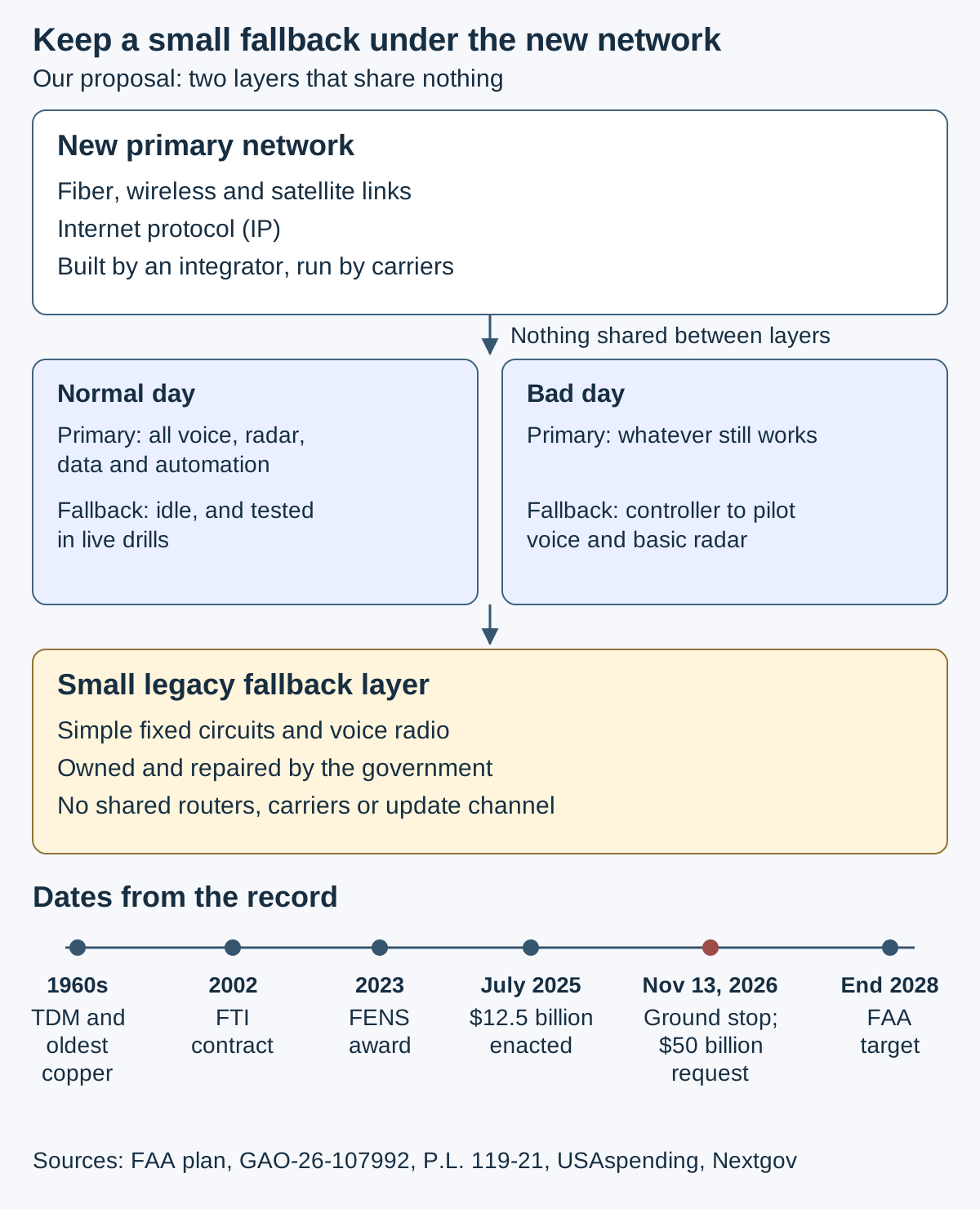
┌──────────────────────────────────────────────────┐
│ NEW PRIMARY NETWORK                              │
│ Fiber, wireless, satellite · internet protocol   │
│ Built by an integrator · run by carriers         │
│ Normal day: voice, radar, data, automation       │
│ Bad day: whatever still works                    │
└──────────────────────────────────────────────────┘
               ▼ nothing shared ▼
┌──────────────────────────────────────────────────┐
│ SMALL LEGACY FALLBACK LAYER                      │
│ Simple fixed circuits · voice radio              │
│ Government owned and repaired                    │
│ No shared routers, carriers or update channel    │
│ Normal day: idle and tested                      │
│ Bad day: controller to pilot voice, basic radar  │
└──────────────────────────────────────────────────┘
1960s → 2002 → 2023 → Jul 2025 → Nov 13, 2026 → end of 2028
TDM,    FTI    FENS   $12.5B     ground stop,    FAA target
copper                           $50B request
Why this is achievable. The fiber conversion is 68% done by the FAA's October count, so the question is what to do with the last third and the equipment coming out. The depot exists, and the principle has precedent inside the FAA and at another safety regulator. What it would cost: no source we found prices a fallback layer. Pricing it should be the first job for the Inspector General or GAO.
9. What a smaller organization can take from this
The same pattern fits a ten person office replacing its phones. Keep the old line until the new one has run through a full busy season. Change one site at a time, with a way back. Own your configurations, admin passwords and a few spares, and write down what your provider owns, because on a bad day that list decides who can fix what. Budget for the refresh in year five as well as the purchase. Our Microsoft 365 outage plan covers working through a provider outage, and our guide to isolating devices on a consumer router shows how to stop one failure from spreading. If you run a group of websites on a small budget, The $100 Network covers building them on one codebase you control.
10. The question for Congress
The FAA needs a new network, and the copper is going away regardless. On the government's own account, November 13 showed old and new tangled together on a network the government does not own, where one change at one remote site stopped the country. A small layer the government owns and can repair is cheap insurance. The question for Congress: before adding $50 billion, will you require the root cause, the refresh cost and a fallback the FAA owns?
The kit
- FAA Modernization Questions and Data Kit (.md): twelve questions with their facts and sources, the public USAspending requests behind every contract figure here, a guide to obligated, outlays and ceiling, a glossary, and a checklist for replacing a network without a blackout.
Related reading
- The Advanced Automation System: the FAA's earlier computer replacement and the $1.5 billion written off.
- Microsoft 365 outage continuity plan: a free outage plan for small businesses.
- FBI and CISA warn of attacks on refrigeration systems: finding and locking down connected building equipment.
- Government contract vehicles, explained: IDIQs, GWACs and why the vehicle matters.
- The GAO High Risk List and improper payments: the watchdog that counts federal waste.
- WIN-T, the Army's mobile network: billions spent, then halted after testers called it fragile.
- Isolating IoT devices on a consumer router: a three network segmentation pattern for beginners.
Fact-check notes and sources
All read November 14, 2026 (UTC) unless noted. Press pages were checked in a desktop browser between 19:58 and 20:12; FAA, DOT, NSA and Air Force pages between 20:10 and 20:20. The FAA advisories, the GAO floppy disk report and the Arista policy were re-read in the browser between 20:50 and 21:00. USAspending figures were pulled 20:00 to 20:14 and re-run by us at 20:23 with identical results. Where sources disagree we give each figure with its source.
- Event and quotes: FAA advisories (20:07 to 20:10), FAA statements (20:12), Nextgov, SecurityWeek, CBS, The Hill, One Mile at a Time (19:58 to 20:02); CNBC, The Hill, Nov 14, Fox Business (20:02 to 20:12).
- Money and plans: P.L. 119-21 and S.5572 (re-read by us 20:25); DOT plan, DOT release, fact sheet, Modern Skies (20:10 to 20:20); Reuters, Roll Call, Nextgov, Sept, Nextgov, Aug, NBC (20:02 to 20:10).
- Contracts: USAspending, award pages in the tables (20:00 to 20:14, re-run 20:23).
- Audits: GAO-26-107992 (re-checked 20:24), GAO-24-107001, GAO-15-370, GAO-26-108439, GAO-21-310, GAO-16-468; DOT Inspector General on FTI 2006, FTI 2008, the 2009 outage, the voice system, NextGen, FY26 challenges, high impact systems, security audit (Nov 13 to 14, 20:00 to 20:13).
- FAA and carriers: NOTAM statement, order JO 1370.124, workforce plan, Logistics Center, Reuters on Philadelphia, ATIS (re-read 20:25), AT&T, Verizon notice, FCC (20:04 to 20:20).
- Repair and research: Air Force, NSA JFAC, NSA research (browser, 20:13 to 20:20); Defense News (re-read 20:25); CBS 2014, DMEA, Tobyhanna, CALCE, GTRI, NSF (20:00 to 20:12).
- Other countries: FAA and EUROCONTROL comparison, Inspector General 2015, Inspector General 2017, EUROCONTROL on NewPENS, 2018 and 2026, UK CAA CAP 670, EUROCONTROL Minimum Operating Network, UK independent review CAP2993, Swiss investigation summary (each read by us in full text, 21:16 to 21:18).
- Cyber and life cycle: CISA and FBI, AA25-239A, BOD 26-02, Cisco, The Record, Federal Register (re-read 20:24 to 20:25); AA24-038A, Nextgov, Dec 2024, Insurance Journal, Juniper, Arista, NIST, Stuxnet advisory, NRC, KEV catalog (20:00 to 20:11).
This post is informational and argues an opinion. It is not legal, financial, engineering or security-consulting advice. Mentions of third parties are nominative fair use. No affiliation or endorsement is implied.
