
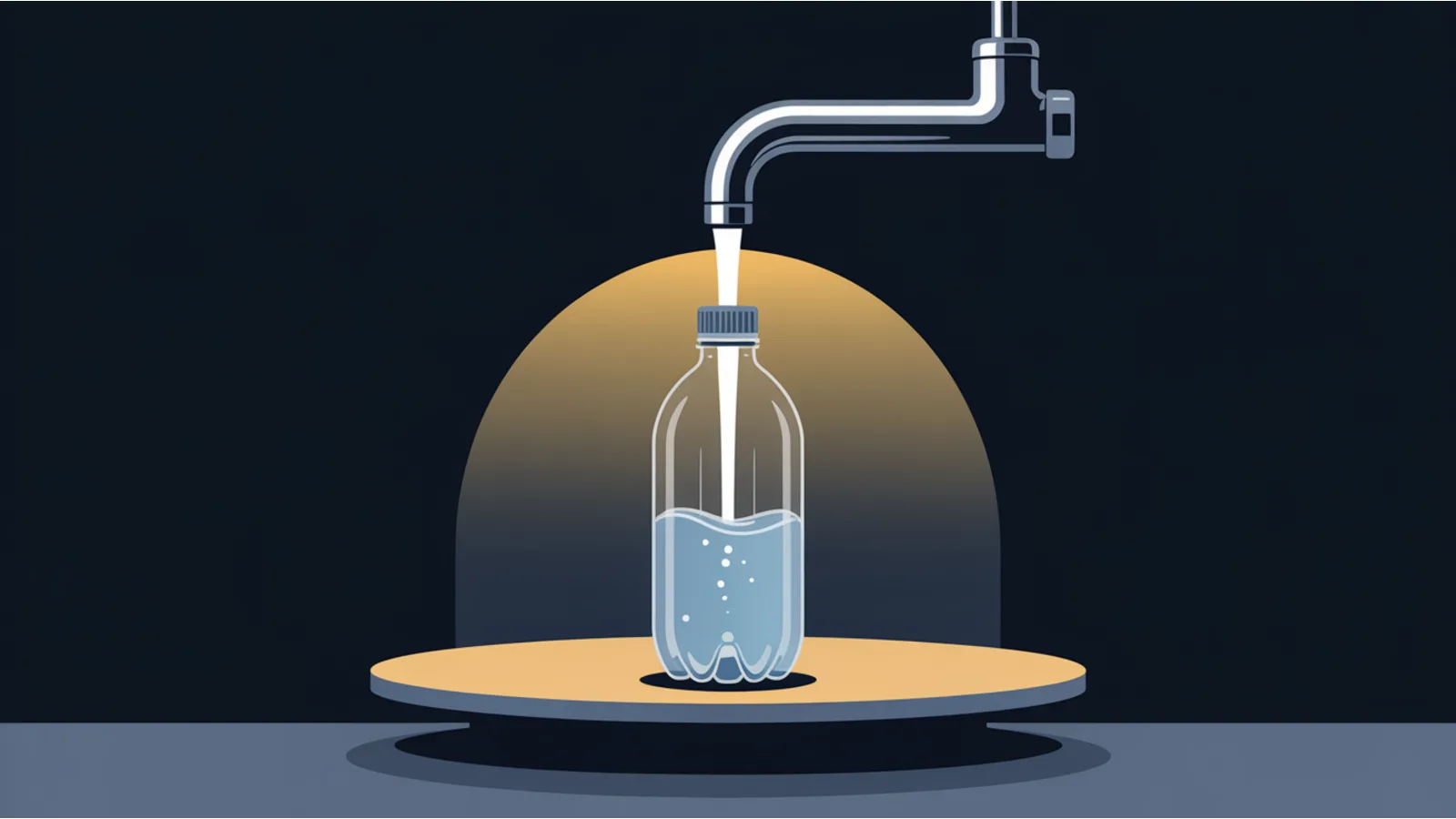
This is one more entry in the running series on the toll economy, the collectors who charge rent on something you could otherwise get for close to nothing. Bottled water is the friendliest looking toll of the set, because nobody forces you to pay it. The water already comes out of your tap for a fraction of a cent, and the entire business is the art of selling it back to you in a bottle for a thousand times more. Every figure below is cited to a company's own website, its filing with the Securities and Exchange Commission, a federal regulation, a court order, a state agency, or a named price on a store shelf. Where a number is an estimate or could not be confirmed at a primary source, I say so rather than dressing it up.
Americans now drink more bottled water than any other packaged drink. In 2025 it was the number one packaged beverage in the country for the tenth year running, at about 47.7 gallons per person, which the Beverage Marketing Corporation puts at roughly 380 of the 16.9 ounce bottles for every man, woman, and child, and a retail market of about $51.3 billion. It first passed carbonated soft drinks by volume back in 2016. A lot of that water started its life in exactly the same place the water in your kitchen sink did. That is not an accusation. It is printed, in various forms, on the labels themselves.
The trick of the category is that the water is almost free and the bottle is not. Once you see that the priced object is the packaging, the brand, and the convenience, and not the liquid, the whole aisle reads differently.
The two words on the label that give it away
Bottled water sells under a handful of legal names, and the U.S. Food and Drug Administration defines each one in a single regulation, 21 CFR 165.110. Two of those names carry the whole story.
"Spring water," under the rule, has to come from a real spring. The regulation says it must be "derived from an underground formation from which water flows naturally to the surface of the earth," and that it "shall be collected only at the spring or through a bore hole tapping the underground formation feeding the spring." There has to be, in the FDA's words, "a natural force causing the water to flow to the surface through a natural orifice." That is Arrowhead, Deer Park, Poland Spring, Ozarka, Ice Mountain, and Zephyrhills, at least as labeled.
"Purified water" is the other kind, and it is the tell. The same rule defines it as water "produced by distillation, deionization, reverse osmosis, or other suitable processes" that meets the purified water standard in the United States Pharmacopeia. Nothing in that definition requires a spring, a mountain, or any particular source. It requires a process. And the cheapest water in the world to run that process on is the water a city already treated and piped to the building.
The two biggest purified brands say so themselves. Aquafina, owned by PepsiCo, states on its own FAQ that "Aquafina originates from public water sources and is then purified through a rigorous purification process," and that "this purification process includes reverse osmosis and other filtering and purification methods." Dasani, owned by Coca-Cola, is even plainer in its own water quality report: "Most facilities that purify and bottle DASANI procure water from municipal water systems." Coca-Cola then runs that municipal water through reverse osmosis and, in its words, "re-mineralized by the addition of small amounts of magnesium sulfate and potassium chloride to assure consistent taste." The Dasani ingredient list reads "Purified Water, Magnesium Sulfate*, Potassium Chloride*. *Minerals added for taste." That is city water, stripped down and then re-seasoned.
Aquafina did not always spell it out. For years the label read only "P.W.S." In 2007, after a campaign by the group Corporate Accountability International, PepsiCo agreed to expand the abbreviation to the words "Public Water Source" on the label. A PepsiCo spokeswoman told CBS News at the time, "If this helps clarify the fact that the water originates from public sources, then it's a reasonable thing to do." The abbreviation had been clarifying nothing on purpose.
How much of the category is repackaged tap? The most careful early number comes from the Natural Resources Defense Council, which in its 1999 study "Bottled Water: Pure Drink or Pure Hype?" tested more than 1,000 bottles of 103 brands and concluded that "about one fourth of bottled water is bottled tap water (and by some accounts, as much as 40 percent is derived from tap water), sometimes with additional treatment, sometimes not." The advocacy group Food and Water Watch later put the municipal share higher, reporting that the share of bottled water drawn from municipal tap rose from 51.8 percent in 2009 to nearly 64 percent by 2014. Treat that second figure as an advocacy estimate rather than a government count. Either way, the direction is clear. A large and growing share of what is sold as bottled water is tap water with a label and a markup.
The markup, measured in cents and dollars
Here is where the numbers get almost comic, so let me build them carefully and honestly, because the honest version is still damning without exaggeration.
Start with what the water costs. The federal government's own WaterSense program puts the price of tap water at about $0.00295 per gallon, which it describes as "roughly 3 cents for every 10 gallons." Aurora, Colorado, which will matter a great deal in a minute, charges its residents a first-tier rate of $5.80 per 1,000 gallons as of January 1, 2026, which works out to $0.0058 per gallon. Food and Water Watch rounds the national figure to "half a penny" a gallon. Call the water, generously, half a cent to six-tenths of a cent per gallon delivered to a building.
A single 16.9 ounce bottle holds about 0.132 of a gallon. Fill it from Aurora's own tap at Aurora's own 2026 residential rate and the water inside costs about eight hundredths of one cent. A 20 ounce bottle holds about 0.156 of a gallon, so its water costs about nine hundredths of a cent. That is the raw material.
Now the shelf, using prices I pulled on July 21, 2026:
- A single 20 ounce Dasani was $2.59 at Target. That is $16.58 a gallon. Against Aurora's tap rate, the retail price is roughly 2,800 times the cost of the water it is made from.
- A 24 pack of 16.9 ounce Aquafina was $5.49 at Target, or about 23 cents a bottle and $1.73 a gallon. That is about 300 times the tap rate.
- A 40 pack of Kirkland Signature purified water, the Costco house brand, runs in the $4 to $6 range depending on the warehouse. At a widely cited $4.53 that is about 11 cents a bottle and $0.86 a gallon, still about 150 times the tap it may have started as, and the cheapest tier in the whole aisle.
- A 32 pack of Poland Spring, a genuine spring brand, was $5.99 on sale at Target, about 19 cents a bottle and $1.42 a gallon.
- For contrast at the top of the market, a 1.5 liter bottle of Fiji, flown in from the South Pacific, was $2.99 at Target, or $7.55 a gallon.
Food and Water Watch ran the same math a different way and landed in the same place: at about $1.50 for a single serve container, a gallon of bottled water works out to nearly $9.50, "2,000 times more expensive than tap water, and four times as expensive as gasoline." Bottled water, at the single-serve price, costs more per gallon than the fuel in your car.
Now the honest counterweight, because this is where lazy versions of the story overreach. That 2,800 times markup is the price over the water, not profit over cost. Most of what you hand over does not go to whoever owns the spring or the tap. It goes to the bottle, the cap, the label, the truck, the refrigerated case, the store's cut, and the advertising that made you reach for a brand instead of a fountain. The most cited breakdown of a retail bottle is journalist Charles Fishman's 2007 accounting in Fast Company, from the era of the $1.29 bottle: "half the price of a typical $1.29 bottle goes to the retailer. As much as a third goes to the distributor and transport. Another 12 to 15 cents is the cost of the water itself, the bottle and the cap. That leaves roughly a dime of profit." Note that in his breakdown the water, the bottle, and the cap together are 12 to 15 cents, so the water alone is a sliver of a sliver. A Dutch filtration company, Aquablu, puts it bluntly: "More than 90 percent of what you pay for a bottle of water goes toward the packaging: production, transport, refrigeration, and disposal."
The public financials of the biggest bottler bear this out, and they are worth reading closely because they cut against the caricature. Primo Brands, the company that now owns Arrowhead, Deer Park, Poland Spring, and the rest, reported net sales of $6,664.0 million for fiscal 2025 in its Form 10-K. Its gross margin was 30.3 percent, which is high. But its operating margin, after all the marketing and distribution, was only 6.5 percent. The company tells the SEC that its "most significant commodities are PET resin, glass, aluminum, HDPE and LDPE," the plastics and metals of the packaging, and that a 10 percent rise in those commodity prices "would cumulatively increase our operating costs during the next 12 months by approximately $82.3 million." It even warns that "the competitive marketplace in which we operate may limit our ability to recover increased costs through higher prices." Read that together and the picture is exact. The water is nearly free. The gross margin on it is fat. And then packaging, trucking, and advertising eat most of that margin back down to a single-digit operating profit. The markup over the water is astronomical. The profit is ordinary. Both things are true, and the gap between them is the whole industrial apparatus that exists to move a heavy, cheap liquid around the country in plastic.
The machine that fills the bottle: Niagara and one family
If the water is nearly free and the value is the packaging and the brand, then the most interesting company in the business is the one that sells you the packaging with almost no brand at all. That is Niagara Bottling.
You have probably never bought a bottle that says Niagara on it, and you have almost certainly drunk its water. Niagara calls itself, on its own site, "the largest family owned and operated bottled water company in the United States" and "the leading private label bottled water company in the United States." Private label is the point. Niagara is the plant behind the store brands. Wikipedia lists it as the maker of Walmart's Great Value water and, among the store brands it fills, Costco's Kirkland Signature. Food and trade outlets from Reader's Digest to Tasting Table to Food Republic all report that Kirkland Signature bottled water is produced by Niagara, though I want to be precise here: neither Costco nor Niagara confirms the account publicly, so treat the Kirkland link as widely reported rather than officially stated.
The company is genuinely a family operation, and not the family the internet sometimes claims. It was founded in 1963 by Andrew Peykoff Sr., who started bottling water in five-gallon glass jugs for home and office delivery in Irvine, California. His son, Andy Peykoff II, has been president and chief executive since 2002, when he took over at 29 after his father had a stroke. Andrew Peykoff Sr. is still alive and still chairman; the company celebrated its 60th anniversary in 2023 with a book signing for his memoir. Niagara is privately held by the Peykoff family, with no public stock and no disclosed outside or private-equity investor, which is unusual at its scale. It is estimated to run more than 50 plants and employ more than 7,000 people. Its revenue is not public, and the third-party estimates that float around, somewhere in the $4 billion to $5.7 billion range, are just that, estimates, not audited figures, so I will not treat any of them as fact.
What Niagara actually sells is the process, not the source. Its own FAQ explains that its purified water comes "from deep protected wells or from municipal water supplies" and is then run through microfiltration and reverse osmosis and disinfected with ozone. Municipal water supplies. The largest family-owned water company in America, the plant behind a good chunk of the store-brand water in the country, will tell you itself that a share of its raw material is the city's tap.
That reframes the store-brand bargain in a useful way. When you buy Kirkland water instead of Aquafina, you are usually buying a nearly identical product, purified municipal or well water in a plastic bottle, from the same kind of plant, minus the advertising budget. The Kirkland price, about 11 cents a bottle, is roughly what the water-in-a-bottle actually costs to make and move at scale. Everything above that on the national brands is the brand. The private-label aisle is the closest thing the category has to an honest price, and it still marks the water up about 150 times.
A city's tap, bottled during a drought
The cleanest place to watch this happen is not on a label. It is in Aurora, Colorado, a high-plains city that has to engineer its water supply out of three river basins and is, right now, in a drought.
Niagara runs a plant in Aurora, on North Gun Club Road, and it fills those bottles with Aurora's municipal water. The city courted the plant: around 2012 the deal was struck, and the plant was operating by 2013. The original permit let Niagara draw 300,000 gallons of city water a day, six days a week, in exchange for 36 full-time jobs, and Aurora threw in about $500,000 in tax waivers and rebates so long as those jobs held. City officials at the time waved off the water as "less than one percent of Aurora's total water production per year." A tiny fraction. Nothing to worry about.
The plant grew. By late 2025, local reporting and city council summaries put Niagara's draw at about 514,000 gallons a day across two bottling lines, roughly 187 million gallons a year, which makes Niagara the single largest water customer in the entire city. And unlike a household, which sends most of its water back down the drain to be treated and reused, essentially none of Niagara's comes back. Aurora Water's general manager, Marshall Brown, put it in one sentence to a local reporter: "Almost all the Niagara water is nonrecoverable. It's bottled and it's sent away." A city in the arid West is loading its own treated water onto trucks and shipping it out of the watershed for good.
Then the drought arrived. In April 2026 the Aurora City Council declared a Stage 1 drought and asked residents to cut water use by 20 percent. Outdoor watering was limited to two days a week and banned in the heat of the day. Filling a private pool was prohibited. Restaurants were told to serve tap water only when a customer asks. The city's reservoirs were about 58 percent full in late March and slipping, roughly 10 percent below normal, with spring runoff projected to come in below the record-low year of 2002. An Aurora Water spokesperson, describing where this all leads, told a reporter, "Eventually, Kentucky Bluegrass is just not going to be a human right." Brown called the situation a water supply crisis.
And through all of that, the city's largest single water user is not being asked to cut its consumptive draw. It is asking to expand it. Niagara has requested a third bottling line that would add roughly 190,000 gallons a day, and Aurora officials have said the city may have to charge the company somewhere between $45 million and $56 million in fees just to consider the request, in part because, despite Niagara having paid more than $2.6 million in connection fees over the years, the city says it has not fully recovered the cost of serving so large a user. So the resident who let the lawn go brown and the restaurant that stopped pouring water without being asked are conserving alongside a plant that ships their city's water away by the truckload and wants to ship away more.
Two honest caveats, because the story does not need to be inflated. First, in raw share, Niagara's draw is still small. At roughly 576 acre-feet a year against Aurora's annual use of about 55,000 to 58,000 acre-feet, my arithmetic puts it at about 1 percent of the city's water, and Aurora is genuinely well-armored against drought, with about 156,000 acre-feet of storage, roughly three years of supply, and a reuse-heavy portfolio that recycles most of its water. The city's original "less than one percent" line was not a lie. Second, there is no evidence Niagara pays a discounted sweetheart rate for the water; the exact price it pays is not public, but it appears to pay Aurora's standard metered rates plus large connection fees, and the fight is precisely over whether that covers the city's cost. One local writer valued the equivalent water at about $62 million a year by 2025, but that is a figure for what the water is worth, not what Niagara actually pays, and it comes from a single source, so I flag it and move on.
The point of Aurora is not that 1 percent is a catastrophe. The point is the asymmetry. When water gets scarce, the city leans on the households, whose water mostly returns, and leaves the largest and most fully consumptive user alone, because that user is a business, a payroll, and a tax base. That is the toll economy in one town. The scarce, shared thing gets rationed for the people who cannot leave, and sold for the operator who can.
Who owns the mountain now: from Nestlé to a buyout shop and a Twinkies billionaire
The spring brands, the ones that show you a snow-capped peak and a rushing stream, are no longer owned by the food giant most people still associate with them, and the real ownership is its own small lesson in where the money goes.
For decades Arrowhead, Deer Park, Poland Spring, Ozarka, Ice Mountain, Zephyrhills, and Pure Life belonged to Nestlé, as Nestlé Waters North America. In 2021 Nestlé sold the entire North American water business. The buyer, for $4.3 billion, was not another beverage company. It was a New York private-equity firm, One Rock Capital Partners, in partnership with the investment family Metropoulos and Company. The deal closed on March 31, 2021, and the business was renamed BlueTriton Brands. In November 2024, BlueTriton merged with Primo Water to form the public company Primo Brands Corporation, which trades on the New York Stock Exchange as PRMB. The former BlueTriton owners, the One Rock and Metropoulos side, took about 57 percent of the combined company, and in accounting terms it was BlueTriton that acquired Primo, not a merger of equals. As of the 2026 proxy, One Rock's affiliated entities were still the single largest holder of Primo Brands, at about 32 percent.
The Metropoulos name is worth pausing on, because it tells you what kind of thing bottled water now is. C. Dean Metropoulos is a Greek-American investor whom Forbes pegs at about $4.3 billion. He is the man who bought Hostess out of bankruptcy and brought back the Twinkie, and who has owned and flipped Pabst Blue Ribbon, Chef Boyardee, Bumble Bee tuna, and a long list of other pantry brands. His firm is run with his sons Evan and Daren Metropoulos; Daren is the one who bought the Playboy Mansion for $100 million in 2016. These are not water people. They are brand people, the specialists who buy a familiar name, run it for cash, and sell it on, and they will do it to almost anything. In 1999, alongside the buyout firm Hicks, Muse, Tate and Furst, the group bought the champagne houses G.H. Mumm and Perrier-Jouet out of the breakup of Seagram for about $310 million, installed Dean Metropoulos to run them, and flipped them about eighteen months later to Allied Domecq for roughly $506 million, close to doubling the enterprise value before the corks had settled. Those houses belong to Pernod Ricard today. To head off the obvious confusion, Perrier-Jouet the champagne is a different thing entirely from Perrier the mineral water, which comes up shortly. That Arrowhead and Poland Spring now sit in the same hands that once held Twinkies, Pabst, and a grande marque of champagne is the clearest possible signal that the label, not the spring, is the asset.
And the label is a very good asset. Primo Brands' own 10-K calls Poland Spring and Pure Life "billion-dollar brands" and states plainly that "brand recognition is one of the key factors that differentiates our products from those of our competitors." In a category where the physical product is close to a commodity and a large chunk of it is treated tap, the differentiation has to live in the name. That is what a private-equity owner pays $4.3 billion for. Not the water. The recognition.
Even the "real" springs got sued over the definition
You might think the spring brands, at least, are safe from the tap-water critique. Mostly the fight over them has been about whether the spring is as pristine, or even as real, as the label implies.
Take Arrowhead. Its water comes in part from Strawberry Canyon in the San Bernardino National Forest, through a pipeline whose U.S. Forest Service permit was originally issued in 1978 and expired in 1988. For decades after that, the company kept drawing water while the Forest Service kept invoicing it a few hundred dollars a year, until a 2015 lawsuit by the Center for Biological Diversity and two other groups forced the question and the Forest Service issued a new permit in 2018. Then the state stepped in. On September 19, 2023, the California State Water Resources Control Board adopted a final cease-and-desist order, WR 2023-0042, that found BlueTriton, the successor to Nestlé, "does not have any water rights that authorize such diversions or beneficial uses" from the canyon. An earlier draft order had proposed capping the company at 7.26 acre-feet a year, about 2.3 million gallons, tied to an old pre-1914 claim; the final order was harsher and found essentially no valid right at all. For scale, the company had actually been taking far more, on the order of 180 acre-feet, roughly 58 million gallons, in 2020 alone. A brand named for a mountain had been drawing tens of millions of gallons a year from a national forest on a permit that had lapsed during the Reagan administration.
Then take Poland Spring, the flagship. In 2017 a group of consumers filed a class action in federal court in Connecticut, Patane versus Nestlé Waters North America, alleging that Poland Spring's "100% Natural Spring Water" is not spring water at all under the FDA definition, but ordinary groundwater from wells. The court's own words: "All of plaintiffs' claims are based on a core of allegations that Nestlé has fraudulently labeled its Poland Spring water products as '100% Natural Spring Water' while knowing that the product is not 'spring water' as that term is defined by law." The case has been grinding for years. A 2018 dismissal was reversed in part in 2019, when the judge let the claims of eight states proceed, and as of 2025 it is still active, with no settlement, now fighting over class certification, and disclosed as pending litigation in Primo Brands' filings. I am not the judge, and the company denies the claims, so treat this as a live allegation rather than a finding. But the mere fact that the definition of "spring water" is worth a multi-year, potentially very large lawsuit tells you how much value hangs on those two words on the label.
The crown jewels Nestlé kept: Perrier and San Pellegrino
There is a piece of that 2021 sale that changes how you read the whole thing. Nestlé sold the American brands and kept the good ones.
When Nestlé announced the deal, its own press release drew the line in a single sentence: "The Company's international premium brands including Perrier, S.Pellegrino and Acqua Panna are not a part of the deal." Arrowhead and Poland Spring and Deer Park went to the buyout firm. Perrier, San Pellegrino, and Acqua Panna, along with the French brands Vittel and Contrex, stayed with Nestlé. The Swiss parent looked at its water portfolio, decided the future was in the premium and international labels, and sold off the regional American spring brands as the part it did not want. The prestige names were the crown jewels.
They earn their place at the top of the shelf. Perrier comes from the Les Bouillens spring at Vergèze in the south of France, where the water and its natural carbon dioxide are actually captured separately and the gas is added back at bottling so the fizz matches the source. San Pellegrino comes from San Pellegrino Terme in northern Italy, and its famous bubbles are not natural at all: the spring is still, and the carbonation is added during production. These are genuine mineral waters with real geology behind them, sold as a small luxury. In the United States, Nestlé relaunched the Perrier retail line as "Maison Perrier" in 2024.
And the price is where the luxury lives. An eight pack of San Pellegrino cans ran $7.99 at Target in July 2026, about a dollar a can, which is roughly $3 a liter or about $11.47 a gallon. Maison Perrier bottles and cans ran a little under that, around $2.66 to $3.03 a liter. Against a municipal tap rate of well under a cent a gallon, that is somewhere between one thousand and several thousand times the cost of the water, and even against an ordinary case of still bottled water it is six or seven times the price. The glass bottle on a restaurant table costs far more again.
Here, though, is the same honest note as everywhere else in this business, and it matters. The premium is a price you pay, not a fortune Nestlé banks. Nestlé's "Water" category, which includes Perrier, San Pellegrino, and Acqua Panna, sold about 3.18 billion Swiss francs in 2024 at an underlying operating margin of roughly 9 percent, well below the Nestlé group's 17.2 percent. Bottling, sourcing, and hauling glass and water around the world is expensive. The premium shows up as the enormous multiple you pay over tap, not as an outsized corporate margin. It is the same shape as Primo's 6.5 percent: the water is nearly free, the markup is huge, and the cost of moving it eats most of the difference.
There is one more thing about the crown jewels, and it is the sharpest illustration of the whole thesis. The label on a premium mineral water is a promise about naturalness, that this water is so pure it reaches you essentially untouched. In January 2024, an investigation by Le Monde and Radio France revealed, and Nestlé acknowledged to the French Ministry of Economy, that it had been using banned treatments on its natural mineral waters, including Perrier, Vittel, Contrex, and Hepar. Under French and European law, water sold as "natural mineral water" must be bottled essentially as it emerges, with only narrow permitted treatments. Nestlé had been running its water through microfiltration below the allowed threshold, plus ultraviolet and activated-carbon treatment, because, in its own explanation, the sources were "regularly contaminated." In September 2024 Nestlé Waters agreed to a 2 million euro judicial settlement to close the investigation into the treatments and some unauthorized drilling, saying its operations had returned to compliance.
It got worse from there. Around three million Perrier bottles were destroyed in the spring of 2024 after E. coli of fecal origin was found. In May 2025 a French Senate commission of inquiry concluded that the French state itself had known about the practices and helped conceal them, and that the president's office had been aware since 2022. Perrier's very right to call itself "natural mineral water" came under formal threat. In December 2025 the prefect of the Gard department settled it for the moment, in a formal order: Perrier could keep the "natural mineral water" name, but only from two of its boreholes, under reinforced monitoring, with three other boreholes ordered disconnected and physically dismantled. Nestlé's own 2024 accounts put the matter in careful language, conceding that "operating practices at some of Nestlé's natural mineral water production sites may not be in line with the applicable regulatory framework."
Sit with what that means. The most prestigious natural mineral water in the world, the small luxury you pay a thousand times tap for precisely because it is supposed to be untouched, was quietly being disinfected and filtered like any other water, because the pristine source was not pristine enough. At the very top of the market, as at the very bottom, the label was doing more work than the water.
Who owns the tap-water brands: nobody in particular
There is a final ownership contrast that closes the loop. The purified, tap-sourced brands, the ones most openly selling you city water, are owned in the most diffuse way possible.
Aquafina belongs to PepsiCo, whose largest shareholders are the index-fund giants: Vanguard at about 9.6 percent and BlackRock at about 8.2 percent, per the company's proxy. Dasani belongs to Coca-Cola, whose largest holder is Warren Buffett's Berkshire Hathaway at 9.29 percent, followed again by Vanguard and BlackRock. Kirkland is simply the house brand of Costco, which is likewise broadly held, and whose private label runs roughly a quarter to a third of the company's sales, about $90 billion in fiscal 2025. No family owns these. Your pension fund does, a little, and so does everyone else's.
Line the four ownership models up and you have the whole industry in miniature. The private-label plant that fills a lot of it, Niagara, is owned outright by one family, the Peykoffs, and keeps its margin private. The American spring brands are owned by a buyout firm and a billionaire brand-flipper, who paid $4.3 billion for the recognition and run it for the return. The prestige European labels, Perrier and San Pellegrino, stayed with Nestlé, which charges the highest price of all and was caught treating the very water whose naturalness is the whole pitch. And the most nakedly tap-sourced brands are owned by the diffuse public markets, by index funds and one famous investor. The water is the same cheap water in every case. Only the owner who captures the markup changes.
What a person who drinks water should take from this
"Purified" is a process, not a place, and it often means the tap. When a bottle says spring water, the law at least requires a spring. When it says purified water, drinking water, or just gives you a brand and a mountain photo with no source claim, assume it may be municipal tap that has been run through a filter and re-mineralized, because the two largest purified brands say on their own pages that this is exactly what it is. The label word that costs the company something to earn is "spring." The word that costs nothing is "purified."
You are buying the bottle, the truck, and the brand, not the water. The water in a single-serve bottle costs under a tenth of a cent and sells for a couple of dollars, but almost none of that gap is profit on the water. It is the plastic, the freight, the refrigeration, the retailer, and the advertising. The biggest bottler in the country makes a 6.5 percent operating margin doing this. So the useful question at the shelf is not "is this a ripoff," it is "what am I actually paying for," and the answer is convenience and a name, delivered at a 150-fold to nearly 3,000-fold markup over the tap the water often came from.
The scarce version of this toll is water itself, and it does not get rationed evenly. Aurora is the tell. When the reservoirs drop, the households that mostly return their water get the restrictions, and the plant that ships the city's water away for good gets to ask for a third production line. Whenever a shared resource gets scarce, watch who is asked to conserve and who is allowed to keep selling. It is rarely the same party, and the one still selling is usually the one calling it a job.
The cheapest bottled water is a bottle you already own. The entire premium is portability and marketing, both of which a reusable bottle and, if you dislike your tap, a $20 carbon filter will replicate for a fraction of a cent per fill. Where the tap is genuinely unsafe, bottled water is a real and sometimes lifesaving product, and none of this applies. But for the tens of millions of bottles bought by people with perfectly good taps, the product is the packaging, and the packaging is the part you can opt out of. This is the same move the whole toll series keeps coming back to and that runs through The W-2 Trap, the book this series grew out of: stop renting the thing you could own, and stop buying back the thing you already have.
Related reading
- The Toll Booth: the full index: where this piece sits among all the collectors who charge rent on the things you cannot easily skip, from card networks to funeral homes.
- Hidden Schemes and How to Opt Out: the practical exit from the fees, premiums, and markups that quietly drain a paycheck, bottled water included.
- The W-2 Trap and the Toll Economy: the capstone essay on why a wage is the one input with no guaranteed return, and what does have one.
- How Card Networks Get Paid: another fee baked invisibly into a price you never itemize, skimmed off trillions of dollars of purchases.
- How Title Insurers Get Paid: a product you pay for, someone else picks, and that almost never pays a claim, the same shape as a bottle of the water you already own.
Fact-check notes and sources
The label language comes from the companies' own pages and a federal regulation. The financials come from SEC filings and named price sources. The Aurora figures come from local reporting and the city's own rate schedule. The extraction and lawsuit facts come from a state water board order and a federal court docket. Where a figure is derived, secondary, or could not be verified at a primary source, it is flagged in the text and here.
- The FDA definitions of spring, purified, mineral, and artesian water are from 21 CFR 165.110(a)(2), the bottled water standard of identity, verified against the official Code of Federal Regulations. Spring water at (a)(2)(vi): "derived from an underground formation from which water flows naturally to the surface of the earth ... collected only at the spring or through a bore hole tapping the underground formation feeding the spring." Purified water at (a)(2)(iv): "produced by distillation, deionization, reverse osmosis, or other suitable processes" meeting the USP standard. eCFR, 21 CFR 165.110. The FDA regulates bottled water as a food under the Federal Food, Drug, and Cosmetic Act, while the EPA regulates public tap water under the Safe Drinking Water Act; see GAO-09-610.
- Aquafina comes from "public water sources" and is purified by reverse osmosis per the brand's own FAQ, aquafina.com. Dasani: "Most facilities that purify and bottle DASANI procure water from municipal water systems," then reverse osmosis and re-mineralization with magnesium sulfate and potassium chloride, per Coca-Cola's DASANI water quality report and brand page. The 2007 Aquafina label change from "P.W.S." to "Public Water Source," after pressure from Corporate Accountability International, and the PepsiCo spokeswoman's quote, are from CBS News.
- The share of bottled water that is repackaged tap is from the NRDC's 1999 report "Bottled Water: Pure Drink or Pure Hype?" ("about one fourth ... as much as 40 percent ... derived from tap water"), nrdc.org. The higher 51.8 percent (2009) to nearly 64 percent (2014) municipal-share figures are from Food and Water Watch's "Take Back the Tap" and are an advocacy estimate. foodandwaterwatch.org.
- Category size: bottled water was the No. 1 U.S. packaged beverage for the 10th straight year in 2025 at 47.7 gallons per capita (about 380 bottles per person) and $51.3 billion retail, per the Beverage Marketing Corporation via The Shelby Report; it first passed carbonated soft drinks by volume in 2016 per Beverage Marketing Corporation (2017).
- The price of tap water is $0.00295 per gallon per EPA WaterSense, and Aurora's first-tier residential rate is $5.80 per 1,000 gallons ($0.0058 per gallon) effective January 1, 2026, per the City of Aurora water rates. Retail prices were pulled July 21, 2026: Aquafina 24-pack $5.49, Dasani 20 oz $2.59, Poland Spring 32-pack $5.99, and Fiji 1.5 L $2.99 at Target; the Kirkland 40-pack $4.53 figure is a secondary price from Chowhound within a confirmed in-warehouse range of about $3.99 to $5.99. Prices vary by store, region, pack size, and promotion, so these are representative current prices, not universal ones. The per-bottle and per-gallon markup multiples (about 150x for Kirkland, about 300x for Aquafina, about 2,800x for a single-serve Dasani, all versus Aurora's tap rate) are my own arithmetic and are illustrative; a single-serve Dasani is not necessarily bottled from Aurora water.
- The cost breakdown of a bottle (retailer about half, distribution and transport up to a third, water plus bottle plus cap 12 to 15 cents, about a dime of profit) is Charles Fishman's 2007 "Message in a Bottle" in Fast Company; the dollar level is dated but the structure is the most-cited journalistic accounting. "More than 90 percent ... goes toward the packaging" is from Aquablu. The bottler's actual margins: Primo Brands' fiscal 2025 net sales of $6,664.0 million, 30.3 percent gross margin, 6.5 percent operating margin, the PET/glass/aluminum commodity note, and the $82.3 million sensitivity to a 10 percent commodity increase are all from the company's FY2025 Form 10-K (SEC EDGAR, CIK 0002042694).
- Niagara Bottling: self-described as "the largest family owned and operated bottled water company" and "the leading private label bottled water company," and its purified water drawn "from deep protected wells or from municipal water supplies," per niagarawater.com. Founded 1963 by Andrew Peykoff Sr.; Andy Peykoff II president and CEO since 2002; the founder is still chairman as of the company's 2023 60th-anniversary events. The Peykoff family is the private owner; there is no public stock and no disclosed outside investor. Plant count (50+) and headcount (7,000+) are from Wikipedia; the roughly $4 billion to $5.7 billion revenue figures are third-party estimates, not audited, and are not asserted here as fact. Kirkland Signature is reported to be produced by Niagara by Reader's Digest, Tasting Table, and Food Republic, but is not officially confirmed by Costco or Niagara.
- Aurora, Colorado: the roughly 2012 deal, the 300,000 gallons per day (six days a week) permit, 36 jobs, about $500,000 in incentives, and the "less than one percent" framing are from CBS Colorado and 9News. The current draw of about 514,000 gallons a day (about 187 million gallons a year), Niagara being the city's largest water customer, the general manager Marshall Brown's "nonrecoverable ... bottled and it's sent away" quote, the third-line expansion request (about 190,000 gallons a day) and the $45 million to $56 million fee figure, and the $2.6 million in connection fees paid, are from local reporting (Nov. 2, 2025) and Aurora City Council workshop summaries. The 2026 Stage 1 drought measures (20 percent reduction target, two-days-a-week outdoor watering, no pool filling, restaurant water on request) are from CBS Colorado; the reservoir levels, runoff projection, and the "Kentucky Bluegrass ... human right" quote are from Colorado Politics (May 24, 2026). The roughly 1 percent share of Aurora's supply is my computation from the cited volumes; the "$62 million a year" valuation of the water is a single-source replacement value, not what Niagara pays, and is flagged as unverified. The exact per-gallon price Niagara pays is not public.
- The Nestlé sale and the current owners: Nestlé sold Nestlé Waters North America to One Rock Capital Partners in partnership with Metropoulos and Company for $4.3 billion, closing March 31, 2021, then renamed BlueTriton Brands, per Nestlé and One Rock. BlueTriton merged with Primo Water on November 8, 2024, to form Primo Brands (NYSE: PRMB), with former BlueTriton holders taking about 57 percent, per the merger completion release and the FY2025 10-K. One Rock's affiliated entities held about 32 percent as of the 2026 proxy. C. Dean Metropoulos's approximately $4.3 billion net worth and his Hostess, Pabst, Chef Boyardee, and Bumble Bee track record are from Forbes; Daren Metropoulos's $100 million purchase of the Playboy Mansion (2016) is per the Los Angeles Business Journal.
- The G.H. Mumm turnaround: Metropoulos and Company, alongside Hicks, Muse, Tate and Furst, bought the champagne houses G.H. Mumm and Perrier-Jouet from Seagram in July 1999 for about $310 million, with Dean Metropoulos running them, and sold them to Allied Domecq in late 2000 for about 575 million euros (roughly $506 million); Pernod Ricard, which acquired Allied Domecq in 2005, owns them today. Sources: Just-Drinks, The Grocer, and Metropoulos and Company. Perrier-Jouet the champagne is unrelated to Perrier the mineral water.
- Perrier and San Pellegrino stayed with Nestlé. Nestlé's 2021 sale announcement states that "the Company's international premium brands including Perrier, S.Pellegrino and Acqua Panna are not a part of the deal," per Nestlé (Feb. 17, 2021). Perrier's source is the Les Bouillens spring at Vergèze, France; San Pellegrino's is San Pellegrino Terme, Italy, where the carbonation is added (Wikipedia: Perrier, S.Pellegrino). US retail prices observed July 21, 2026, at Target: San Pellegrino cans about $1.00 each (about $11.47 per gallon) and Maison Perrier about $2.66 to $3.03 per liter. Nestlé's "Water" product category sold about CHF 3,180 million in 2024 at roughly a 9 percent underlying operating margin, below the group's 17.2 percent, per Nestlé's 2024 financial statements.
- The Perrier natural-mineral-water scandal: a January 2024 Le Monde and Radio France investigation revealed, and Nestlé acknowledged to the French Ministry of Economy, the use of banned treatments (microfiltration below 0.8 microns, ultraviolet, and activated carbon) on natural mineral waters including Perrier, Vittel, Contrex, and Hepar because sources were "regularly contaminated"; Nestlé Waters agreed to a 2 million euro judicial settlement in September 2024 (Just-Drinks). About three million Perrier bottles were destroyed in 2024 over E. coli (Water News Europe); a French Senate commission of inquiry concluded in May 2025 that the state had concealed the practices (Euronews); and in December 2025 the prefect of the Gard allowed Perrier to keep the "natural mineral water" name from only two boreholes under reinforced monitoring, ordering three others dismantled (Préfecture du Gard, order N°30 2025 12 18 00009). Nestlé's own 2024 accounts concede that "operating practices at some of Nestlé's natural mineral water production sites may not be in line with the applicable regulatory framework" (2024 financial statements, Note 11.2). The judicial investigation in France remains ongoing.
- The Arrowhead order: the California State Water Resources Control Board's final cease-and-desist Order WR 2023-0042, adopted September 19, 2023, found that BlueTriton "does not have any water rights that authorize such diversions" from Strawberry Canyon; the draft order had proposed a 7.26 acre-feet-per-year cap, while the company had actually diverted on the order of 180 acre-feet (about 58 million gallons) in 2020. The original Forest Service permit was issued in 1978 and expired in 1988, with a new permit issued in 2018. State Water Board Order WR 2023-0042; permit history via NPR.
- The Poland Spring lawsuit is Mark J. Patane, et al. v. Nestlé Waters North America, Inc., No. 3:17-cv-01381 (D. Conn.), filed August 15, 2017, alleging the "100% Natural Spring Water" label is false because the product is ordinary groundwater. A 2018 dismissal was reversed in part on March 28, 2019, letting eight states' claims proceed; the case remains active and unsettled as of 2025 and is disclosed as pending litigation in Primo Brands' filings. The company denies the allegations, which are unproven. Court order via govinfo.gov.
This post is informational and journalistic, not legal, financial, or consumer-safety advice. It describes federal regulations, company filings and websites, a state agency order, a pending lawsuit whose allegations are unproven, and named retail prices that change over time. Where the tap water is unsafe, bottled water is a genuine and sometimes essential product. Mentions of specific companies, brands, families, agencies, and cities are nominative fair use, and no affiliation is implied.
