# Open-Weight AI vs ChatGPT and Claude: Models, Costs, Hardware
Which open-weight models come close to ChatGPT and Claude on independent tests, what they cost hosted, rented or owned, and what power and space self-hosting takes.
Author: J.A. Watte
Published: November 14, 2026
Source: https://jwatte.com/blog/open-weight-ai-vs-chatgpt-claude-self-host-hardware/
---
**Updated November 14, 2026:** added Xiaomi's MiMo V2.6 Pro to the model list, tier comparison, hosted prices and fit tables.
**An open-weight model is an AI model whose trained numbers you can download and run on your own computer. This month the best ones on two independent leaderboards are Kimi K3.1 Pro, DeepSeek V4.1 Flash and GLM-5.3, with NVIDIA's Nemotron family running from a laptop up to a rack. One leaderboard puts them beside the middle of the ChatGPT and Claude lineups, the other well below; neither at the top. Renting them from a host is cheap; owning an 8-GPU server starts near a quarter of a million dollars, needs server-room or data-center power, and only beats a hosted API at very high, steady volume. This week, write down 20 real tasks and test one hosted open model against what you use today.**
We name Qubrid and NVIDIA because planning needs real products and prices. We have no relationship with either and were not paid; prices are list prices read November 14, 2026, not quotes.
## Open weights in plain English
A model's **weights** are the billions of numbers it learned in training. "Open weights" means you may download and run them. It does not always mean open source: training code and data may stay private, and a license still decides commercial use. Like a recipe card you may cook from, with fine print on selling the dish.
**Parameters** are those numbers, counted in billions (B) or trillions (T); more usually means more knowledge and more memory. A **mixture of experts** model wakes only a few specialist groups for each word. NVIDIA writes this into names: "550B A55B" is 550 billion parameters with 55 billion active at once; "30B A3B", 30 billion with 3 billion. Like a hospital: all staff need housing (memory), few work each case (speed).
**Tokens** are word pieces; prices are per million. **Context length** is how many tokens the model considers at once; 1M is several thick books. **Quantization** stores each number in fewer bits. NVIDIA's "NVFP4" files use 4 bits per weight instead of BF16's 16, so weights need about a quarter of the memory.
## NVIDIA's open-weight family
[NVIDIA's Nemotron page](https://developer.nvidia.com/topics/ai/nemotron) calls it "a family of open models with open weights, training data, and recipes": Bolt for laptops, Nano for sub-agents, Lightning for always-on agents, Super for reasoning and images, Ultra for the hardest reasoning. Facts below are from each model card.
| Model, release | Total / active | Context | Inputs | Card's hardware |
|---|---|---|---|---|
| [Nemotron 3 Ultra](https://huggingface.co/nvidia/NVIDIA-Nemotron-3-Ultra-550B-A55B-BF16), Jun 4 | 550B / 55B | Up to 1M | Text | BF16 8x B200; [NVFP4](https://huggingface.co/nvidia/NVIDIA-Nemotron-3-Ultra-550B-A55B-NVFP4) 4x B200 or 8x H100 |
| [Nemotron 3.5 Super VL](https://huggingface.co/nvidia/NVIDIA-Nemotron-3.5-Super-VL-120B-A12B-NVFP4), Oct 15 | 120B / 12B | Up to 1M | Text, image, video | NVFP4 1x DGX Spark or 1x RTX PRO 6000 |
| [Nemotron 3.5 Lightning](https://huggingface.co/nvidia/NVIDIA-Nemotron-3.5-Lightning-30B-A3B-NVFP4), Aug 11 | 30B / 3B | Up to 1M | Text | NVFP4 1x DGX Spark or 1x H100 |
| [Nemotron 3 Nano Omni](https://huggingface.co/nvidia/Nemotron-3-Nano-Omni-30B-A3B-Reasoning-BF16), Apr 28 | 31B / about 3B | 256K | Video, audio, image, text | NVFP4 1x RTX 5090 32GB minimum |
| [Nemotron 3.5 Bolt 74B](https://huggingface.co/nvidia/NVIDIA-Nemotron-3.5-Bolt-74B-A9B-24GB), Oct 15 | 74B / 9B | Up to 256K | Text, image, video | 24GB packed, 2-bit |
All dates are 2026. A smaller [Bolt E4B](https://huggingface.co/nvidia/NVIDIA-Nemotron-3.5-Bolt-E4B-4GB) (4 GB, October 23) is post-trained from Google's Gemma 4 E4B for local voice and device assistants. Retrieval models index and rerank documents, Speech transcribes, and Safety includes a 4B [content safety model](https://huggingface.co/nvidia/Nemotron-3.5-Content-Safety) that screens prompts and answers against your policy.
**Licenses.** All but Nano Omni use [OpenMDW 1.1](https://raw.githubusercontent.com/OpenMDW/OpenMDW/refs/heads/main/1.1/LICENSE.OpenMDW-1.1): use "without restriction", keep the license and notices if you redistribute, and lose your rights if you sue claiming the model infringes. Nano Omni's [NVIDIA Open Model Agreement](https://www.nvidia.com/en-us/agreements/enterprise-software/nvidia-open-model-agreement/) says the work is commercially usable, allows derivatives, and requires export and sanctions compliance. Bolt E4B's Gemma base is Apache 2.0. A plain reading, not legal advice.
**Beyond weights,** NVIDIA publishes over 12 trillion pretraining tokens and 60 million post-training samples as datasets, each under its own license, plus recipes and reports. [NeMo Switchyard](https://github.com/NVIDIA-NeMo/Switchyard) (Apache 2.0) routes each request by accuracy, speed and cost, sending routine work to a small model.
**"Any NVIDIA GPU" means NVIDIA's.** The page says the models run with vLLM, SGLang, Ollama and llama.cpp "on any NVIDIA GPUs". The cards list only NVIDIA hardware, none AMD or Apple. Ultra's card limits current support to Blackwell GPUs while its summary names H100 setups; recheck before buying.
## Other top-rated open-weight models right now
We picked from two independent sources that test open and closed models alike: the [Artificial Analysis Intelligence Index v5.0.1](https://artificialanalysis.ai/leaderboards/models) and the November 11, 2026 [Vals Index 2.2](https://www.vals.ai/benchmarks/vals_index) of finance, coding, legal and tax tasks. A model qualified with downloadable weights and a top open placing on both; Artificial Analysis's [open-weights page](https://artificialanalysis.ai/models/open-source) names Kimi, DeepSeek, GLM and Inkling as its top four, and its leaderboard lists MiMo next among open models. Only Artificial Analysis had laptop-tier rows; LMArena would not load for us.
| Model, maker | Total / active | License, in short | Context |
|---|---|---|---|
| [Kimi K3.1 Pro](https://huggingface.co/moonshotai/Kimi-K3.1-Pro), Moonshot AI | 2.8T / 104B | Custom: model-service sellers over $20M revenue need a deal | 1,048,576 |
| [DeepSeek V4.1 Flash 1017](https://huggingface.co/deepseek-ai/DeepSeek-V4.1-Flash-1017), DeepSeek | 552B plus 196B lookup memory | MIT | 1M |
| [GLM-5.3](https://huggingface.co/zai-org/GLM-5.3), Z.ai | 753B (file count) | Custom: review only for model-service sellers over $10B | 1M (hosts) |
| [Inkling 2 Small](https://huggingface.co/thinkingmachines/Inkling-2-Small), Thinking Machines | 594B / 17B | Apache 2.0 | Up to 1M |
| [MiMo V2.6 Pro](https://huggingface.co/XiaomiMiMo/MiMo-V2.6-Pro-RL), Xiaomi | 1.02T / 42B | MIT, in card metadata | 1M |
| [Mistral Large 4](https://huggingface.co/mistralai/Mistral-Large-4-1T-A52B), Mistral | About 1T / 52B | Custom: any model-service seller needs a license | 1M |
| [Qwen3.8 27B](https://huggingface.co/Qwen/Qwen3.8-27B), Alibaba; [Gemma 4 31B](https://huggingface.co/google/gemma-4-31B-it), Google | 27.8B; 31.3B | Apache 2.0 | 262K; 256K |
| [gpt-oss-120b](https://huggingface.co/openai/gpt-oss-120b) and [20b](https://huggingface.co/openai/gpt-oss-20b), OpenAI | 117B and 21B | Apache 2.0 | 131K |
From the [Kimi](https://huggingface.co/moonshotai/Kimi-K3.1-Pro/blob/main/LICENSE), [GLM](https://huggingface.co/zai-org/GLM-5.3/blob/main/LICENSE) and [Mistral](https://huggingface.co/mistralai/Mistral-Large-4-1T-A52B/blob/main/LICENSE) license files: the Kimi and Mistral service clauses exempt internal use, and Kimi also requires its name on products over 100 million monthly users or $20 million in monthly revenue. MiMo's MIT license is declared in its [card's](https://huggingface.co/XiaomiMiMo/MiMo-V2.6-Pro-RL) metadata; the repository has no separate license file. MiMo takes text, image, video and audio, and the card's use notice, ruling out "any military purpose or application" among others, says it does not amend the license. Lower-ranked Muse Spark Open (Meta, 816B) is gated and requires "Built with Muse Spark Open" in your product; MiniMax-M3.1-Flash is non-commercial unless you notify or license with MiniMax.
**Where the makers are.** Artificial Analysis [wrote on April 30, 2026](https://artificialanalysis.ai/articles/recent-open-weights-model-launches) that its top 10 open-weight models all came from China-based labs, naming the Kimi, MiMo and DeepSeek lines. With government contracts or a foreign-software policy, ask counsel and your contracting officer whether any rule reaches weights you run yourself; we found no current primary-source rule to cite.
## Fair comparisons with ChatGPT and Claude, tier by tier
A fair pairing uses the same independent test and date, comparable reasoning effort, and similar context and tools. Artificial Analysis (AA) scores each effort setting; we use the highest listed. Vals's index table has one row per model with no effort label. Lineups are from [OpenAI](https://developers.openai.com/api/docs/models) and [Anthropic](https://platform.claude.com/docs/en/about-claude/models/overview); all offer about 1M tokens of context.
| Frontier tier | AA index | Vals Index | What open gives up |
|---|---|---|---|
| Claude Fable 5.2 (max) | 65 | 71.31% | |
| Claude Opus 5.5 (max) | 59 | 70.14% | |
| GPT-6 Astra (max) | 57 | 65.02% | |
| Kimi K3.1 Pro (open) | 46 | 62.52% | 19 index and 8.79 Vals points to the top |
| Nemotron 3 Ultra (open) | 12 | not tested | Far behind here |
No open model reaches the frontier on either source. NVIDIA's Ultra card reports 70.7 on SWE-Bench Verified, the vendor's own claim on its own test setup.
| Workhorse tier | AA index | Vals Index | Pairing note |
|---|---|---|---|
| Claude Sonnet 5.5 (max) | 55 | 70.85% | |
| GPT-6.1 Sol (max) | 55 | 63.94% | |
| GPT-6.1 Terra (max) | 51 | 60.54% | |
| Kimi K3.1 Pro (open) | 46 | 62.52% | Near Sol on Vals, 9 below on AA |
| DeepSeek V4.1 Flash 1017 (open, max) | 33 | 61.26% | Level with Terra on Vals, 18 below on AA (between Haiku and Luna there) |
| GLM-5.3 (open, max) | 32 | 59.85% | Same pattern |
The sources disagree on closeness. On Vals's Terminal-Bench 4 coding test, DeepSeek scored 31.8% against Terra's 49.5% and Kimi's 63.6%.
| Small, fast tier | AA index | Vals Index | Pairing note |
|---|---|---|---|
| Claude Haiku 5.5 (max) | 36 | 58.73% | |
| MiMo V2.6 Pro (open) | 30 | 57.81% | 6 index and 0.92 Vals points below Haiku; 2 and 5.49 above Luna; too big for a desk machine (573 GB of files) |
| GPT-6 Luna (max) | 28 | 52.32% | |
| Nemotron 3.5 Super VL (open) | 14 | 29.78% | Well behind; runs on one desk machine |
MiMo's card reports its own tests against older closed models, unused here.
**Laptop and offline tier.** No closed model runs unplugged. AA lists Qwen3.8 27B at 20, Lightning at 6, Gemma 4 31B and gpt-oss-120b at 4, and Bolt 74B, Nano Omni and gpt-oss-20b with no score: no independent result found as of November 14, 2026.
**What the numbers miss:** tool-call reliability over long tasks, refusal behavior, and whether a 1M context is usable (Ultra's recipe defaults to 256K). Several open models read text only. Hosted models change under you; your copy does not. Closed models bring managed safety, enterprise terms and connected apps. Open weights bring offline use, a fixed version, data that stays home, fine-tuning on your records and no per-seat fee.
## What it costs, three ways
**Closed, pay per use** (per million tokens, input / output): GPT-6 Astra $10 / $50, GPT-6.1 Sol $2 / $10, GPT-6.1 Terra $1 / $5, GPT-6 Luna $0.10 / $0.50 ([OpenAI](https://developers.openai.com/api/docs/pricing); batch is half price; inputs over 272K tokens use a long-context rate). Claude Fable 5.2 $8 / $40, Opus 5.5 $4 / $20, Sonnet 5.5 $2 / $10, Haiku 5.5 $0.10 / $0.50, or $0.50 / $2.50 for prompts over 100K tokens ([Anthropic](https://platform.claude.com/docs/en/about-claude/pricing); batch 50% off; cached reads 0.1 times input on most models). [Claude plans](https://claude.com/pricing): Pro $20 a month ($17 billed annually), Max $100, Ultra $200, Team $25 per seat monthly ($20 annually), Enterprise $20 per seat a month annually with a 20-seat minimum plus API-rate usage. [ChatGPT plans](https://chatgpt.com/pricing): Free $0, Go $8, Plus $20 and Pro $100 a month ("$100 with Pro 100, $200 with Pro 200, or $500 with Pro 500"); Business not read.
**The same open models from a host** (input / output per million):
| Model | Fireworks | DeepInfra list | OpenRouter |
|---|---|---|---|
| Kimi K3.1 Pro | $2.00 / $10.00 | $2.00 / $10.00 | $2.00 / $10.00 |
| DeepSeek V4.1 Flash 1017 | $0.30 / $1.20 | $0.20 / $0.60 | $0.038 / $0.50 |
| Nemotron 3 Ultra | $0.60 / $2.40 | $0.50 / $2.20 | $0.60 / $2.40 |
| GLM-5.3 | $1.40 / $4.40 | $0.90 / $4.00 | $0.084 / $3.60 |
| MiMo V2.6 Pro | not listed | $0.43 / $0.87 | $0.435 / $0.87 |
From [Fireworks](https://fireworks.ai/pricing), [DeepInfra](https://deepinfra.com/pricing) (which also shows temporary discounts; MiMo from its [model page](https://deepinfra.com/XiaomiMiMo/MiMo-V2.6-Pro)) and [OpenRouter](https://openrouter.ai/api/v1/models), which lists free Ultra, Super VL and Lightning. Per token, MiMo lists above Haiku 5.5 and Luna: at three input tokens per output token, our arithmetic gives (3 x $0.435 + $0.87) / 4 = $0.54 per million against $0.20 for each of them. Per task, both leaderboards recorded MiMo cheaper than Haiku: $0.26 against $0.41 at Haiku's max setting on the [AA leaderboard](https://artificialanalysis.ai/leaderboards/models) (Luna cheaper, $0.15), and $0.43 per test against $3.17 on [Vals](https://www.vals.ai/benchmarks/vals_index) (Luna $0.45). Kimi costs the same as GPT-6.1 Sol, which it nears on Vals only. [build.nvidia.com](https://build.nvidia.com/nvidia/nemotron-3-ultra-550b-a55b) has a free endpoint, but its [trial terms](https://assets.ngc.nvidia.com/products/api-catalog/legal/NVIDIA%20API%20Trial%20Terms%20of%20Service.pdf) allow internal testing and evaluation only, and the page says inputs and outputs are recorded. Any host sees your prompts: cheaper, not private.
**Renting by the hour:** [RunPod](https://www.runpod.io/pricing) lists RTX Pro 6000 (96 GB) $2.69, B200 (180 GB) $7.99 and B300 (288 GB) $8.99; [DeepInfra](https://deepinfra.com/pricing) B200 $4.89 and B300 $5.89; [Fireworks](https://fireworks.ai/pricing) $13.00 and $15.00. Our arithmetic for a 730-hour month: one RTX Pro 6000 is $2.69 x 730 = $1,963.70; eight DeepInfra B200s, $4.89 x 730 x 8 = $28,557.60.
**Owning:** three 8-GPU appliances from Qubrid.
| Appliance | Sale (list) price | GPU memory | Rack size | Power supplies |
|---|---|---|---|---|
| [8x RTX PRO 6000](https://www.qubrid.com/ai-appliances/llm-gen-ai-appliance-server-8-x-nvidia-rtx-pro-6000-96gb-blackwell-gpu) | $234,000 ($254,000) | 8 x 96 = 768 GB | 5U | 6 x 2,700 W |
| [8x B200](https://www.qubrid.com/ai-appliances/qubrid-llm-gen-ai-appliance-server-8-x-nvidia-b200-gpu-air-cooled) | $564,000 ($600,000) | 8 x 180 = 1,440 GB | 10U, air-cooled | 6 x 5,250 W |
| [8x B300](https://www.qubrid.com/ai-appliances/qubrid-llm-gen-ai-appliance-server-8-x-nvidia-b300-hgx-sxm-air-cooled) | $680,000 ($735,500) | 8 x 288 = 2,304 GB | 8U, air-cooled | 6 x 6,600 W |
Each lists two 64-core AMD EPYC processors, 1, 2 or 3 TB of memory, 7.6, 15 or 60 TB of NVMe, Ubuntu 24.04, three years of next-business-day onsite support, and 3 to 4 weeks to ship. The RTX page does not say air-cooled, and no page states power draw, weight, noise or operating temperature. Managed hosting adds $195,800 for two years or $283,200 for three. NVIDIA confirms [96 GB per RTX PRO 6000 Server Edition](https://www.nvidia.com/en-us/data-center/rtx-pro-6000-blackwell-server-edition/), [1,440 GB across eight B200s](https://www.nvidia.com/en-us/data-center/dgx-b200/) and "8 x 288 GB = 2.3 TB" for B300 in its [DGX B300 guide](https://docs.nvidia.com/dgx/dgxb300-user-guide/introduction-to-dgxb300.html), though its HGX page writes 2.1 TB.
**Smaller steps.** [Apple's store](https://www.apple.com/shop/buy-mac/mac-studio) gives $1,999 for a 14-inch MacBook Pro with 16 GB and starts the Mac Studio at $2,499, memory to 512 GB, prices not read. [DGX Spark](https://www.nvidia.com/en-us/products/workstations/dgx-spark/) has 128 GB of unified memory; NVIDIA's store showed it out of stock with no price. Sellers of the 96 GB [RTX PRO 6000 Workstation Edition](https://www.nvidia.com/en-us/products/workstations/professional-desktop-gpus/rtx-pro-6000/) refused us, so no card price. [Bizon's X5500 G2](https://bizon-tech.com/bizon-x5500.html) takes up to four of those cards (384 GB); its base configuration is $9,076; the four-card price was not read. CPU only: the OVH SYS-5 we run is $125 a month plus $125 setup, as in our [CPU versus GPU post](/blog/cpu-ai-server-vs-gpu-server-costs/).
## Which model fits which machine
Our arithmetic: weight memory in GB = parameters in billions x bits per weight / 8. Ultra in BF16 is 550 x 16 / 8 = 1,100 GB; in NVFP4, 550 x 4 / 8 = 275 GB before scale factors. Each conversation adds working memory that grows with context, so we use each card's stated hardware where it gives one.
| Model and precision | Weights | Smallest machine here |
|---|---|---|
| Bolt E4B, Q4 | 4 GB (card) | 16 GB laptop, our arithmetic |
| Lightning, NVFP4 | 15 GB, our arithmetic | DGX Spark (card) |
| Bolt 74B, 2-bit | 24 GB (card) | DGX Spark or one RTX PRO 6000, our arithmetic |
| Nano Omni, NVFP4 | 32 GB GPU minimum (card) | DGX Spark (card) |
| Super VL, NVFP4 | 60 GB, our arithmetic | DGX Spark or one RTX PRO 6000 (card) |
| gpt-oss-120b | One 80 GB GPU (card) | One RTX PRO 6000, our arithmetic |
| Qwen3.8 27B / Gemma 4 31B, BF16 | 55.6 / 62.5 GB, our arithmetic | One RTX PRO 6000 or DGX Spark |
| Inkling 2 Small, NVFP4 | 500 GB or more (card) | 8x RTX PRO 6000 by memory, untested; 8x B200 |
| DeepSeek V4.1 Flash 1017 | About 511 GB of [files](https://huggingface.co/api/models/deepseek-ai/DeepSeek-V4.1-Flash-1017); card names no hardware | 8x RTX PRO 6000 by memory, untested |
| MiMo V2.6 Pro | About 573 GB of [files](https://huggingface.co/api/models/XiaomiMiMo/MiMo-V2.6-Pro-RL?blobs=true); card names no hardware; recipes use eight GPUs, or sixteen across two machines | 8x RTX PRO 6000 by memory, untested |
| GLM-5.3, FP8 | 753 GB, our arithmetic | 8x B200 (768 GB is too tight) |
| Nemotron 3 Ultra, BF16 | 1,100 GB, our arithmetic | 8x B200, "with headroom" (card) |
| Kimi K3.1 Pro, MXFP4 | 2,800 x 4 / 8 = 1,400 GB plus | 8x B300 |
The 768 GB RTX box exceeds Ultra NVFP4's 8x H100 minimum (640 GB), but no card lists that pairing, so it is untested. The only user count any card gives is Super VL's Spark recipe: one conversation at a time.
## Power, cooling and where it can live: a house, an office or a data center
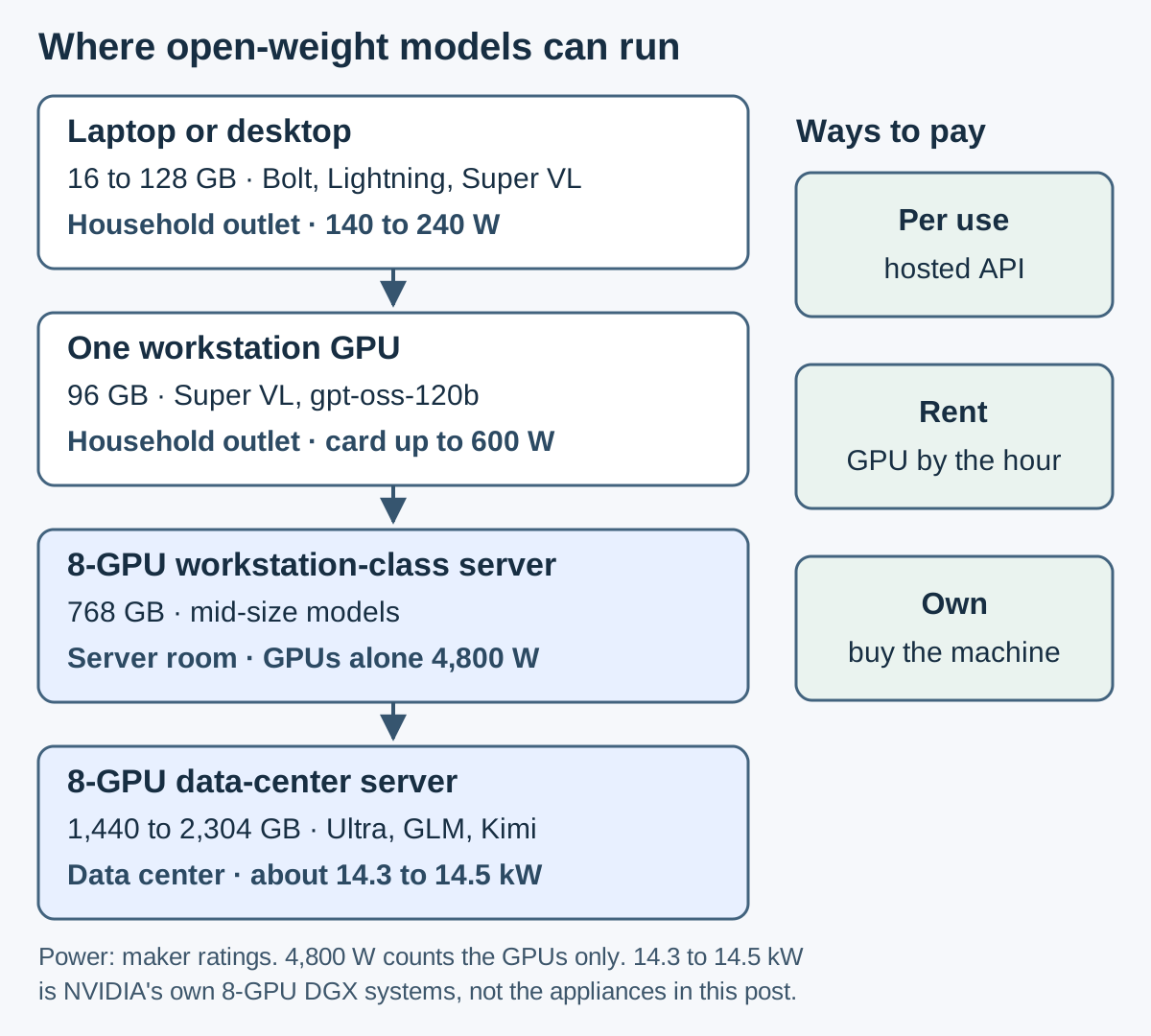
Each step up needs more power, cooling and a more controlled room.
```text
┌────────────────────────────────┐ Ways to pay
│ Laptop or desktop │ Per use → hosted API
│ 16 to 128 GB · Bolt, Super VL │ Rent → GPU by the hour
│ Household outlet · 140 to 240 W│ Own → buy the machine
└───────────────┬────────────────┘
▼
┌────────────────────────────────┐
│ One workstation GPU · 96 GB │
│ Super VL, gpt-oss-120b │
│ Household outlet · card 600 W │
└───────────────┬────────────────┘
▼
┌────────────────────────────────┐
│ 8x RTX PRO 6000 · 768 GB │
│ Mid-size models │
│ Server room · GPUs 4,800 W │
└───────────────┬────────────────┘
▼
┌────────────────────────────────┐
│ 8x B200 or B300 │
│ 1,440 to 2,304 GB · Ultra, Kimi│
│ Data center · 14.3 to 14.5 kW │
└────────────────────────────────┘
kW figures: NVIDIA's own DGX, a stand-in.
```
**From the wall outlet up.** Volts are electrical pressure, amps are how much current flows, and watts are the work done: watts = volts x amps. A circuit is one wire run from your breaker panel; its outlets share one limit. US home outlets are 120 volts on 15 or 20 amp circuits, the sizes [Bizon's page](https://bizon-tech.com/bizon-x5500.html) calls regular and standard: 120 x 15 = 1,800 W, or 2,400 W at 20 amps. Electricians size a breaker at 125% of a continuous load (three hours or more), as the [IAEI explains NEC 210.20(A)](https://iaeimagazine.org/2016/may2016/100-vs-80-choosing-the-right-ocpd-solution/), which leaves 80%: 1,440 W continuous on 15 amps, 1,920 W on 20. A 240-volt circuit, the kind clothes dryers and cooktops use, gives 7,200 W at 30 amps, or 5,760 W continuous. The IAEI lists a portable heater at 750 to 1,500 W and a clothes dryer at 1,800 to 5,000 W ([table and voltages](https://iaeimagazine.org/electrical-fundamentals/energy-use-of-home-appliances/)). Everything on the circuit counts, and only a licensed electrician can say what your house carries.
**What each machine draws:** MacBook Pro adapters are 70, 96 or 140 W by model ([Apple](https://www.apple.com/macbook-pro/specs/)); DGX Spark has a 240 W supply; an RTX PRO 6000 card alone draws up to 600 W (we read no whole-workstation rating); Bizon gives 2,700 to 3,000 W for a four-GPU build (its RTX 5090 example), asks for a dedicated 20-amp circuit for one GPU and two for four, and says to consult your electrician. Qubrid's pages state no draw. Eight RTX PRO 6000 cards alone are 8 x 600 = 4,800 W, a floor, not the system total. For the B200 and B300 boxes we use stand-ins that are not Qubrid's specifications: NVIDIA's own 8-GPU [DGX B200](https://docs.nvidia.com/dgx/dgxb200-user-guide/introduction-to-dgxb200.html), 14.3 kW maximum on six 200 to 240 volt, 16 amp supplies with C19/C20 cords, and [DGX B300](https://docs.nvidia.com/dgx/dgxb300-user-guide/introduction-to-dgxb300.html), 14.5 kW. Ask the seller for real figures.
**What the electricity costs.** Our arithmetic: monthly kWh = watts x hours a day x 30 / 1,000, times the rate. The [EIA's August 2026 averages](https://www.eia.gov/electricity/monthly/epm_table_grapher.php?t=epmt_5_6_a) are 18.16 cents per kWh for homes and 14.47 for businesses. A DGX Spark at 240 W around the clock: 240 x 24 x 30 / 1,000 = 172.8 kWh, $31.38 a month ($10.46 at 8 hours a day). The four-GPU workstation at 3,000 W: $392.26 around the clock, $130.75 at 8 hours. The 14.3 kW stand-in at the business rate: 10,296 kWh, $1,489.83 around the clock, $496.61 at 8 hours. These are rated maximums; idling costs less.
**Cooling and noise.** Nearly every watt ends up as heat in the room. The [EIA](https://www.eia.gov/energyexplained/units-and-calculators/british-thermal-units.php) gives 1 kWh = 3,412 Btu, so Btu per hour = watts x 3.412. A resting adult gives off about 105 W, 356 Btu per hour ([Cornell](https://www.ergo.human.cornell.edu/studentdownloads/DEA3500notes/Thermal/thcondnotes.html)); a 1,500 W heater, 5,118. A ton of cooling is 12,000 Btu per hour ([ACCA](https://hvac-blog.acca.org/?p=16063)), and [ENERGY STAR](https://www.energystar.gov/products/room_air_conditioners) sizes room units from 5,000 Btu per hour for 100 to 150 square feet to 10,000 for 400 to 450.
- DGX Spark: 240 x 3.412 = 819 Btu per hour, about two people. NVIDIA declares 29 dB(A) at full load.
- Four-GPU workstation: 3,000 x 3.412 = 10,236 Btu per hour, two space heaters, a 10,000 Btu window unit's worth. Bizon measured its two-GPU build at up to 55 dB from six feet. Plan a dedicated air conditioner.
- 8-GPU server (stand-ins): NVIDIA rates the DGX B200 at 48,794 Btu per hour (about 4 tons), 1,550 cubic feet of air a minute, 142.4 kg, 10 rack units and 10 to 35 °C; the DGX B300 at 49,476 Btu per hour and 168 kg. Its B300 noise line is blank; [NIOSH, via NIDCD](https://www.nidcd.nih.gov/health/how-loud-too-loud), advises hearing protection from 85 dBA.
Air cooling pulls room air through; liquid cooling carries heat away in a plumbed coolant loop. A battery backup must be rated above the peak load, and battery energy = watts x minutes / 60: 3,000 W for 10 minutes is 500 Wh before losses. Surge protection and grounding are electrician work.
| Place | Power and heat | Largest machine, memory | Models that fit |
|---|---|---|---|
| Household outlet | Under 1,440 W continuous; a one-GPU tower may need its own circuit | DGX Spark 128 GB or one RTX PRO 6000, 96 GB | Bolt, Lightning, Nano Omni, Super VL, gpt-oss-120b, Qwen3.8 27B, Gemma 4 31B |
| House, circuits added by an electrician | 3,840 W continuous on 240 V 20 A, or two dedicated 120 V circuits; 10,000+ Btu/h, noise | Four-GPU workstation, 384 GB | Above, plus Super VL in BF16 (240 GB) by arithmetic |
| Office server room | 4,800 W or more (GPUs alone), 16,378+ Btu/h, a lock | 8x RTX PRO 6000, 768 GB | By memory only, untested: Inkling 2 Small, DeepSeek V4.1 Flash, MiMo V2.6 Pro, Ultra NVFP4 |
| Data center or seller hosting | About 14.5 kW and 4 tons per box (NVIDIA DGX stand-in) | 8x B200 or B300, 1,440 to 2,304 GB | Ultra, GLM-5.3, DeepSeek V4.1 Flash, Inkling, MiMo V2.6 Pro; Kimi K3.1 Pro on B300 only |
[Hurricane Electric](https://he.net/colocation.html) advertises a 42U cabinet with power and 1 Gbps for $600 a month without saying how much power; another provider quotes racks on request. One 14.3 kW box needs 14,300 / 5,760 = about 2.5 continuous 240 V 30 A circuits, so ask about high-density power first.
A household can run models up to about 120B parameters in 4-bit form. A four-GPU workstation needs circuits added by an electrician, or an office room. The open models nearest ChatGPT and Claude cannot run in a house: their files are about 511 GB (DeepSeek V4.1 Flash), 573 GB (MiMo V2.6 Pro), 753 GB (GLM-5.3) and 1.4 TB (Kimi K3.1 Pro), over a four-GPU workstation's 384 GB, and NVIDIA's own 8-GPU systems draw over 14 kW. What 2-bit Bolt or other heavy reductions lose is unmeasured.
## The break-even, worked out
Our formula: tokens per month needed = owned cost per month / blended price per million. Owned cost = price / months of use + electricity + forgotten costs. Blended price assumes three input tokens per output token: (3 x input + output) / 4.
Filled example: the 8x B200 box at $564,000, running around the clock, with NVIDIA's DGX B200 maximum of 14.3 kW as the stand-in, at the EIA business rate.
- 3 years: $564,000 / 36 = $15,666.67 + $1,489.83 = $17,156.50 a month. 5 years: $9,400 + $1,489.83 = $10,889.83.
- Against GPT-6.1 Terra (blended $2.00), which DeepSeek V4.1 Flash sits beside on Vals: 8,578 million tokens a month over 3 years, 5,445 million over 5.
- Against DeepSeek V4.1 Flash from Fireworks (blended $0.525): 32,679 million over 3 years, 20,743 million over 5.
- Against Claude Haiku 5.5 (blended $0.20): 85,782 million over 3 years.
That is 5 to 86 billion tokens a month before owning wins, before the room or colocation bill, a person to run it, spares and software support. Using NVIDIA NIM in production requires an AI Enterprise license per its [FAQ](https://docs.api.nvidia.com/nim/docs/product), listed at [$4,500 per GPU per year](https://docs.nvidia.com/ai-enterprise/planning-resource/licensing-guide/latest/pricing.html): $36,000 a year for eight. With no measured throughput for these models on these machines, we cannot say whether one box can serve that volume, or how many people it is.
For most small businesses and nonprofits the honest answer is ChatGPT or Claude, plus a hosted open model for routine work. Owning pays for privacy, offline work or huge steady volume, starting with desk-sized machines.
## Running it on your own premises, step by step
All commands are from each project's documentation, not run by us.
1. **Choose the serving software.** Who: IT person. Done when one model answers a test question. [Ollama](https://ollama.com/library/nemotron3) (MIT) suits one machine and a few people; its Nemotron entry is Nano Omni: `ollama run nemotron3`. [LM Studio](https://lmstudio.ai/docs/cli) is a desktop app under a proprietary [license](https://lmstudio.ai/app-terms) for personal and internal business use; start its server with `lms server start`. vLLM and SGLang (Apache 2.0) serve many users; NVIDIA's cards carry `vllm serve` and SGLang recipes per GPU, so copy yours. [llama.cpp](https://github.com/ggml-org/llama.cpp/blob/master/tools/server/README.md) (MIT) handles CPUs and mixed hardware: `llama-server -hf /:`. [NVIDIA NIM](https://docs.nvidia.com/nim/large-language-models/latest/deployment/air-gap-deployment.html) is a supported container, free to Developer Program members for development on up to 16 GPUs.
2. **Expose an OpenAI-compatible endpoint.** Who: IT person. Done when an existing tool works after changing only its base address. These servers speak OpenAI's request format, so ChatGPT-ready tools can point at your machine. Put a gateway in front for keys, limits and logs, as in our [LiteLLM post](/blog/ai-api-vs-subscription-guardrails-litellm-backups/).
3. **Give staff a chat screen.** Who: IT person and owner. Done when each person has an account and logs record who used it, kept no longer than your policy allows. Open WebUI's [license](https://github.com/open-webui/open-webui/blob/main/LICENSE) forbids removing its branding once more than 50 people use it in 30 days, unless you get permission or an enterprise license.
4. **Test before anyone relies on it.** Who: owner. Done when 20 real tasks, run on your current hosted model and the local one and scored blind by a person, show the local one passing the tasks that matter.
5. **Size for people.** Concurrency is how many requests run at once. A laptop serves its user; a server with spare memory can hold several conversations at once. Done when you have timed answers with your expected number of people at once.
## Offline for real
For regulated or contract-controlled data, client confidentiality and poor connections. Defense contractors should read our [CMMC readiness post](/blog/blog-mega-analyzer-defense-contractor-readiness/) and our [workstation hardening practices](/blog/sovereign-ai-workstation-best-practices/).
- Download weights and installers on a connected computer, record checksums, move them on encrypted removable storage, and verify. Done when checksums match.
- Confirm licenses: the OpenMDW and NVIDIA Open Model Agreement texts we read contain no online condition; check each other license the same way. NVIDIA's air-gap guide runs NIM "with no outbound network access and no API keys" from a cache prepared while connected; we did not find its production license-check procedure, so ask NVIDIA.
- Turn off phone-home features: `VLLM_NO_USAGE_STATS=1` for [vLLM](https://docs.vllm.ai/en/latest/usage/usage_stats.html); `HF_HUB_OFFLINE=1` and `HF_HUB_DISABLE_TELEMETRY=1` for [Hugging Face](https://huggingface.co/docs/huggingface_hub/package_reference/environment_variables); `OLLAMA_NO_CLOUD=1` for [Ollama](https://docs.ollama.com/faq); `OFFLINE_MODE` for [Open WebUI](https://docs.openwebui.com/reference/env-configuration/) once its embedding model is downloaded.
- Keep a local update mirror, time source, logs and backups, and a written procedure for new model versions.
- Prove it: unplug the cable, restart, run the acceptance test. Done when every task passes unplugged. Rack machines also need the power and cooling above, in a locked room.
## Risks and limits
Licenses change between versions. Open models carry bias, can be pushed into misbehaving, and have no vendor safety layer unless you add one, such as NVIDIA's [NeMo Guardrails](https://github.com/NVIDIA-NeMo/Guardrails) (Apache 2.0), which puts "programmable guardrails" between your app and the model, or its content safety model. Qubrid's pages say US export controls cover advanced NVIDIA GPU systems and offer help; ask the seller what your order needs. This hardware ages fast, resale value is unknown, and the person who runs it may leave. Not legal, financial, procurement, electrical or engineering advice.
## Three paths for owners
**Stay on ChatGPT or Claude,** in their data centers, when the best answers matter most. This week, list what you pay and what you send.
**Use a hosted open model** for routine, high-volume work, in someone else's data center. This week, run your 20 tasks through DeepSeek V4.1 Flash or Kimi K3.1 Pro and compare.
**Own a machine** for privacy, offline work or steady volume. A household outlet runs a DGX Spark or one workstation card; several cards need new circuits or an office room; the strongest open models need an 8-GPU server in a server room or data center. This week, price the room before the server.
For owners who build their own, *[The $100 Network](/books/)* covers running a group of websites for about $100 a month.
## Download the kit
- [Open-Weight Self-Host Sizing Kit (.md)](/downloads/open-weight-self-host-sizing-kit.md): decision checklist, memory and break-even worksheets, a 20-task scoring sheet, and setup, offline, license, power and site checklists.
## Related reading
- [Our $125 CPU AI server versus GPU servers](/blog/cpu-ai-server-vs-gpu-server-costs/)
- [A 128GB mini PC and unified memory](/blog/apu-vs-gpu-on-prem-ai-unified-memory/)
- [AI subscriptions, API keys and a LiteLLM gateway](/blog/ai-api-vs-subscription-guardrails-litellm-backups/)
- [Local models, Codex drafts, Claude review](/blog/sovereign-ai-model-routing-local-codex-claude/)
- [Gemma and where it fits](/blog/gemma-open-weights-where-it-fits/)
## Fact-check notes and sources
All read November 14, 2026, UTC; reviewed again 04:31 to 04:41; prices rechecked in a desktop browser 04:22 to 04:26. "Our arithmetic" marks derived figures. We ran no model and measured no throughput.
- **Models, licenses, rankings:** NVIDIA page and cards 03:34:47 to 03:35:30; license texts 03:36:00 to 03:38:21; Artificial Analysis 03:36:10 to 03:36:12 and 03:50:55; Vals 03:37:11; other cards and metadata 03:37:44 to 03:50; DeepSeek file size 04:40. [SWE-bench](https://www.swebench.com/) (03:36:14) has nothing after February 2026, so it is unused.
- **Prices:** OpenAI and Anthropic 03:38:34 to 03:38:39; ChatGPT plans 04:23:28 and 04:26:31 (browser); OpenRouter, Fireworks, DeepInfra, RunPod and build.nvidia.com 03:40:01 to 03:40:29; NVIDIA AI Enterprise 03:41:11; Qubrid 03:34:48 to 03:34:49; [OVH catalog](https://api.us.ovhcloud.com/1.0/order/catalog/public/eco?ovhSubsidiary=US), Apple, Bizon and Hurricane Electric 03:44:25 to 03:46:14.
- **Specs, software, terms, power:** NVIDIA pages including [HGX](https://www.nvidia.com/en-us/data-center/hgx/) and DGX guides 03:43:33 to 03:44:07; Apple specs 03:51:15; trial terms and NIM 03:41:12 to 03:41:47; GitHub licenses and docs 03:46:50 to 03:47:28; LM Studio terms 04:02:47; EIA, IAEI, ENERGY STAR, NIDCD, Cornell and ACCA 03:41:48 to 03:43:20.
- **MiMo V2.6 Pro:** card, repository metadata and missing license file 18:11:30 to 18:11:31; rankings re-read 18:11:34 to 18:11:36 and in a desktop browser 18:13:36 to 18:13:44; OpenRouter and DeepInfra prices in a desktop browser 18:12:32 to 18:13:28; Fireworks 18:12:52.
- **Not verified:** ChatGPT Business price; current DGX Spark, RTX PRO 6000 card, Mac Studio memory and Bizon four-GPU prices; the appliances' power draw; colocation power allowances; any throughput or user count.
*This post is informational, not legal advice. Mentions of third parties are nominative fair use. No affiliation or endorsement is implied.*
---
Canonical HTML: https://jwatte.com/blog/open-weight-ai-vs-chatgpt-claude-self-host-hardware/
RSS: https://jwatte.com/feed.xml
JSON Feed: https://jwatte.com/feed.json
Hero image: https://jwatte.com/images/open-weight-ai-vs-chatgpt-claude-self-host-hardware.webp